



By: Ralf Ellspermann
25-Year, Multi-Awarded BPO Veteran
Published: 14 March 2026
Updated: March 13, 2026
TL;DR: The Key Takeaway
Machine translation training outsourcing to India has transcended simple data input, evolving into a strategic partnership for achieving true linguistic and cultural nuance. The nation’s deep talent pool is the critical human-in-the-loop component, transforming machine translation from a literal-minded tool into a sophisticated engine for global communication.
High-fidelity machine translation (MT) now depends on expert human-verified data to capture linguistic nuances and cultural contexts that algorithms alone miss. In 2026, India serves as the premier hub for this “Intelligence Arbitrage,” leveraging an elite STEM and linguistic workforce to refine MT models. This strategic approach ensures that global brand voices and technical specifications remain accurate and resonant across borders.
Executive Briefing
- Nuance-Driven Training: The next phase of MT evolution requires human-in-the-loop verification to master cultural idioms and specialized industry jargon.
- The South Asian Powerhouse: India provides an unmatched blend of technical STEM graduates, multilingual experts, and a mature IT infrastructure.
- From Savings to Intelligence: Value is no longer measured by labor costs but by “Intelligence Arbitrage”—the measurable boost in model accuracy provided by human cognition.
- Centers of Excellence: Leading Indian providers have built specialized units focused on sentiment analysis and domain-specific vernacular (Legal, Medical, Engineering).
- Accelerated Iteration: A 10- to 12-hour time difference allows Western firms to maintain 24/7 development cycles, significantly shortening the path to deployment.
Executive Summary
The period of settling for “adequate” automated translation has reached its end. As global corporations integrate AI into high-stakes international dialogue, the requirement for linguistic precision and cultural sensitivity has intensified. Consequently, outsourcing machine translation training to India has become a strategic necessity. The objective has moved beyond feeding algorithms massive data volumes toward polishing them with the subtle, situational intelligence that only human specialists provide. India’s tech sector leads this field, offering a massive talent pool capable of teaching AI to grasp intent rather than just words. This evolution transforms MT from a mere utility into a significant competitive edge, protecting brand integrity and technical precision in every language.
“We are at a turning point for AI communication. Organizations are moving beyond basic data; they want MT models infused with deep cultural understanding and industry-specific logic. The advantage in India is the ‘cognitive surplus’—the human ability to interpret sarcasm, idioms, and sentiment to ensure the machine’s output is truly resonant.” — John Maczynski, CEO, Cynergy BPO
The New Frontier of Global Communication
For years, seamless instant translation was an elusive goal. While algorithms have improved, the failure of purely automated systems is evident in professional settings. Standard models often miss the mark on industry-specific terminology or misread cultural cues, leading to brand damage or critical documentation errors.
The coming generation of MT requires an expert-led methodology. This shift moves away from “brute-force” data ingestion toward a curated approach known as Reinforcement Learning from Human Feedback (RLHF). By involving linguists and subject matter experts in reviewing and refining outputs, businesses can unlock a level of sophistication where the machine understands the context and the subtle art of human persuasion.
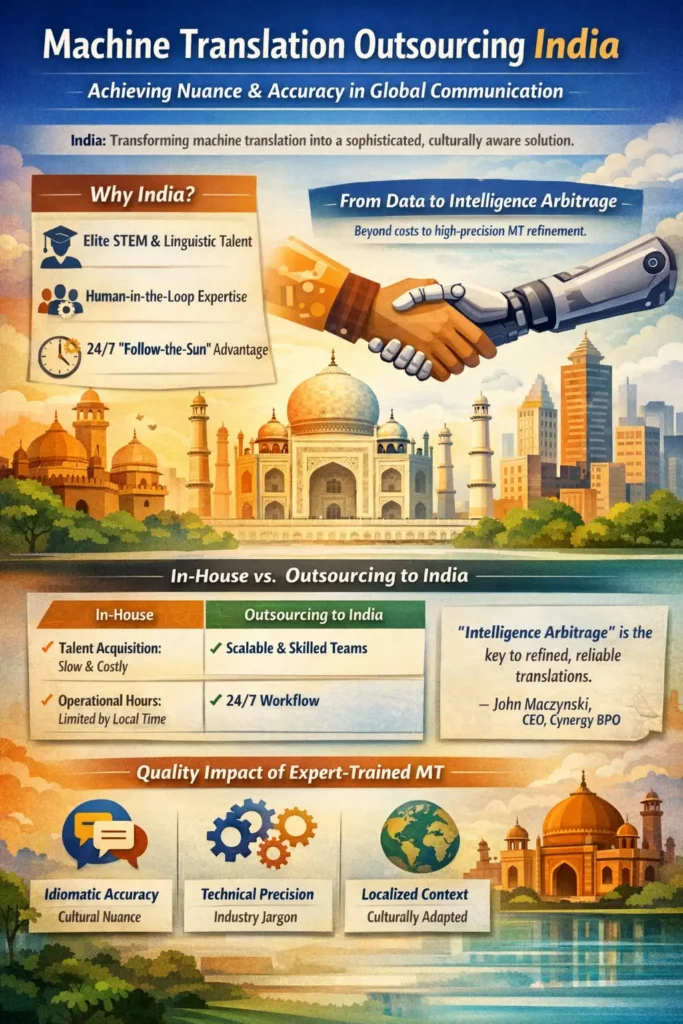
India’s Unmatched Talent Ecosystem for AI
The surge in demand for premium MT training data is met by the robust Indian IT-BPM sector. This ecosystem is anchored by millions of STEM graduates from institutions like the IITs and IISc, providing the mathematical and analytical rigor needed for natural language processing (NLP).
Furthermore, India’s widespread English proficiency and internal multilingualism make it a natural fit for linguistic training. Indian professionals do not simply swap words; they evaluate them for cultural relevance and brand consistency. This global talent corridor provides the “cognitive horsepower” required to solve the most difficult hurdles in modern artificial intelligence.
Machine Translation Training: In-House vs. Outsourcing to India
Deciding between internal development and external partnership is a pivotal choice for AI leaders in 2026.
| Factor | In-House Team | Outsourcing to India | Strategic Advantage |
| Talent Acquisition | Slow, expensive, and highly competitive. | Access to pre-vetted STEM and linguistic pools. | Faster speed-to-market. |
| Scalability | Rigid; difficult to adjust to project spikes. | Elastic; teams can expand or contract rapidly. | Operational agility. |
| Cost Structure | High fixed costs (salaries, benefits). | Variable cost model based on project scope. | Predictable expenses. |
| Domain Expertise | Limited to current staff knowledge. | Access to global subject matter experts (SMEs). | Higher data quality. |
| Operations | Restricted by local business hours. | 24/7 “follow-the-sun” development cycles. | Faster model iteration. |
“Intelligence Arbitrage” in Machine Translation
While traditional outsourcing relied on labor arbitrage (cost savings), the modern paradigm is “Intelligence Arbitrage.” This value is created when human cognition solves problems that remain opaque to machines. It is the quantifiable improvement in an MT model’s performance derived from the nuanced feedback of a specialist.
When a Silicon Valley firm partners with an Indian team, they aren’t just buying “tags.” They are accessing professionals who can catch a mistranslated legal term or a misread marketing sentiment. This synergy leverages human expertise to build a more reliable and culturally intelligent AI system, moving the conversation from the procurement office to the C-suite.
Quality and Nuance Scorecard for MT Models
How do we measure the impact of expert training? The following table compares standard models with those refined by Indian specialists.
| Quality Dimension | Standard MT (Automated) | Expert-Trained (India) | Business Impact |
| Idiomatic Accuracy | Translates literally; often nonsensical. | Correctly interprets cultural metaphors. | Protects brand voice. |
| Sentiment Nuance | Misses sarcasm or irony. | Captures the intended emotional tone. | Empathetic support. |
| Technical Jargon | Misidentifies specific industry terms. | Uses approved technical glossaries. | Prevents safety/legal errors. |
| Cultural Context | Often ignores local sensitivities. | Adapts language for local norms. | Builds international trust. |
| Brand Voice | Generic and robotic. | Consistent with brand style guides. | Seamless user experience. |
The Strategic Advantage of the Indian IT-BPM Sector
India’s success is built on a foundation of operational excellence and world-class infrastructure. The sector is highly mature, offering robust data security protocols (ISO 27001, GDPR) and a proven track record of service.
Furthermore, the time zone difference acts as a force multiplier. Project hand-offs occur at the end of the US day, allowing work to be completed while the domestic team is offline. This “follow-the-sun” strategy accelerates development timelines, providing a decisive advantage in the fast-paced AI market of 2026.
Expert FAQ
Q1: Is “good enough” machine translation sufficient for global business?
In high-stakes fields like law, medicine, or technical engineering, “good enough” often leads to catastrophic errors. Expert-led training is what transforms a basic translation tool into a reliable strategic asset that protects a company’s reputation.
Q2: What are the credentials of the professionals in India doing this work?
Teams typically consist of computational linguists and domain-specific experts (e.g., medical doctors or financial analysts). Many hold advanced degrees from premier universities, ensuring they understand the complexities of the subject matter they are translating.
Q3: How is data privacy handled during the training process?
Leading providers in the subcontinent utilize secure, isolated environments and adhere to strict international standards like HIPAA and GDPR. Multi-layered security ensures that sensitive training data remains confidential.
Q4: How does Cynergy BPO help companies find the right partner?
We serve as strategic advisors, vetting the top 1% of BPO providers in India. We match your specific technical needs with a partner that has the right talent and infrastructure to deliver a measurable lift in your AI performance.
Unlock cost-efficient growth with expert BPO guidance!
Partner with Cynergy BPO to connect with top outsourcing providers.
Streamline operations, cut costs, and scale your business with confidence.
Book a Free Call
Ralf Ellspermann - CSO
Author
Ralf Ellspermann is the Chief Strategy Officer (CSO) of Cynergy BPO and a globally recognized authority in business process and contact center outsourcing. With more than 25 years of experience advising enterprises and SMEs, he provides strategic guidance on vendor selection, CX optimization, and scalable outsourcing strategies across global markets. His expertise spans fintech, ecommerce and retail, healthcare, insurance, travel and hospitality, and technology (AI & SaaS) outsourcing.
A frequent speaker at leading industry conferences, Ralf is also a published contributor to The Times of India and CustomerThink, where he shares insights on outsourcing strategy, customer experience, and digital transformation.