



By: Ralf Ellspermann
25-Year, Multi-Awarded BPO Veteran
Published: 17 March 2026
Updated: March 16, 2026
TL;DR: The Key Takeaway
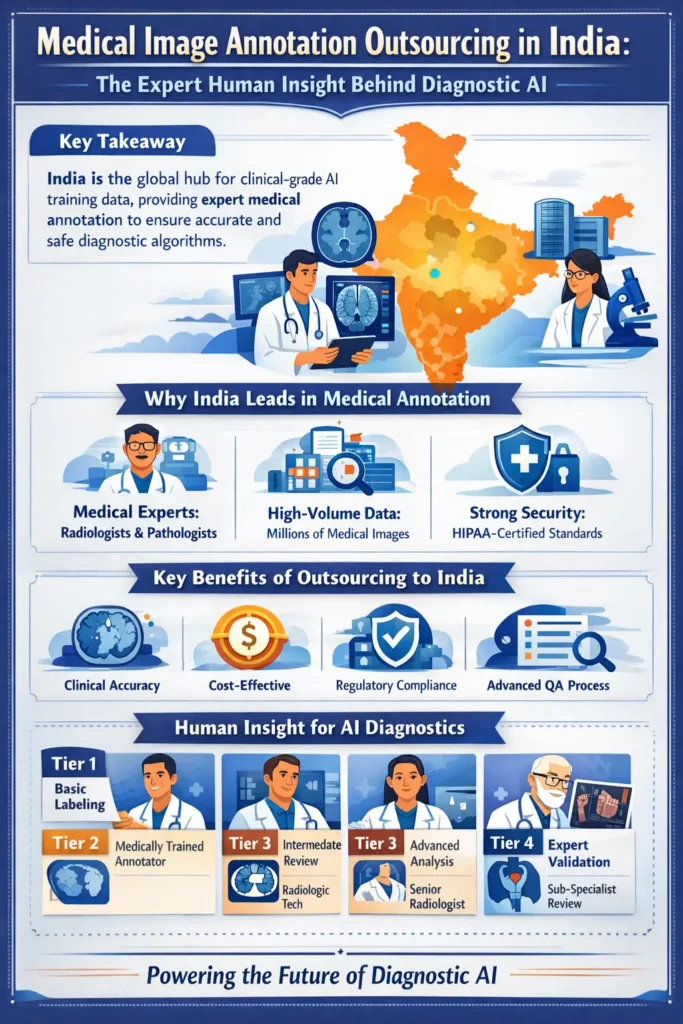
Medical image annotation outsourcing in India has become the definitive strategy for leading healthcare technology firms to achieve clinical-grade accuracy in their AI models. The nation provides an unparalleled ecosystem of medical domain experts and data specialists who deliver the nuanced human insight that algorithms alone cannot replicate, ensuring safer and more effective diagnostic tools.
High-fidelity AI diagnostics depend on massive datasets of medical imagery labeled with clinical precision. India has become the premier global hub for this work, providing a deep bench of radiologists and pathologists who deliver the expert “ground truth” necessary for FDA-cleared algorithms. This shift toward cognitive arbitrage ensures that AI models are trained on nuanced human expertise.
Executive Briefing
- Human-Centric Development: Creating dependable diagnostic AI requires vast repositories of precisely labeled medical images, a complex undertaking necessitating deep clinical knowledge that automation cannot yet replicate.
- Global Leadership: India is the primary destination for this sophisticated labor, offering an unmatched concentration of medical specialists—including pathologists and radiologists—essential for developing regulatory-compliant software.
- Cognitive Arbitrage: The motivation for partnering with Indian firms has evolved from simple cost reduction to accessing a highly specialized workforce capable of interpreting intricate diagnostic data with surgical precision.
- Security Standards: Elite service providers in the region maintain rigorous, HIPAA-certified environments and exhaustive quality control systems to protect patient confidentiality while advancing machine learning.
Executive Summary
The evolution of modern diagnostics is inextricably linked to artificial intelligence, yet the efficacy of these digital tools is entirely dependent on the caliber of their training data. For machine learning to function safely in clinical settings, it demands human interpretation of the highest order. This necessity is fueling a massive increase in medical image annotation outsourcing in India. Global health-tech leaders are no longer seeking basic data entry; they are scouting for a sophisticated network of medical professionals who can decode complex scans, pinpoint subtle pathologies, and provide the detailed labeling required for clinical-grade software. This strategic collaboration focuses on sharpening diagnostic accuracy and speeding up the deployment of transformative medical technology. Cynergy BPO acts as the bridge in this ecosystem, connecting visionary AI developers with top-tier Indian partners who possess the medical talent and fortified infrastructure to drive the next generation of healthcare innovation.
Beyond the Pixel: Why Clinical Expertise is Non-Negotiable for AI
The potential for AI to transform medicine is vast, promising faster disease detection and reduced pressure on frontline doctors. However, these digital systems do not possess innate intelligence; they are painstakingly taught. Within medical imaging, this education involves exposing a model to millions of X-rays, MRIs, and pathology slides that have been meticulously marked by specialists. In this specialized field, an annotation is far more than a tag. It involves tracing the exact perimeter of a growth, determining the severity of a malignancy, or spotting microscopic anomalies that bypass the untrained eye.
This is where the ceiling of pure automation becomes obvious. An algorithm may recognize a repeating pattern, but it lacks the contextual logic, years of clinical practice, and refined intuition of a veteran physician. A human specialist can differentiate a harmless cyst from a dangerous lesion by identifying minute variations in texture or by weighing the findings against a patient’s unique history. This high-level cognitive contribution is the most vital ingredient in crafting a dependable diagnostic tool. Without this human “common sense,” models remain vulnerable to bias and catastrophic errors. The industry currently requires human intelligence at a massive scale—a logistical hurdle the Indian IT-BPM sector is perfectly built to clear.
The Indian Advantage: Where Talent Meets Technology
A unique professional corridor has emerged in India, aligning perfectly with the rigorous demands of medical AI. These national strengths are the result of long-term investments in technical education and a sophisticated service economy. Each year, the country produces a significant volume of STEM and medical graduates from elite institutions like the All India Institutes of Medical Sciences (AIIMS). This provides a ready-made workforce of doctors and nurses who already possess the foundational biological knowledge required for expert-level data labeling.
Furthermore, the local digital infrastructure is world-class, featuring high-security facilities that meet the stringent HIPAA standards required for handling private health records. These firms employ mature protocols for data management and quality oversight, refined through decades of supporting the world’s most regulated industries. By combining a fluent, highly educated workforce with a deep grasp of international healthcare ethics, the subcontinent has become the undisputed center for this niche. Organizations choosing medical image annotation outsourcing in India are doing more than saving money; they are securing a strategic asset that validates their clinical products and shortens the timeline to regulatory approval.
“Our partners in the MedTech industry are no longer looking for simple labelers; they want clinical collaborators. They require teams that think like practitioners, challenge assumptions, and provide the nuanced observations that turn an algorithm into a trustworthy medical tool. This is the new frontier of the global service model, and India is its heart.” — John Maczynski, CEO, Cynergy BPO
Hierarchy of Annotation Complexity and Specialist Roles
Medical image labeling is a tiered process. Different tasks demand varying levels of clinical training to ensure both accuracy and cost-efficiency. The following table breaks down these specialized tiers.
| Annotation Tier | Representative Tasks | Specialist Level | Strategic Value |
| Tier 1: Foundational | Labeling major organs and basic anatomical markers. | Medically Trained Annotator | Creating baseline datasets for general AI models. |
| Tier 2: Intermediate | Identifying common issues like fractures or standard tumors. | Radiologic Tech / Junior Pathologist | Boosting accuracy for routine diagnostic automation. |
| Tier 3: Advanced | Complex tumor contouring and grading of malignant cells. | Veteran Radiologist or Oncologist | Enabling detection of early-stage or rare diseases. |
| Tier 4: Expert Review | Adjudicating difficult cases and verifying AI outputs. | Sub-specialist (e.g., Neuroradiologist) | Ensuring the final product meets “gold standard” safety. |
The Governance of Clinical-Grade Datasets
Maintaining the purity of training data is the single most important factor in any medical AI initiative. A transparent governance structure is mandatory for creating tools that both doctors and regulators can stand behind. This framework utilizes multiple layers of security and expert validation to create a cycle of constant improvement.
The workflow begins with comprehensive annotation manuals, often developed through a partnership between the AI firm and the Indian clinical team. These documents serve as the definitive “source of truth,” clarifying every potential edge case. Following this, a multi-stage Quality Assurance (QA) protocol is implemented. Typically, an initial label is reviewed by a more senior specialist. Any discrepancies are then settled by a panel of experts or a clinical lead. This consensus-based methodology eliminates individual subjectivity and ensures the data reflects peak accuracy.
Oncology AI Quality Assurance Model
- Stage 1: Primary Labeling (Tier 3 Specialist): Tracing tumor margins and tissue classification based on strict manuals.
- Stage 2: Peer Validation (Second Tier 3 Specialist): A secondary review of 100% of the data to catch inconsistencies or missed details.
- Stage 3: Specialist Adjudication (Senior Sub-specialist): Resolving any remaining conflicts to establish a “gold standard” data point.
- Stage 4: Model Refinement (AI Development Team): Using the finalized data to train the model and identifying specific areas where the software continues to struggle.
This organized approach, facilitated by elite BPO partners, converts raw imagery into the high-octane fuel required for next-gen diagnostics. Opting for medical image annotation outsourcing in India is ultimately a commitment to patient safety and clinical excellence.
Expert FAQs
Q: Why is Indian outsourcing better than using automated tools or internal staff?
The main benefit is the ability to scale a team of qualified doctors without the overhead of internal hiring. While in-house teams are capable, they are often too small to handle massive datasets and are better utilized for direct patient care. Current automated tools lack the “clinical eye” needed for subtle pathologies. India offers the perfect middle ground: expert human judgment at a scale and price point that makes large projects viable.
Q: How do providers ensure HIPAA compliance and data security?
Top-tier Indian firms operate in highly controlled environments featuring encrypted workflows and strict physical access limits. Data is typically de-identified before it ever leaves the client’s country, meaning the annotators never see the patient’s name or personal details. Frequent third-party audits ensure these security measures stay current with global regulations.
Q: What specific medical fields are being transformed by this data?
The impact is felt across all of medicine. In radiology, it powers tools that detect strokes or lung embolisms. In pathology, it helps AI grade cancers and count cells with high precision. Other growing areas include ophthalmology for retinopathy screening and cardiology for automated echocardiogram analysis.
Q: How does Cynergy BPO select its recommended partners?
We utilize a rigorous screening process that looks beyond technical specs. We verify the actual medical credentials of the staff, test their quality control workflows, and look for a track record of success in specific therapeutic areas. We only recommend providers capable of producing data that can withstand the scrutiny of the FDA and other global regulators.
Unlock cost-efficient growth with expert BPO guidance!
Partner with Cynergy BPO to connect with top outsourcing providers.
Streamline operations, cut costs, and scale your business with confidence.
Book a Free Call
Ralf Ellspermann - CSO
Author
Ralf Ellspermann is the Chief Strategy Officer (CSO) of Cynergy BPO and a globally recognized authority in business process and contact center outsourcing. With more than 25 years of experience advising enterprises and SMEs, he provides strategic guidance on vendor selection, CX optimization, and scalable outsourcing strategies across global markets. His expertise spans fintech, ecommerce and retail, healthcare, insurance, travel and hospitality, and technology (AI & SaaS) outsourcing.
A frequent speaker at leading industry conferences, Ralf is also a published contributor to The Times of India and CustomerThink, where he shares insights on outsourcing strategy, customer experience, and digital transformation.