



By: Ralf Ellspermann
25-Year, Multi-Awarded BPO Veteran
Published: 15 March 2026
Updated: March 13, 2026
TL;DR: The Key Takeaway
Named entity recognition outsourcing in India has matured beyond simple data extraction, now focusing on the strategic construction of enterprise knowledge graphs. This shift leverages the nation’s deep AI talent pool to convert vast, unstructured data universes into interconnected, queryable intelligence, driving significant advancements in machine learning and business strategy.
Modern enterprises face a common paradox: they are saturated with information yet starved for insight, as critical intelligence remains trapped in unstructured text. Named Entity Recognition (NER) provides the key to unlocking this data, identifying and classifying the vital “nouns” within documents to build machine-readable structures. In 2026, India has emerged as the global center for this technology, moving beyond simple tagging to the construction of enterprise-wide knowledge graphs—dynamic, semantic networks that map complex relationships to turn raw data noise into a strategic, queryable digital brain.
Executive Briefing
- The Extraction Challenge: Most corporate value is hidden in unstructured formats like contracts and feedback; NER is the essential tool for making this data machine-intelligible.
- Structural Foundation: By automatically categorizing entities such as people, organizations, and products, NER creates the baseline for all advanced AI data intelligence.
- The Indian Nexus: With an elite STEM workforce and research-backed methodologies from the likes of the IITs, India provides the high-level cognitive skill required for precise data modeling.
- Knowledge Graph Evolution: Strategic outsourcing has shifted toward building interconnected knowledge graphs that define the “verbs” or relationships between entities for deeper context.
- Guided Integration: Cynergy BPO bridges the gap between US-based AI innovators and the top-tier Indian specialists who architect the high-fidelity data maps powering next-gen applications.
Executive Summary
The landscape of named entity recognition (NER) in India is currently undergoing a fundamental strategic shift. What was once treated as a routine data extraction exercise is now recognized as the critical first step in assembling sophisticated enterprise knowledge graphs—the semantic foundations of modern intelligent systems. For the contemporary, AI-driven organization, the primary objective is to convert a chaotic universe of text into a structured, interconnected web of knowledge. This is where the South Asian tech hub excels, offering a vast pool of machine learning experts who perform complex NER workflows with surgical precision. This evolution is no longer about identifying isolated words; it is about grasping the context and relationships that build a logical map of a firm’s entire data landscape. Cynergy BPO serves as the vital link, enabling Western companies to tap into the elite Indian talent capable of distilling strategic intelligence from digital noise.
From Unstructured Text to Actionable Intelligence
Today’s corporations are essentially drowning in a sea of raw information. Elements like emails, legal contracts, support tickets, and internal memos represent a massive, yet largely invisible, reservoir of business value. The barrier to utilizing this asset is its format: text intended for humans is naturally opaque to computer systems. NER is the technology that breaks this barrier. At its core, it is a specialized branch of Natural Language Processing (NLP) that scans text to identify and categorize specific entities—such as names, dates, locations, and brands.
This initial classification serves as the bedrock for all subsequent intelligence layers. Without high-precision NER, unstructured text is essentially digital static. By organizing this information, NER converts it into a machine-readable index that can be analyzed for patterns or used to refine advanced predictive models. This is the indispensable first step toward a truly data-centric operation, allowing businesses to finally query the 80% of their data that previously sat dormant and inaccessible.
“Our partners aren’t just looking for keyword tagging; they want a semantic map of their entire business ecosystem. They need to understand not just that a competitor was mentioned, but how that competitor links to a specific executive or a recent market shift. This contextual intelligence—built through NER in India—is the primary competitive advantage in 2026.” — John Maczynski, CEO, Cynergy BPO
The Knowledge Graph: Your Enterprise’s Digital Brain
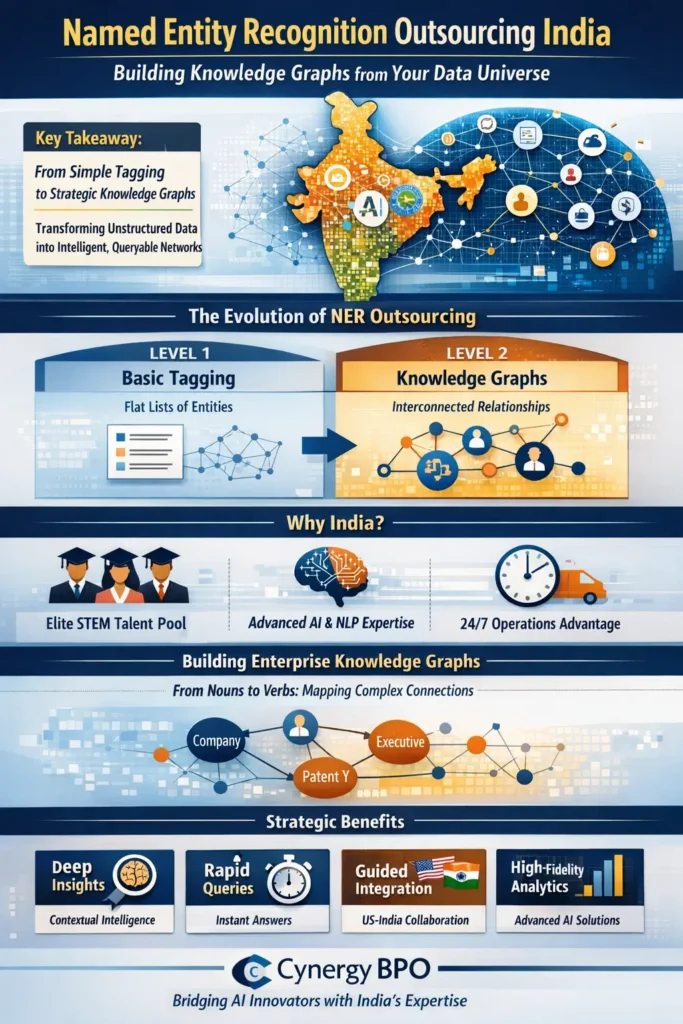
While NER identifies the individual building blocks, the knowledge graph is the architectural masterpiece. If NER finds the “nouns,” the knowledge graph maps the “verbs”—the intricate relationships that bind them together. This dynamic, semantic network represents how entities interact. For example, while NER identifies “Company A” and “Executive X,” a knowledge graph establishes that “Executive X” manages “Company A,” which recently acquired “Patent Y.”
This network creates a powerful, queryable map of the business universe. Instead of simple keyword searches, teams can ask complex, multi-layered questions like: “Which California-based partners have contracts expiring during the next quarter involving our core intellectual property?” Retrieving such an answer from a traditional database would take days; with a knowledge graph, it takes seconds. This shift from data points to interconnected knowledge is a core competency of the specialized BPO services in the subcontinent.
NER Maturity Model: From Data Points to Integrated Knowledge
Moving from basic tagging to a full-scale knowledge graph represents a significant leap in data maturity.
| Feature | Level 1: Traditional Extraction | Level 2: Knowledge Graph Construction |
| Primary Goal | Tagging isolated entities. | Modeling relationships and context. |
| Output | Flat lists of people/places. | Interconnected nodes and edges. |
| Data Structure | Tabular (Spreadsheets). | Graph Databases (e.g., Neo4j). |
| Query Style | Keyword-based. | Multi-hop relational queries. |
| Business Value | Basic categorization. | Deep contextual AI and analytics. |
| Strategic Focus | Task-oriented/Cost-driven. | Insight-oriented/Value-driven. |
India: The Global Nexus for AI-Powered Knowledge Construction
The choice to build a knowledge graph necessitates a partner with immense technical depth, leading many to the South Asian tech hub. India is no longer just a site for cost-saving; it is a global center for high-end machine learning. This leadership is sustained by several pillars.
First is the unparalleled quality of the talent pool. The nation produces millions of STEM graduates every year, with an increasing focus on NLP and graph technologies. Premier institutions like the IITs are world-renowned for training the engineers who lead global AI research. This expertise is paired with high English fluency—essential for navigating the nuances of Western business text—and a time zone advantage that allows for 24/7 annotation and development cycles, drastically shortening project timelines.
NER Implementation Framework: Comparative Strategies
Choosing the right path depends on balancing speed with domain specificity.
- Off-the-Shelf APIs: Fast deployment for general entities (e.g., Google NLP), but lacks the nuance needed for specialized industries.
- Open-Source Models: Highly customizable (e.g., spaCy) but requires significant internal engineering to fine-tune on proprietary data.
- Managed Outsourcing: Partnering with elite Indian teams offers the highest accuracy and domain expertise, especially for large-scale knowledge graph projects.
- Hybrid Approach: Automated models handle the bulk of the work, while human-in-the-loop experts in India manage edge cases and quality control.
Intelligence Arbitrage: The Strategic Advantage of Indian NER Teams
The ultimate value of Indian NER partnerships is found in “Intelligence Arbitrage.” This isn’t about saving on wages; it’s about the superior cognitive output of a focused, elite team. While an internal Western team might be spread thin, a dedicated Indian unit provides a concentration of expertise that moves beyond literal text to deep contextual understanding.
This is vital for resolving linguistic ambiguity. For instance, the word “Jaguar” could mean an animal, a car, or a defense system. A basic model might fail this test, but an expert team applies sophisticated disambiguation logic based on surrounding clues. This ability to interpret domain-specific jargon and complex relational phrases provides a measurable lift in the accuracy of the final knowledge graph, offering a sustainable advantage to companies that utilize it.
Unlock cost-efficient growth with expert BPO guidance!
Partner with Cynergy BPO to connect with top outsourcing providers.
Streamline operations, cut costs, and scale your business with confidence.
Book a Free Call
Ralf Ellspermann - CSO
Author
Ralf Ellspermann is the Chief Strategy Officer (CSO) of Cynergy BPO and a globally recognized authority in business process and contact center outsourcing. With more than 25 years of experience advising enterprises and SMEs, he provides strategic guidance on vendor selection, CX optimization, and scalable outsourcing strategies across global markets. His expertise spans fintech, ecommerce and retail, healthcare, insurance, travel and hospitality, and technology (AI & SaaS) outsourcing.
A frequent speaker at leading industry conferences, Ralf is also a published contributor to The Times of India and CustomerThink, where he shares insights on outsourcing strategy, customer experience, and digital transformation.