



By: Ralf Ellspermann
25-Year, Multi-Awarded BPO Veteran
Published: 21 March 2026
Updated: March 20, 2026
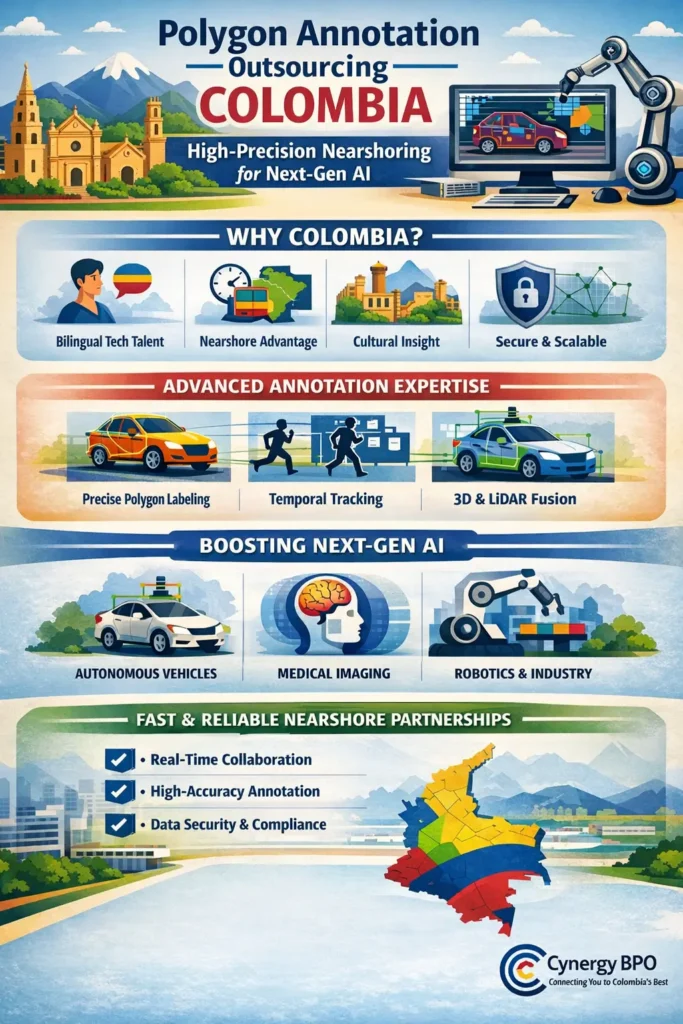
Colombia has become a critical nearshore destination for polygon annotation, supporting AI developers that need more than basic image labeling. Its value lies in delivering highly detailed visual data preparation for sophisticated computer vision systems, helping transform unstructured imagery into dependable training data for next-generation AI. Through Cynergy BPO, companies can connect with Colombia’s most capable annotation specialists—firms equipped to produce the precision, consistency, and scalability required for modern machine intelligence.
- Bilingual Technical Talent: Colombia offers an educated workforce able to interpret subtle visual, semantic, and contextual distinctions across complex datasets.
- Nearshore Collaboration: Alignment with North American working hours enables rapid reviews, faster revisions, and continuous production cycles.
- Environmental Familiarity: Local teams bring strong recognition of Western urban layouts, consumer settings, infrastructure, and behavioral patterns.
- Secure Delivery Models: Providers operate within carefully vetted data protection environments aligned with enterprise security and privacy expectations.
Advanced Annotation Capacity: Teams can scale from standard object outlining to intricate spatiotemporal polygon work across high-volume, high-complexity projects.
Colombia’s Rise in the Computer Vision Economy
As AI expands into robotics, autonomous systems, medical imaging, and other real-world applications, annotation quality has become more important than annotation volume. This shift has created demand for specialists who can interpret structure, motion, and intent inside visual data—not simply label what is visible on screen. Colombia has responded by building a strong reputation in high-accuracy polygon annotation, particularly for use cases where model reliability depends on fine-grained spatial understanding.
Cities such as Bogotá and Medellín have helped position the country as a serious player in the visual AI ecosystem. The local talent pool increasingly combines technical fluency with practical problem-solving, making Colombia well suited for annotation programs that require careful judgment rather than repetitive execution. In this environment, Cynergy BPO helps enterprises identify providers that pair skilled human oversight with disciplined delivery frameworks and enterprise-ready operational maturity.
Why Nearshore Delivery Matters for AI Development
For AI teams building computer vision products, model improvement depends on rapid feedback between engineers and annotators. Colombia’s nearshore alignment significantly reduces the communication lag that often slows offshore programs. Instead of waiting until the next business day for revisions, developers can refine instructions, review samples, and implement corrections within the same work cycle.
This responsiveness is especially valuable in dynamic model development environments where annotation rules evolve quickly. Whether the task involves edge-case mobility data, medical scans, industrial scenes, or surveillance imagery, nearshore collaboration allows enterprises to shorten iteration loops and keep projects moving at engineering speed.
Colombia’s infrastructure also supports the secure movement and processing of large visual datasets, including video libraries and multi-sensor inputs. That matters for organizations in regulated or mission-critical industries where performance and protection must coexist. By integrating Colombian annotation teams into their workflows, enterprises gain an extension of their internal AI function that is both agile and operationally dependable.
A Strategic Talent Base for High-Complexity Vision Work
“Colombia’s strength in AI services comes from the quality of its people and the sophistication of the work they can perform,” says John Maczynski, CEO of Cynergy BPO. “More companies are choosing Colombian partners for polygon annotation because precision and consistency are now central to trustworthy AI. The market is demanding accuracy at a much higher level, and Colombia has emerged as one of the most reliable places to find it.”
This reflects a larger market transition. Computer vision today requires annotation partners that can go beyond outlining shapes. Models must interpret motion, depth, occlusion, overlap, biomechanics, and scene relationships. Colombian teams have become increasingly valuable because they can support this next tier of work with both speed and accuracy.
Table 1: Strategic Advantages of Polygon Annotation in Colombia
| Advantage | Operational Strength | Business Value |
| Fine-Grained Accuracy | Detailed polygon tracing for complex object boundaries and irregular forms | Better model performance in crowded, occluded, or high-risk environments |
| Temporal Reliability | Consistent object tracking across sequences and moving scenes | Improved stability for video-based perception and tracking systems |
| Real-Time Collaboration | Same-day communication with North American product and ML teams | Faster revision cycles and compressed development timelines |
| Specialized Talent | Access to professionals with technical, medical, and engineering exposure | Greater accuracy in domain-specific annotation programs |
| Cost Efficiency | High-caliber output delivered at a more efficient cost structure | Stronger return on AI training and data operations investment |
Supporting the Full Annotation Workflow
Training an AI model to understand the physical world requires far more than drawing shapes around objects. It depends on a disciplined annotation pipeline that can handle data preparation, privacy controls, segmentation logic, quality assurance, and workflow integration. Colombian providers increasingly support that full lifecycle, helping enterprises move from raw data ingestion to production-ready labeled assets.
This includes tasks such as image cleaning, sensitive data masking, semantic segmentation, instance-level separation, and 3D projection work. As enterprise AI projects grow in complexity, Colombian teams are proving capable of handling nuanced programs that require both operational scale and precise human judgment.
One of the most important areas of growth is sensor fusion. In advanced mobility, robotics, and industrial AI, systems must combine inputs from cameras, LiDAR, and other sensors into a single coherent perception layer. Colombian annotation specialists have become effective partners in synchronizing these data streams, helping ensure that models interpret space, distance, movement, and object boundaries with greater consistency. This reduces downstream perception errors and supports safer, more reliable AI behavior.
Table 2: Polygon Annotation Capabilities Delivered from Colombia
| Workflow Stage | Colombian Capability | Enterprise Impact |
| Semantic Segmentation | Classifying pixels across full visual environments | Stronger scene comprehension for navigation and environment-aware systems |
| Instance Segmentation | Separating individual objects within the same category | Higher precision in dense and overlapping visual scenes |
| Motion and Kinematic Labeling | Tracking form, movement, and positional change over time | Better performance for robotics, biomechanics, and action-based AI |
| 3D and LiDAR Alignment | Mapping 2D visual labels into spatial depth frameworks | Improved distance estimation and environmental awareness |
| Bias and Quality Review | Identifying inconsistencies, skew, and risk patterns in data | More inclusive, safer, and more trustworthy model training |
| Workflow Integration | Delivering outputs directly into data and MLOps pipelines | Less operational friction and faster deployment readiness |
Colombia’s Role in the Future of Physical AI
As AI systems become more interactive, mobile, and physically aware, the quality of training data will increasingly determine competitive advantage. Polygon annotation is no longer a background task. It is part of the core engineering foundation that shapes how safely and effectively AI performs in the real world.
Colombia is well positioned to support this future. Its combination of skilled talent, nearshore accessibility, domain adaptability, and maturing AI operations capability makes it an attractive destination for companies building advanced vision systems. Through Cynergy BPO, enterprises can identify partners that not only meet technical requirements, but also align with long-term quality, governance, and scalability objectives.
For organizations developing the next generation of computer vision products, Colombia offers a nearshore model built around precision, responsiveness, and specialized expertise. That makes it more than a cost alternative—it makes it a strategic partner in building high-performance AI.
Expert FAQs
Why are companies choosing Colombia for polygon annotation?
Colombia combines strong technical talent, bilingual capabilities, and close working-hour alignment with North America. This makes it especially effective for computer vision programs that demand fast iteration, detailed QA, and high annotation accuracy.
How does Cynergy BPO evaluate Colombian annotation partners?
Cynergy BPO assesses providers based on delivery quality, operational maturity, data security discipline, workforce stability, and their ability to manage complex visual annotation requirements such as sensor fusion and advanced segmentation.
Can Colombian providers support generative vision and RLHF-related tasks?
Yes. Many Colombian teams can contribute to human review, ranking, and correction workflows used to refine generative visual models, particularly in projects where realism, contextual accuracy, and visual coherence are essential.
Unlock cost-efficient growth with expert BPO guidance!
Partner with Cynergy BPO to connect with top outsourcing providers.
Streamline operations, cut costs, and scale your business with confidence.
Book a Free Call
Ralf Ellspermann - CSO
Author
Ralf Ellspermann is the Chief Strategy Officer (CSO) of Cynergy BPO and a globally recognized authority in business process and contact center outsourcing. With more than 25 years of experience advising enterprises and SMEs, he provides strategic guidance on vendor selection, CX optimization, and scalable outsourcing strategies across global markets. His expertise spans fintech, ecommerce and retail, healthcare, insurance, travel and hospitality, and technology (AI & SaaS) outsourcing.
A frequent speaker at leading industry conferences, Ralf is also a published contributor to The Times of India and CustomerThink, where he shares insights on outsourcing strategy, customer experience, and digital transformation.