



By: Ralf Ellspermann
25-Year, Multi-Awarded BPO Veteran
Published: 18 March 2026
Updated: March 16, 2026
TL;DR: The Key Takeaway
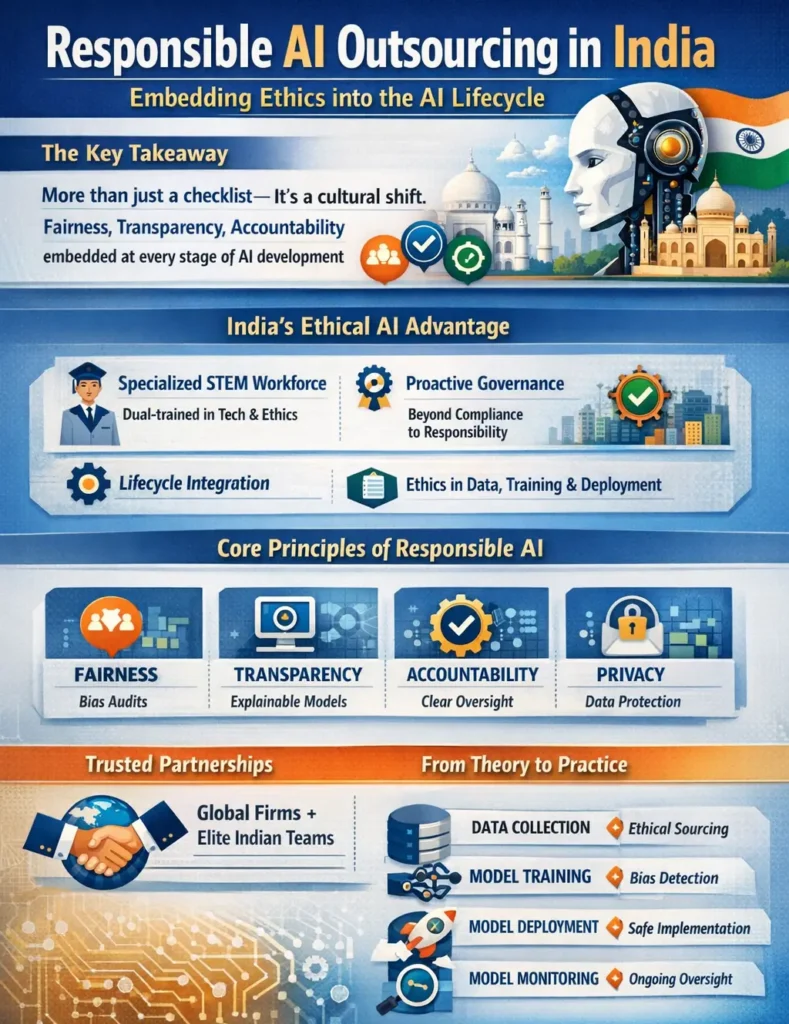
Operationalizing ethical AI requires more than just a checklist; it demands a cultural shift within the outsourcing ecosystem. Responsible AI outsourcing in India is moving beyond theoretical frameworks to embed ethical considerations directly into the AI development lifecycle, ensuring that fairness, transparency, and accountability are not just afterthoughts, but core operational principles.
Machine learning has moved past the era of prioritizing speed over safety. Today, the industry focus has transitioned toward a holistic methodology that embeds morality into the machine, making Responsible AI outsourcing in India a fundamental pillar of global technology strategies. India’s massive STEM workforce is undergoing specialized training in ethical governance, creating a professional class that is both technically elite and socially conscious. Rather than just following international rules, the Indian IT-BPM sector is actively architecting new standards for accountability. Operationalizing these values requires weaving fairness and transparency into every phase of the lifecycle—from initial data ingestion to long-term model monitoring. Cynergy BPO leads this transition, pairing enterprises with Indian partners who prove that clinical accuracy and ethical integrity are two sides of the same coin.
Executive Briefing
- The Ethical Shift: Modern AI development now views ethical integrity as a core performance metric, positioning India’s responsible outsourcing model as a strategic necessity.
- Specialized Workforce: Technical talent in the subcontinent is increasingly dual-trained in data science and ethical principles, ensuring bias detection is part of the engineering process.
- Proactive Governance: Indian service providers are moving beyond simple legal compliance to foster a corporate culture rooted in algorithmic responsibility.
- Lifecycle Integration: Successful ethical AI requires embedding accountability into data sourcing, model training, and real-world deployment phases.
- Trust Facilitation: Cynergy BPO bridges the gap between global firms and elite Indian teams that prioritize fairness as much as computational power.
Executive Summary
The dialogue regarding Responsible AI outsourcing in India has reached a new level of maturity. It is no longer a peripheral academic debate; it is a functional requirement for any business seeking to maintain public trust and reduce regulatory risk. As the world’s primary laboratory for digital innovation, India is now leading the global effort to turn abstract ethical frameworks into repeatable operational processes. This involves moving past high-level manifestos to install transparency and fairness into the very code of the AI development cycle. The Indian IT-BPM sector is not merely participating in this movement—it is setting the pace, defining how the world builds and deploys trustworthy technology. Cynergy BPO remains at the center of this shift, ensuring that AI innovators can access a workforce dedicated to making intelligence both powerful and safe.
“Our partners no longer accept models that are just fast or accurate; they demand systems that are demonstrably fair and transparent. They recognize that ethical AI is a prerequisite for long-term viability. This trend toward Responsible AI in India proves that the industry has grown up—morality is now a primary value proposition.” — John Maczynski, CEO, Cynergy BPO
From Theory to Execution: The New Global Requirement
The international narrative on artificial intelligence has hit a defining moment. For years, the world marveled at the “how”—the ability of machines to digest billions of data points and predict outcomes with staggering precision. However, as these systems begin to influence hiring, healthcare, and finance, the “how” is being eclipsed by the “why” and the “who.” Responsible AI is no longer just a checkbox for social responsibility; it is the cornerstone of risk management. The South Asian tech hub is uniquely positioned for this new era. By combining deep technical roots with a sophisticated approach to governance, India’s IT-BPM sector has evolved into a strategic architect of “ground truth” ethics.
The Indian Advantage: Cultivating Responsible Innovation
India’s strength in ethical AI stems from its rare combination of scale, infrastructure, and a tradition of intellectual inquiry. Premier schools like the Indian Institutes of Technology (IITs) are now producing engineers who view bias mitigation as a core part of their technical identity. This educational pivot ensures that the next generation of data scientists is prepared to defend the ethical implications of their code.
Core Pillars of Ethical Implementation
| Ethical Principle | Lifecycle Implementation | Performance Indicator (KPI) |
| Fairness | Auditing datasets for bias and using fairness-aware ML algorithms. | Measurable reduction in bias across demographic groups. |
| Transparency | Utilizing interpretable “white-box” models and clear documentation. | Verifiable user trust and explainable decision paths. |
| Accountability | Establishing governance boards and redress mechanisms. | Clear attribution of responsibility for all AI outcomes. |
| Privacy | Employing differential privacy and federated learning techniques. | Zero-incident compliance with global data regulations (GDPR/HIPAA). |
A Framework for Operationalizing Ethics
Turning ethics into an operational reality is a massive logistical challenge. It is insufficient to simply declare a “fairness policy”; organizations must deploy specific tools and audits that check for bias in real-time. This is where India’s IT-BPM sector excels. With decades of experience in process optimization and Six Sigma-level quality management, Indian firms are expertly equipped to manage the “ethics audit.” This includes developing rigorous checklists, conducting adversarial testing (Red Teaming), and fostering a culture where engineers feel empowered to flag ethical concerns. The goal is to make “human-in-the-loop” oversight an instinctive part of the development process.
The Road Ahead: Securing a Future of Trust
Building a truly responsible AI ecosystem is a long-distance race. It requires the sustained cooperation of tech firms, governments, and ethical oversight bodies. The Indian IT-BPM sector serves as a vital catalyst in this journey, acting as a global thought leader for trustworthy technology. By operationalizing ethical frameworks, the nation ensures that the benefits of the AI revolution are not undermined by algorithmic prejudice or privacy breaches.
Lifecycle Risk & Mitigation Strategy
- Data Sourcing: Focuses on privacy and consent. Strategy: Anonymization and the use of truly representative, diverse datasets.
- Model Training: Addresses the “black box” problem. Strategy: Regular bias audits and the deployment of explainable AI (XAI) models.
- Model Deployment: Prevents misuse and societal harm. Strategy: Robust governance frameworks and continuous impact assessments.
- Model Monitoring: Corrects for “model drift” over time. Strategy: Persistent performance tracking and periodic retraining to maintain fairness.
Expert FAQs
Q: What is the Indian government’s role in this ethical shift?
The government is taking a front-seat role through initiatives like the National Strategy for Artificial Intelligence. This policy prioritizes #AIforAll, focusing on social inclusion and the development of a national ethics framework. Public-private partnerships are also flourishing to ensure research remains aligned with human-centric values.
Q: How can corporations guarantee their outsourced AI is truly unbiased?
It requires a multi-layered approach: auditing the raw training data, using algorithms specifically designed for fairness, and conducting “Red Team” testing to see how the model behaves under pressure. Most importantly, firms must work with partners who have an established culture of ethical accountability.
Q: Is there a functional difference between “Ethical” and “Trustworthy” AI?
Yes. Ethical AI is the moral foundation—ensuring the system aligns with human values. Trustworthy AI is the broader result; it means the system is not only ethical but also technically robust, secure, and reliable. Ethics is the requirement; trust is the outcome.
Q: How does Cynergy BPO vet its ethical AI partners in India?
We conduct deep-dive audits of a partner’s internal governance. We look beyond their technical stack to examine their bias-testing protocols, the diversity of their data teams, and their history of compliance with global standards. We only connect our clients with firms that view ethics as a non-negotiable part of their engineering DNA.
Unlock cost-efficient growth with expert BPO guidance!
Partner with Cynergy BPO to connect with top outsourcing providers.
Streamline operations, cut costs, and scale your business with confidence.
Book a Free Call
Ralf Ellspermann - CSO
Author
Ralf Ellspermann is the Chief Strategy Officer (CSO) of Cynergy BPO and a globally recognized authority in business process and contact center outsourcing. With more than 25 years of experience advising enterprises and SMEs, he provides strategic guidance on vendor selection, CX optimization, and scalable outsourcing strategies across global markets. His expertise spans fintech, ecommerce and retail, healthcare, insurance, travel and hospitality, and technology (AI & SaaS) outsourcing.
A frequent speaker at leading industry conferences, Ralf is also a published contributor to The Times of India and CustomerThink, where he shares insights on outsourcing strategy, customer experience, and digital transformation.