


By: Ralf Ellspermann
25-Year, Multi-Awarded BPO Veteran
Published: 30 March 2026
Updated: March 23, 2026
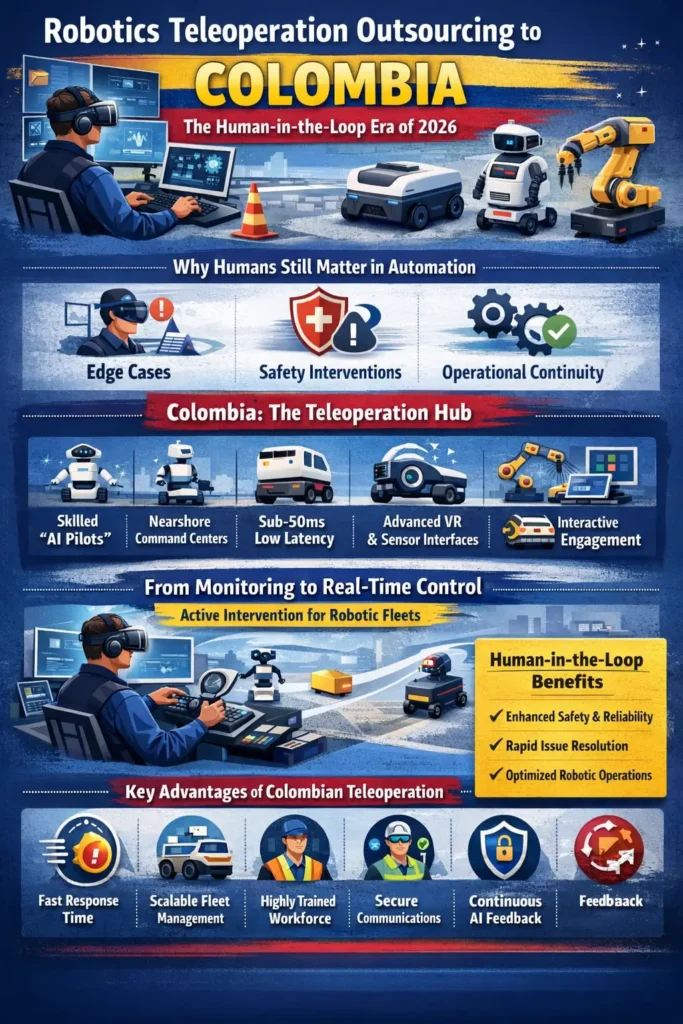
Robotics Teleoperation Support Services Outsourcing to Colombia has become a critical layer in scaling real-world automation. In 2026, fully autonomous systems still depend on human oversight for edge cases, safety interventions, and operational continuity. Colombia has positioned itself as a nearshore command center where skilled “AI Pilots” remotely guide, correct, and stabilize robotic fleets in real time.
- Specialized teleoperators provide low-latency control for AMRs, delivery robots, and industrial cobots.
- AI Pilots manage large fleets, intervening only when autonomous logic fails.
- National AI investments have strengthened Colombia’s robotics and teleoperation ecosystem.
- Workforce professionalization ensures stable, highly trained operators for complex environments.
- Direct fiber connectivity enables sub-50ms command latency for real-time control.
The Reality of Autonomy: Why Humans Still Matter
Despite rapid advances in robotics, full autonomy remains limited in unpredictable environments. Robots can handle structured tasks, but they struggle with anomalies—unexpected obstacles, sensor confusion, or ambiguous situations.
In 2026, teleoperation fills this gap. Instead of replacing humans, robotics systems rely on them as a fallback layer. When a robot encounters a scenario it cannot resolve, control is seamlessly transferred to a remote operator.
Colombia has emerged as a leader in this model, providing trained specialists who can step into a robot’s perspective and resolve issues instantly. This ensures continuity of operations without requiring physical intervention on-site.
From Monitoring to Real-Time Control
Earlier models of robotics support focused on passive monitoring—observing system performance and flagging issues. Today, the approach is fundamentally different.
Teleoperators actively control machines when needed. Using immersive interfaces such as VR dashboards, live video feeds, and sensor telemetry, they can navigate robots through complex environments.
This shift from observation to intervention has redefined the role of human operators. They are no longer support staff but active participants in robotic systems, ensuring that machines can function reliably in dynamic conditions.
Colombia’s Emergence as a Teleoperation Hub
Colombia’s rise in this field is driven by a combination of technical education, infrastructure investment, and workforce development. Cities like Bogotá and Medellín have become centers for robotics support, supported by national initiatives that prioritize AI and automation.
A key differentiator is technical literacy. Colombian operators are trained not only in control interfaces but also in understanding the underlying systems—sensor inputs, navigation logic, and failure modes.
This allows them to diagnose problems quickly and apply precise corrections. Whether guiding a delivery robot through a crowded sidewalk or stabilizing an industrial system, Colombian teams provide the expertise required for high-reliability operations.
The Nearshore Advantage: Real-Time Intervention
In robotics, timing is critical. Delays in response can lead to operational disruptions, financial losses, or safety risks.
Colombia’s alignment with North American time zones enables immediate response to issues. When a robot signals for assistance, operators are available in real time, eliminating delays associated with offshore models.
This creates a continuous operational loop. Robots can function at scale while maintaining a human safety net that responds instantly to anomalies.
For enterprises, this means higher uptime, faster recovery from errors, and more efficient use of robotic assets.
Table 1: Strategic Benefits of Colombian Teleoperation (2026)
| Advantage | Technical Specification | Strategic Outcome |
| Low-Latency Control | Sub-50ms command response via fiber connectivity | Safe real-time operation in dynamic environments |
| Fleet Scalability | One operator managing multiple robots | Efficient scaling of robotic deployments |
| Advanced Interfaces | Integration of VR, haptics, and sensor feeds | High-precision control of complex systems |
| Workforce Stability | Structured teleoperation roles and training | Consistent performance and low attrition |
| Secure Operations | Encrypted communication channels | Protection against unauthorized access |
Managing Complexity in Real-World Environments
Robotic systems operate in environments that are often unpredictable. Public spaces, industrial sites, and healthcare facilities present challenges that cannot always be anticipated during development.
Colombian teleoperators are trained to handle these complexities. Their role includes navigating unexpected obstacles, resolving sensor conflicts, and ensuring that robots continue operating safely.
This capability is particularly important for applications such as last-mile delivery, warehouse automation, and service robotics, where conditions can change rapidly.
By providing a human layer of adaptability, teleoperation ensures that robotic systems remain functional even in uncertain conditions.
Structuring Robotics Support Operations
Effective teleoperation requires a structured approach that integrates monitoring, intervention, and continuous improvement. Colombian providers organize these functions into coordinated workflows that support the full lifecycle of robotic operations.
Key components include:
- Active Control: Direct intervention in navigation and task execution
- Exception Handling: Resolving system errors and unexpected scenarios
- Fleet Coordination: Managing multiple robots across different locations
- Diagnostics: Identifying hardware and software issues remotely
- Data Feedback: Feeding operational insights back into AI training models
- Security Monitoring: Protecting systems from unauthorized access
Table 2: The 2026 Robotics Support Lifecycle in Colombia
| Phase | Colombian Contribution | Enterprise Value |
| Active Teleoperation | Real-time remote control of robots | Continuous operation without downtime |
| Exception Handling | Resolution of edge cases and system errors | Reduced operational disruptions |
| Fleet Management | Monitoring and prioritizing alerts | Optimized resource utilization |
| Diagnostics | Remote analysis of system performance | Extended lifespan of robotic assets |
| Data Feedback | Integration of operational data into AI models | Continuous system improvement |
| Security Oversight | Monitoring for potential threats | Protection of assets and brand reputation |
Human-in-the-Loop as a Strategic Advantage
Rather than being a limitation, the need for human intervention has become a competitive advantage. Teleoperation allows companies to deploy robotics systems faster, without waiting for full autonomy.
Colombian teams act as an extension of enterprise operations, providing the flexibility needed to handle real-world variability. Their involvement ensures that systems can adapt to new conditions without requiring costly redesigns.
This hybrid model—combining automation with human oversight—has become the dominant approach for scaling robotics in 2026.
Colombia’s Role in the Future of Robotics
As industries adopt Robotics-as-a-Service (RaaS) and expand autonomous operations, the importance of teleoperation will continue to grow. Human oversight will remain essential for maintaining safety, reliability, and efficiency.
Colombia’s combination of skilled talent, nearshore accessibility, and advanced infrastructure positions it as a key player in this evolving landscape. Its providers deliver not just support services, but a critical layer of operational intelligence.
Through partnerships facilitated by Cynergy BPO, enterprises can access specialized teleoperation capabilities that enable scalable, resilient, and high-performing robotic systems.
Expert FAQs
What is an AI Pilot?
A trained operator who supervises and controls autonomous systems, intervening when necessary to resolve complex situations.
Why is low latency important in teleoperation?
Because delays can impact safety and system performance, especially in dynamic or human-populated environments.
Can Colombian teams manage large robotic fleets?
Yes. Operators are trained to handle multiple systems simultaneously, enabling efficient scaling.
How is security maintained?
Through encrypted communication channels and controlled access systems that protect both data and operations.
Unlock cost-efficient growth with expert BPO guidance!
Partner with Cynergy BPO to connect with top outsourcing providers.
Streamline operations, cut costs, and scale your business with confidence.
Book a Free Call
Ralf Ellspermann - CSO
Author
Ralf Ellspermann is the Chief Strategy Officer (CSO) of Cynergy BPO and a globally recognized authority in business process and contact center outsourcing. With more than 25 years of experience advising enterprises and SMEs, he provides strategic guidance on vendor selection, CX optimization, and scalable outsourcing strategies across global markets. His expertise spans fintech, ecommerce and retail, healthcare, insurance, travel and hospitality, and technology (AI & SaaS) outsourcing.
A frequent speaker at leading industry conferences, Ralf is also a published contributor to The Times of India and CustomerThink, where he shares insights on outsourcing strategy, customer experience, and digital transformation.