



By: Ralf Ellspermann
25-Year, Multi-Awarded BPO Veteran
Published: 12 April 2026
Updated: March 30, 2026
In 2026, technical support outsourcing in Costa Rica has become the primary destination for North American SaaS and Enterprise IT firms seeking “Resolution over Redirection.” By leveraging a workforce of 80,000+ tech-certified professionals, Costa Rican centers provide L1–L3 support at $18–$24 per hour. This model integrates seamlessly into U.S. DevOps cycles, delivering real-time troubleshooting and API-level support that offshore hubs often struggle to maintain.
30-Second Executive Briefing
- Tiered Expertise: 2026 hubs offer specialized “Squads” for L1 (Helpdesk), L2 (Systems Admin), and L3 (Developer-level) support.
- Cost-Efficiency: Rates of $18–$24 per hour provide a 50%–60% reduction in total cost of ownership (TCO) compared to onshore engineering teams.
- STEM Powerhouse: With over 7,000 new STEM graduates annually, Costa Rica offers the highest density of certified cloud and cybersecurity talent in Latin America.
- Sync-Ops Integration: Real-time alignment with CST/EST allows technical support teams to join morning “Stand-ups” and interact directly with U.S. product owners.
- AI-Augmented Workflows: Support engineers utilize real-time code-assist and predictive diagnostic tools to reduce “Time to Resolution” (TTR) by 30%.
From “Scripted Help” to “Engineering Support”
By 2026, the traditional “call center” approach to tech support is dead. Technical Support Outsourcing in Costa Rica has evolved into an extension of the client’s engineering department. Costa Rican support engineers don’t just follow a knowledge base; they contribute to it.
In 2026, these teams are specifically recruited for their “Code-Reading” capabilities. Whether it’s troubleshooting a React-based front-end issue or diagnosing a latency spike in an AWS environment, the Costa Rican team provides the cognitive heavy lifting that allows onshore developers to stay focused on the product roadmap.
2026 Technical Support: Capability & Rate Matrix
| Support Tier | Scope of Work | Key Certifications | Hourly Rate (Fully Loaded) |
| L1: Digital Helpdesk | User Admin, App Troubleshooting | Google IT Support, A+ | $18 – $20 |
| L2: Systems Support | Cloud Config, API Integration | AWS Practitioner, CCNA | $21 – $23 |
| L3: Dev-Support | Bug Triage, Code Review, SQL | Python/Java, Azure Architect | $24 – $27 |
| Security Support | SOC Monitoring, Threat Triage | Security+, CISSP (Associate) | $25+ |
The Infrastructure of “High-Availability” Support
Reliability in 2026 is defined by Infrastructure Resilience. Costa Rica has invested heavily in “Tech-Corridors” (San José, Heredia, and Cartago) that offer:
- Triple-Redundant Fiber: Direct peering with U.S. data centers ensures that support engineers have the same “low-latency” experience as if they were sitting in the same office.
- 99.9% Uptime Guarantee: Most 2026 providers operate out of Tier-III data center facilities with dedicated 5G backup for remote-hybrid teams.
- Clean Energy Continuity: 100% renewable power means that even during global energy fluctuations, Costa Rica’s geothermal and hydro-powered hubs remain online.
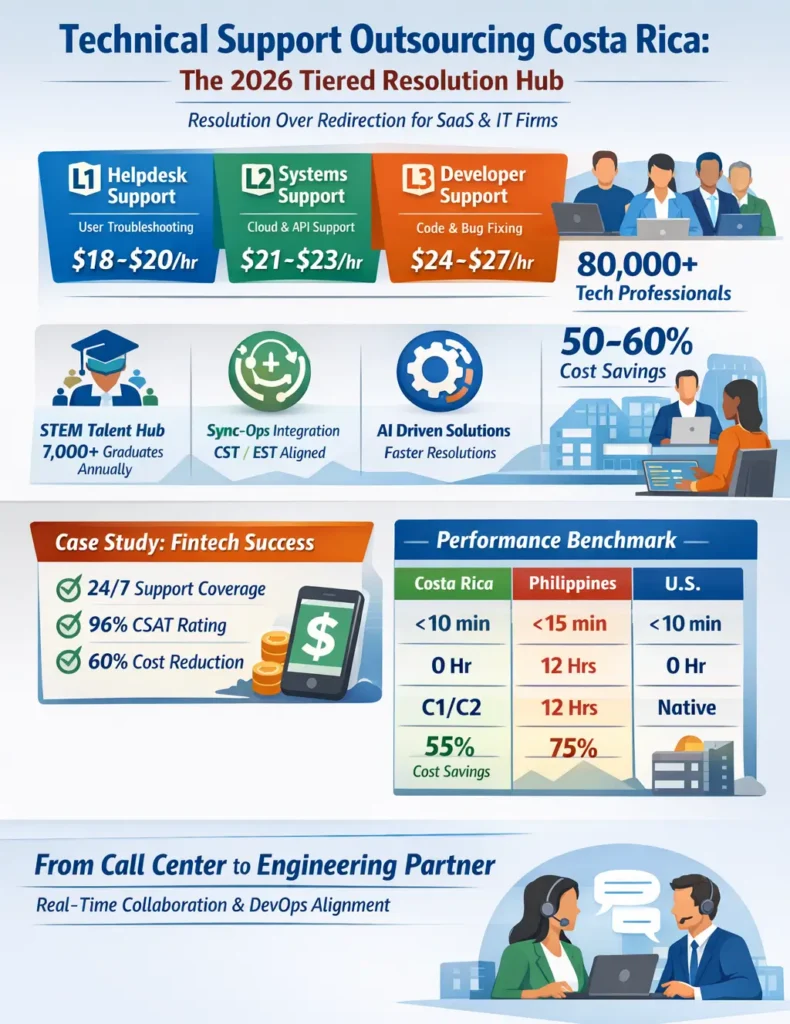
Performance Benchmarks: Costa Rica vs. Global Alternatives
| Metric | Costa Rica (Nearshore) | Philippines (Offshore) | U.S. (Onshore) |
| Avg. First Response Time | < 10 Minutes | < 15 Minutes | < 10 Minutes |
| Time Zone Lag | 0 Hours | 12 Hours | 0 Hours |
| English Proficiency | C1/C2 (Elite) | B2/C1 | Native |
| Agile Participation | Active (Daily) | Passive (Email) | Active (Daily) |
| Avg. Cost Savings | 55% | 75% | 0% |
Case Study: Optimizing L2 Support for a Fintech Leader
The Client: A 2026 mobile payment platform processing 1M+ transactions daily.
The Challenge: Their L2 technical support was handled in-house in San Francisco at a cost of $145k per engineer. The high cost limited their ability to provide 24/7 coverage for the East Coast market.
The Costa Rica Solution: The firm established a “Nearshore Dev-Support Pod” in Cartago, consisting of 12 engineers with background in SQL and Cloud Architecture.
The 2026 Results:
- Coverage Expansion: Achieved 24/7 “Follow-the-Sun” support for 60% less than the cost of their previous day-shift only team.
- Resolution Quality: The Costa Rican team maintained a 96% CSAT score, matching the domestic team’s performance exactly.
- Knowledge Gain: The nearshore team identified three recurring API bugs within the first 60 days, providing the fix documentation that reduced L3 escalations by 20%.
2026 Strategic Advantage: The “Agile Collaboration” Model
The true 2026 differentiator for Technical Support Outsourcing in Costa Rica is the ability to work in Synchronous Cycles.
- Morning Stand-ups: The support team joins the U.S. engineering team’s 9:00 AM meeting to discuss the previous night’s tickets.
- Slack/Teams Integration: Nearshore engineers act as “Real-time Responders” in the company’s internal developer channels.
- Live Debugging: Support teams and U.S. developers can jump on a screen-share at 2:00 PM CST to troubleshoot a live environment issue together—something impossible with 12-hour offshore gaps.
Frequently Asked Questions
Does the $18–$24 rate include the cost of AI tools?
In 2026, most top-tier providers include “Support Copilot” licenses in their hourly rate. These tools help agents summarize tickets and search internal documentation faster, increasing their output by up to 40%.
How do you handle Data Sovereignty for technical data?
Costa Rican providers follow strict SOC2 and GDPR protocols. For 2026, “Data Localization” tools ensure that sensitive customer logs never leave your U.S.-based cloud environment; the Costa Rican engineers access them via secure, biometrically-authenticated VDI.
What is the typical “Ramp-Up” time for a new team?
Due to the high level of existing certifications in the workforce, a “Knowledge Transfer” period for an L2 team typically takes 3–5 weeks, compared to 8–10 weeks for offshore teams requiring more language or cultural training.
Can I hire just one or two specialists?
While most BPOs prefer teams of 10+, the 2026 “Staff Augmentation” model allows you to hire individual L3 engineers in Costa Rica to sit directly within your U.S. team on a long-term contract basis.
Share This
Unlock cost-efficient growth with expert BPO guidance!
Partner with Cynergy BPO to connect with top outsourcing providers.
Streamline operations, cut costs, and scale your business with confidence.
Book a Free Call
Ralf Ellspermann - CSO
Author
Ralf Ellspermann is the Chief Strategy Officer (CSO) of Cynergy BPO and a globally recognized authority in business process and contact center outsourcing. With more than 25 years of experience advising enterprises and SMEs, he provides strategic guidance on vendor selection, CX optimization, and scalable outsourcing strategies across global markets. His expertise spans fintech, ecommerce and retail, healthcare, insurance, travel and hospitality, and technology (AI & SaaS) outsourcing.
A frequent speaker at leading industry conferences, Ralf is also a published contributor to The Times of India and CustomerThink, where he shares insights on outsourcing strategy, customer experience, and digital transformation.