



By: Ralf Ellspermann
25-Year, Multi-Awarded BPO Veteran
Published: 22 April 2026
Updated: April 1, 2026
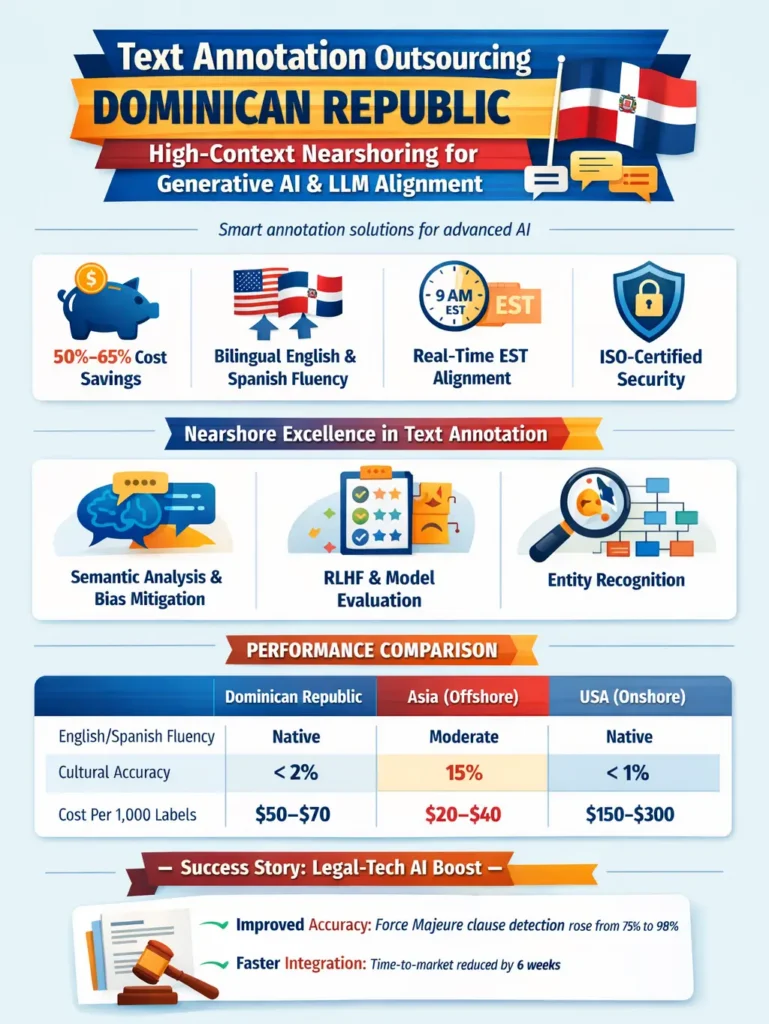
As global AI development shifts from massive data scraping to high-precision curation, the Dominican Republic has emerged as a premier nearshore destination for text annotation. This strategic move allows North American technology firms to secure the linguistic depth and cultural nuance essential for Large Language Model (LLM) fine-tuning and Reinforcement Learning from Human Feedback (RLHF). By integrating a bilingual, Western-aligned workforce, developers can achieve the semantic precision that offshore hubs often fail to deliver.
30-Second Executive Briefing
- Semantic Superiority: Access to a talent pool with native-level fluency in “Neutral Spanish” and US English, minimizing “hallucination” risks in localized LLMs.
- Economic Efficiency: Typical cost savings of 50% to 65% over internal US-based data science teams while maintaining higher throughput.
- Geographic Synergy: EST/AST time zone alignment facilitates real-time “Human-in-the-Loop” (HITL) calibration and same-day feedback for agile development.
- Security & Compliance: Operations within Dominican Free Trade Zones offer ISO-certified facilities and 100% tax exemptions under Law 8-90, lowering project overhead.
- Bilingual Versatility: Specialized capability in “code-switching” datasets, critical for the growing US Hispanic and Latin American fintech and retail markets.
The Precision Pivot: Beyond Basic Labeling to Cognitive Alignment
In the 2026 AI landscape, simple sentiment analysis is no longer enough. The market has transitioned toward Reasoning-Based Annotation, where human agents must explain the logic behind a model’s output. The Dominican Republic’s education-forward workforce—boasting a 43% inclination toward STEM fields—provides the cognitive foundation required for these high-complexity tasks.
Unlike offshore locations that rely on rigid scripts, Dominican annotators bring a “cultural mirror” effect to the data. They understand the subtext, sarcasm, and regional idioms of the North American market. This is particularly vital for Toxicity Redaction and Bias Mitigation, where a literal interpretation of text can lead to catastrophic model failures in production.
Nearshore Text Annotation Performance Benchmarks
| Metric | Dominican Republic (Nearshore) | Asia-Pacific (Offshore) | Onshore (USA/Canada) |
| English/Spanish Fluency | Native/Near-Native | Moderate/Variable | Native |
| Logic-Based Reasoning | High | Moderate | High |
| Cost Per 1,000 Labels | $45 – $75 | $20 – $40 | $150 – $300 |
| Cultural Misinterpretation Rate | < 2% | 12% – 18% | < 1% |
| Daily Sprint Syncs | Synchronous | Asynchronous (12h delay) | Synchronous |
Specializations in Modern Text Data Workflows
Dominican service hubs have evolved to support the specific architecture of 2026-era transformer models, focusing on data quality over sheer volume.
Named Entity Recognition (NER) and Relationship Extraction
In highly regulated sectors like finance and healthcare, identifying the relationship between entities is critical. Dominican teams excel at tagging complex hierarchies, such as identifying the “Purchaser” vs. “Beneficiary” in fragmented insurance documents. This high-fidelity tagging reduces the training epochs required for a model to reach production-grade accuracy.
RLHF and Model Rank-Ordering
The most significant growth area in the region is Reinforcement Learning from Human Feedback. Annotators are presented with multiple model-generated responses and must rank them based on truthfulness, helpfulness, and safety. The ability to articulate why one response is superior to another requires a level of linguistic sophistication that is the hallmark of the Dominican BPO sector.
Operational Scalability and Fiscal Incentives
The Dominican Republic’s “Vision 2030” has established the country as a “Digital Export” powerhouse. Companies leveraging Dominican teams benefit from a unique fiscal structure that prioritizes long-term partnership over transactional vendor relationships.
Strategic Savings: A Comparative Analysis of 2026 Labor Models
| Project Type | Monthly Token Volume | Dominican Provider Cost | US In-House Cost | Net Margin Improvement |
| LLM Safety Fine-Tuning | 5,000,000 | $112,000 | $310,000 | 63.8% |
| Fintech Intent Classification | 2,000,000 | $55,000 | $145,000 | 62.1% |
| Multilingual Sentiment (Retail) | 10,000,000 | $90,000 | $225,000 | 60.0% |
Case Study: Optimizing Legal-Tech AI for a New York Startup
The Challenge: A legal-tech firm specializing in automated contract review was experiencing a 25% failure rate in identifying “Force Majeure” clauses in bilingual (English/Spanish) leases. Their previous offshore partner lacked the legal context to distinguish between standard boilerplates and specific legal exceptions.
The Solution: The startup transitioned its annotation to a specialized team in Santo Domingo comprised of law students and recent paralegal graduates. The team implemented a multi-stage “Expert-in-the-Loop” workflow, where senior leads audited the most ambiguous 10% of annotations.
The Outcome:
- Accuracy: Entity recognition accuracy improved from 75% to 98.4%.
- Integration: Daily stand-ups with the NY engineering team reduced guideline drift by 40%.
- Efficiency: The time-to-production for the Spanish-language module was cut by 6 weeks, allowing for a faster market entry.
From Data Labeling to Knowledge Engineering
We are witnessing a shift where Dominican hubs are no longer just “labeling factories” but “knowledge centers.” As AI models become more specialized, the demand for Domain-Specific Text Annotation will continue to rise. By positioning teams in the Dominican Republic, enterprises secure a workforce that is not only cost-effective but also capable of the high-level reasoning required to build the next generation of intelligent systems.
Expert FAQs
How do Dominican providers handle “Code-Switching” in text datasets?
Due to the close cultural and economic ties between the DR and the US, a significant portion of the workforce is natively bilingual. They are uniquely equipped to annotate text where speakers blend English and Spanish—a critical requirement for training AI that serves the 65 million Hispanic individuals in the United States.
What measures are in place to prevent data leakage in text annotation?
Top-tier Dominican providers utilize “Clean Room” environments and Virtual Desktop Infrastructure (VDI). All annotation takes place on the client’s secure servers; no data is ever downloaded to local machines, and all employees undergo rigorous background checks and sign enforceable NDAs.
Can Dominican teams support low-resource language annotation?
While their strength lies in English, Spanish, and French, many hubs have developed “Linguistic Transfer” protocols. They use their highly trained bilingual leads to manage and quality-control smaller teams focusing on secondary Caribbean or Latin American dialects.
How does the time zone alignment impact the “Gold Set” creation process?
“Gold Sets” (the master data used to grade annotators) often require real-time debate between the AI engineers and the annotation leads. Being in the same time zone allows these discussions to happen instantly via Slack or Zoom, ensuring the entire 100+ person team is aligned with the latest model requirements by lunch.
Share This
Unlock cost-efficient growth with expert BPO guidance!
Partner with Cynergy BPO to connect with top outsourcing providers.
Streamline operations, cut costs, and scale your business with confidence.
Book a Free Call
Ralf Ellspermann - CSO
Author
Ralf Ellspermann is the Chief Strategy Officer (CSO) of Cynergy BPO and a globally recognized authority in business process and contact center outsourcing. With more than 25 years of experience advising enterprises and SMEs, he provides strategic guidance on vendor selection, CX optimization, and scalable outsourcing strategies across global markets. His expertise spans fintech, ecommerce and retail, healthcare, insurance, travel and hospitality, and technology (AI & SaaS) outsourcing.
A frequent speaker at leading industry conferences, Ralf is also a published contributor to The Times of India and CustomerThink, where he shares insights on outsourcing strategy, customer experience, and digital transformation.