



By: Ralf Ellspermann
25-Year, Multi-Awarded BPO Veteran
Published: 24 March 2026
Updated: March 18, 2026
Kenya has established itself as a critical global node for training voice-activated AI, providing the linguistic nuance and technical precision required to transform rigid machine responses into fluid, natural conversations. By leveraging a highly educated, multilingual workforce, enterprises are successfully bridging the gap between functional speech recognition and true empathetic interaction.
30-Second Executive Briefing
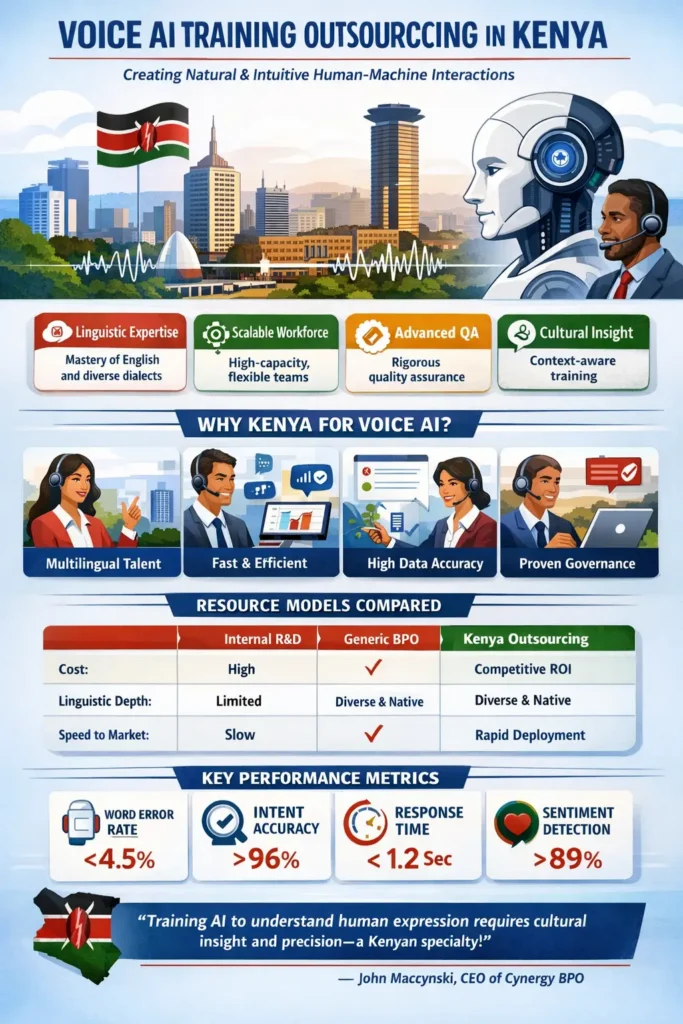
- Strategic Precision: Kenyan teams excel at identifying subtle linguistic markers that generic automated training models frequently overlook.
- Linguistic Versatility: Native-level English proficiency combined with diverse dialectical understanding ensures global voice assistant compatibility.
- Scalable Intelligence: Outsourcing to Kenya provides a flexible, high-capacity workforce for intensive data labeling and intent validation.
- Proven Governance: Leading partners utilize structured quality assurance (QA) frameworks that exceed international standards for data integrity.
- Cynergy BPO Advantage: We curate partnerships with the top 1% of Kenyan AI-ops firms, specializing in high-stakes voice model refinement.
The Strategic Imperative of Advanced Voice AI Training
The efficacy of a modern voice assistant—whether in a smart home device, a vehicle, or a corporate customer service portal—is defined entirely by its training. Generic datasets often struggle with regional accents, emotional subtext, or complex multi-part queries. In 2026, the competitive edge belongs to brands that move beyond basic “command-and-response” logic toward intuitive, context-aware dialogue.
Achieving this level of sophistication requires a rigorous human-in-the-loop (HITL) approach. Specialized training involves meticulous audio transcription, sentiment analysis, and the constant refinement of intent recognition. When a voice assistant can accurately interpret sarcasm, frustration, or urgency, it stops being a tool and starts being a digital companion. Kenya’s talent pool provides exactly this layer of cognitive insight, ensuring that AI systems are as empathetic as they are efficient.
Comparative Analysis: Voice Training Resource Models
| Training Model | Internal R&D Teams | Generic Global BPO | Specialized Kenya Outsourcing |
| Operational Cost | High fixed overheads | Low, but variable quality | Competitive with high ROI |
| Linguistic Depth | Limited to local staff | Often lacks cultural context | Deep understanding of diverse accents |
| Speed to Market | Slower due to hiring cycles | Fast but requires heavy rework | Rapid, expert-led deployment |
| Data Accuracy | High, but resource-strained | Inconsistent and robotic | Consistently high via rigorous QA |
| Innovative Edge | Tied to internal capacity | Execution-focused only | Proactive, tech-ecosystem driven |
Why Kenya is the Premier Destination for Voice AI Development
The rise of Kenya as an AI powerhouse is driven by a unique confluence of a tech-savvy youth population and proactive digital infrastructure investment. Nairobi, often referred to as “Silicon Savannah,” has cultivated a workforce that is not only proficient in English but also deeply immersed in the nuances of global communication.
Outsourcing voice assistant training to Kenya grants access to professionals who specialize in complex data annotation and phonetic validation. These teams provide the human “ground truth” necessary for machine learning models to handle code-switching and regional slang. By investing in Kenyan expertise, global tech firms ensure their voice products are inclusive, accessible, and capable of operating flawlessly in a globalized market.
“The future of AI is not just about raw processing power; it is about the human judgment that refines these systems. Training a machine to understand the subtleties of human expression requires cultural insight and clinical meticulousness—qualities that are standard among specialized Kenyan teams.” — John Maczynski, CEO of Cynergy BPO.
The Role of Governance in AI Training Excellence
Managing the lifecycle of AI training involves navigating significant data privacy and ethical hurdles. Without a robust governance framework, models risk inheriting human biases or violating user privacy. Cynergy BPO acts as a strategic architect in this process, ensuring that every outsourcing partnership is built on a foundation of security and transparency.
By vetting only the most elite AI-ops firms in Kenya, we ensure that our clients work with partners who adhere to international standards like ISO 27001 and GDPR. This governance extends to the performance level, where strict KPIs are monitored to ensure the AI’s “Word Error Rate” (WER) and “Intent Recognition Accuracy” continue to improve. This disciplined approach minimizes risk and maximizes the long-term value of the AI investment.
Key Performance Indicators for Voice AI Success
| Metric | Definition | Global Industry Average | Kenya Outsourcing Target |
| Word Error Rate (WER) | Frequency of transcription errors | < 10% | < 4.5% |
| Intent Recognition | Accuracy in identifying user goals | > 88% | > 96% |
| Response Latency | Time between query and AI answer | < 2.0 seconds | < 1.2 seconds |
| Sentiment Accuracy | Correct detection of user emotion | > 75% | > 89% |
| Task Completion | Success rate of user requests | > 84% | > 93% |
Expert FAQs
What specific linguistic advantages do Kenyan teams provide?
Kenyan professionals are uniquely positioned due to their multi-dialectical fluency and strong command of English. They excel at identifying the subtle shifts in tone and syntax that define different English-speaking regions, making them ideal for training AI meant for North American, European, and African markets.
How does Cynergy BPO mitigate bias in voice assistant training?
We partner with Kenyan firms that implement diverse hiring practices and rigorous “bias-checking” protocols. By ensuring that the human trainers represent a wide range of backgrounds and linguistic styles, we help developers create AI that is fair, inclusive, and free from the skewed perspectives often found in more homogenous datasets.
What types of data annotation are most common in Kenya?
Kenyan firms offer a full spectrum of services, including audio-to-text transcription, phonetic labeling, named entity recognition (NER), and sentiment tagging. They are also adept at “edge case” identification—tagging unusual or complex queries that often cause automated systems to fail.
Is it possible to scale these projects rapidly?
Yes. One of Kenya’s greatest strengths is its deep pool of educated talent ready to be deployed. Whether you are launching a pilot program or need a workforce of hundreds for a multi-year project, the Kenyan infrastructure allows for rapid scaling without the typical degradation in data quality.
Share This
Unlock cost-efficient growth with expert BPO guidance!
Partner with Cynergy BPO to connect with top outsourcing providers.
Streamline operations, cut costs, and scale your business with confidence.
Book a Free Call
Ralf Ellspermann - CSO
Author
Ralf Ellspermann is the Chief Strategy Officer (CSO) of Cynergy BPO and a globally recognized authority in business process and contact center outsourcing. With more than 25 years of experience advising enterprises and SMEs, he provides strategic guidance on vendor selection, CX optimization, and scalable outsourcing strategies across global markets. His expertise spans fintech, ecommerce and retail, healthcare, insurance, travel and hospitality, and technology (AI & SaaS) outsourcing.
A frequent speaker at leading industry conferences, Ralf is also a published contributor to The Times of India and CustomerThink, where he shares insights on outsourcing strategy, customer experience, and digital transformation.