



By: Ralf Ellspermann
25-Year, Multi-Awarded BPO Veteran
Published: 16 March 2026
Updated: March 16, 2026
TL;DR: The Key Takeaway
Warehouse robotics training outsourcing in India has transcended basic data labeling, becoming a strategic necessity for achieving flawless automated logistics. The nation’s elite human-in-the-loop specialists are the critical factor in training, validating, and governing robotic systems, ensuring a new standard of operational excellence in the global supply chain.
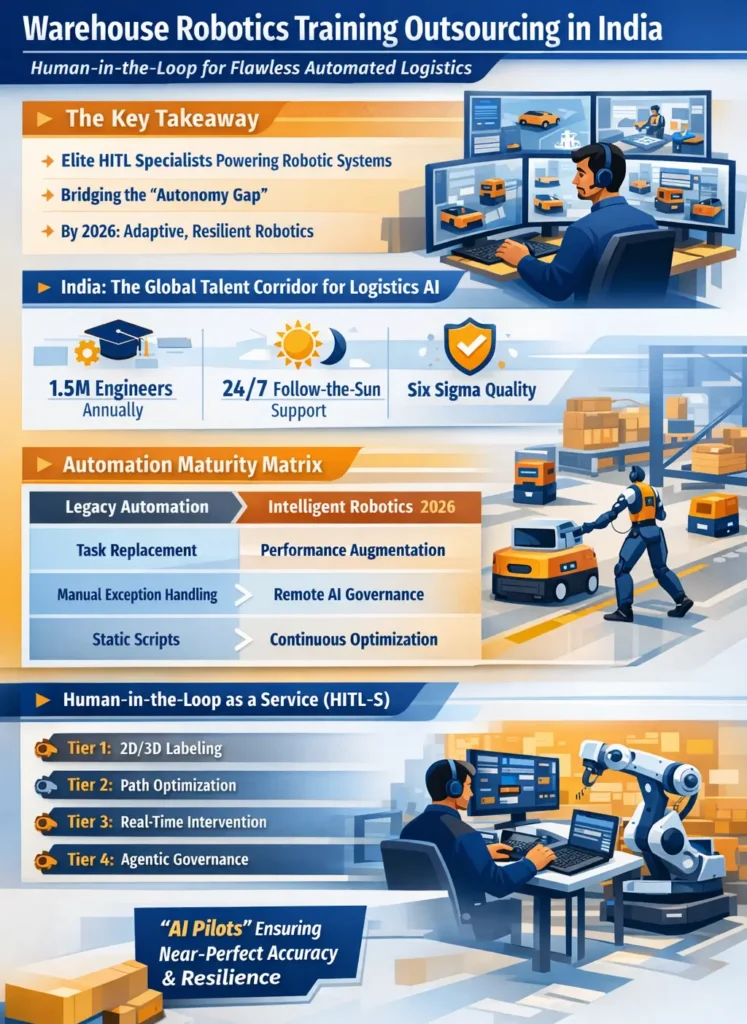
Outsourcing warehouse robotics training to India enables logistics leaders to bridge the “Autonomy Gap” through expert Human-in-the-Loop (HITL) services. By 2026, the transition from rigid automation to intelligent, adaptive robotics requires elite STEM specialists to resolve complex edge cases, perform real-time exception handling, and refine AI models—ensuring near-perfect pick accuracy and operational resilience at global scale.
Executive Briefing
- The Precision Mandate: Modern warehouse efficiency now hinges on a hybrid model that blends machine speed with the “Robot Whisperer” oversight found in India’s elite tech hubs.
- Beyond Automation: Leading firms are moving past simple task replacement toward Performance Augmentation, using remote specialists to govern fleets of autonomous mobile robots (AMRs).
- The Cognitive Dividend: The value of the South Asian tech corridor has shifted from cost-cutting to providing the critical human intelligence layer necessary for 360-degree spatial awareness.
- Institutional Rigor: Graduates from premier institutions like the IITs and IISc provide the analytical depth required for Tier 4 agentic governance and predictive maintenance flagging.
- Strategic Connector: Cynergy BPO integrates global logistics firms with the top 1% of Indian robotics training teams, ensuring seamless “AI Pilot” operations.
From Raw Automation to Intelligent Robotics: The New Logistics Paradigm
In 2026, the benchmark for supply chain success is no longer just throughput—it is flawless execution. The first wave of warehouse automation relied on rigid scripts; however, these systems frequently stalled when encountering a crushed barcode or an unexpected spill. To break through this performance ceiling, the industry has embraced Intelligent Robotics.
This paradigm recognizes that machines require a continuous feedback loop from human experts to navigate the unpredictability of a dynamic warehouse. Training an AI to perceive the difference between a floor reflection and a liquid spill requires a level of nuance that only a human-in-the-loop (HITL) process can provide. By outsourcing these training and validation tasks to India, logistics firms are creating robots that don’t just follow instructions—they reason and adapt.
India: The Global Talent Corridor for Logistics AI
The subcontinent has evolved into much more than a service provider; it is the “Remote Command Center” for the global automated economy. Several factors solidify its position:
- STEM Density: India produces roughly 1.5 million engineers annually, creating a massive pool of talent capable of interpreting complex 3D sensor data.
- Operational Excellence: Decades of BPO leadership have resulted in a culture of Six Sigma quality and rigorous data security, essential for mission-critical logistics.
- The 24/7 Cycle: The 12-hour time difference with the US allows for a “Follow-the-Sun” training model, where AI models are refined overnight and ready for peak shift performance the following morning.
“Our partners are no longer hiring data taggers; they are recruiting ‘AI Pilots.’ These specialists analyze live telemetry and provide corrective feedback that prevents system-wide shutdowns. In the high-stakes world of automated logistics, the human intelligence found in India is the ultimate fail-safe.” — John Maczynski, CEO of Cynergy BPO
Automation Maturity Matrix: Warehouse Logistics (2026)
As logistics networks become more complex, the role of the human operator moves from on-site troubleshooting to strategic remote governance.
| Feature | Legacy Automation (2022) | Intelligent Robotics (2026) |
| Primary Goal | Task Replacement | Performance Augmentation |
| Core Metric | Uptime / Units per hour | Mean Time Between Failures (MTBF) |
| Human Role | Manual Exception Handler | Remote AI Trainer & Robotics Governor |
| Data Strategy | Static Programming | Continuous High-Fidelity Feedback |
| Value Prop | Labor Cost Reduction | Operational Resilience & Accuracy |
Human-in-the-Loop as a Service (HITL-S)
The most successful automated warehouses utilize Human-in-the-Loop as a Service (HITL-S). In this model, premier Indian providers offer “AI Pilots” who manage several key functions:
- Initial Model Refinement: Labeling 3D point clouds and LiDAR data to teach robots spatial awareness.
- Real-Time Exception Handling: Instantly resolving pathing errors or object recognition failures that would otherwise halt production.
- Agentic Governance: Auditing robotic behavior to ensure compliance with safety standards and peak efficiency protocols.
HITL Service Tiers for Warehouse Robotics
Aligning the complexity of the task with the right tier of talent is essential for maximizing ROI.
- Tier 1: Foundational Training: 2D/3D annotation for basic object recognition (e.g., distinguishing a pallet from a pedestrian).
- Tier 2: Behavioral Refinement: Analyzing path planning and sensor fusion to help robots navigate tight aisles safely.
- Tier 3: Exception Handling: Real-time remote intervention to clear “logic jams” in the autonomous fleet.
- Tier 4: Agentic Governance: High-level performance auditing and predictive analysis to ensure the entire system evolves toward perfect accuracy.
Expert FAQs
Q1: What makes Indian talent uniquely effective for logistics AI?
Indian STEM graduates possess a high degree of spatial reasoning and logical problem-solving skills. In the context of warehouse robotics, they don’t just label images; they understand the physical constraints of a 3D environment, allowing them to provide more accurate feedback for robot trajectory and object manipulation.
Q2: How does HITL for robotics differ from standard data labeling?
Data labeling is a “post-mortem” activity on static images. HITL for robotics is a dynamic, live process. Specialists interact with active data streams, providing corrective inputs that influence the robot’s immediate behavior and long-term learning.
Q3: Is my data secure when outsourcing to India?
Yes. Leading providers adhere to ISO 27001 and SOC 2 standards. In 2026, many use “Ephemeral Memory” environments where data is processed in real-time but never stored on local Indian servers, ensuring total intellectual property protection for global logistics firms.
Q4: Can this model scale for seasonal peaks like Black Friday?
Absolutely. One of the primary benefits of the Indian IT-BPM sector is elastic scalability. Firms can rapidly expand their “AI Pilot” teams during peak logistics seasons to ensure that the increased robot fleet remains governed and error-free.
Unlock cost-efficient growth with expert BPO guidance!
Partner with Cynergy BPO to connect with top outsourcing providers.
Streamline operations, cut costs, and scale your business with confidence.
Book a Free Call
Ralf Ellspermann - CSO
Author
Ralf Ellspermann is the Chief Strategy Officer (CSO) of Cynergy BPO and a globally recognized authority in business process and contact center outsourcing. With more than 25 years of experience advising enterprises and SMEs, he provides strategic guidance on vendor selection, CX optimization, and scalable outsourcing strategies across global markets. His expertise spans fintech, ecommerce and retail, healthcare, insurance, travel and hospitality, and technology (AI & SaaS) outsourcing.
A frequent speaker at leading industry conferences, Ralf is also a published contributor to The Times of India and CustomerThink, where he shares insights on outsourcing strategy, customer experience, and digital transformation.