



By: Ralf Ellspermann
25-Year, Multi-Awarded BPO Veteran
Published: 3 April 2026
Updated: March 23, 2026
Colombia has emerged as a nearshore hub for Edge AI data labeling by enabling enterprises to train models on real-time, multi-sensor data with high precision and speed. Its specialized workforce, synchronous collaboration model, and secure infrastructure allow organizations to deploy responsive, on-device AI systems with greater accuracy and efficiency.
- Colombia is gaining traction as a nearshore center for Edge AI data preparation
- Teams specialize in annotating streaming, sensor-driven, and multimodal datasets
- Real-time collaboration accelerates model iteration and deployment cycles
- Advanced workflows support low-latency AI environments
- Secure, zero-possession systems protect distributed edge data
- Organizations benefit from faster, more reliable on-device intelligence
Where AI Meets the Physical World
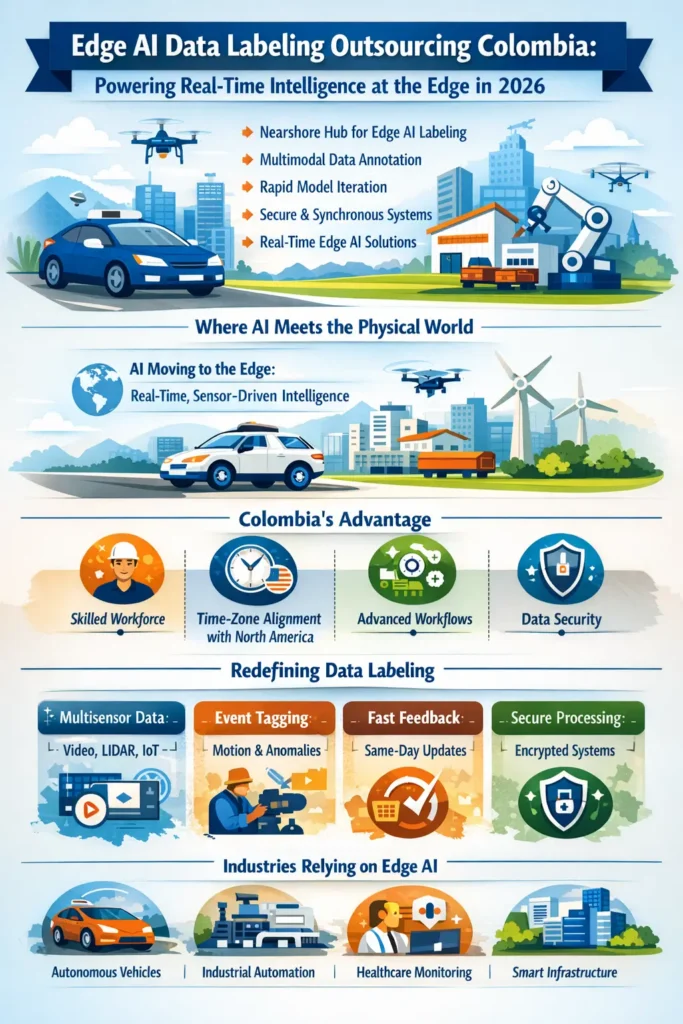
The next phase of artificial intelligence is unfolding outside the cloud. From autonomous vehicles navigating city streets to industrial sensors monitoring production lines, intelligence is being pushed to the edge—closer to where decisions must happen instantly.
This shift has created a new category of data challenges. Edge systems do not rely on static datasets; they depend on continuously evolving streams of information. Training these systems requires data that reflects motion, uncertainty, and environmental complexity.
Colombia has stepped into this space with a distinct advantage. By cultivating a workforce skilled in processing real-world signals rather than static inputs, the country is becoming a preferred nearshore partner for organizations building edge-native AI systems.
Redefining Data Labeling for Real-Time Environments
Conventional annotation workflows were built for images and text. Edge AI demands something far more dynamic. Data arrives in sequences, often from multiple sources at once—video feeds, LiDAR scans, radar signals, and IoT telemetry.
Colombian specialists approach this challenge by treating data as an interconnected system rather than isolated inputs. Their work focuses on aligning signals across time and modality, ensuring that each data point contributes to a coherent representation of reality.
This includes capturing motion patterns, identifying interactions between objects, and labeling transient events that may only appear for milliseconds. Such precision is critical for systems that must react instantly—whether avoiding a collision or detecting a mechanical fault.
The Importance of Timing in Edge Intelligence
Speed defines success in edge AI. Models must not only be accurate but also capable of adapting quickly to new conditions. A delay in updating training data can lead to performance degradation or operational risk.
Colombia’s geographic alignment with North America introduces a practical advantage: teams operate in parallel with engineering units, enabling immediate feedback and rapid adjustments. Instead of waiting overnight for updates, organizations can refine datasets within the same working day.
This responsiveness transforms how AI systems are developed. Continuous iteration becomes the norm, allowing models to evolve alongside the environments they operate in.
As John Maczynski, CEO of Cynergy BPO, notes: “Edge AI is not just about processing data faster—it’s about learning faster. That’s where Colombia creates measurable impact.”
Table 1: Strategic Benefits of Colombian Edge AI Labeling
| Advantage | Technical Capability | Business Outcome |
| Multimodal Annotation | Integration of video, LiDAR, radar, and IoT data | Holistic understanding of real-world environments |
| Sequence-Based Labeling | Tracking events across time | Improved prediction and situational awareness |
| Rapid Iteration Cycles | Same-day feedback and dataset updates | Faster deployment of edge models |
| Context-Aware Tagging | Interpreting environmental and behavioral signals | Higher model reliability in complex scenarios |
| Secure Processing | Encrypted, non-persistent data environments | Protection of distributed and sensitive data |
Designing Data for Constrained Environments
Unlike cloud-based systems, edge devices operate under strict limitations. Processing power, storage capacity, and energy consumption all influence how models are designed and trained.
Colombian annotation teams take these constraints into account from the outset. Their workflows prioritize clarity and relevance, ensuring that datasets are optimized for efficient model performance. Redundant or low-value data is filtered out, while critical features are emphasized.
This approach leads to models that are not only accurate but also efficient—capable of delivering high performance within the limitations of edge hardware.
Table 2: The 2026 Edge AI Data Workflow in Colombia
| Phase | Technical Contribution | Enterprise Value |
| Stream Processing | Handling continuous data inputs from edge devices | Real-time dataset readiness |
| Cross-Sensor Alignment | Synchronizing multiple data sources | Accurate contextual interpretation |
| Event Annotation | Labeling dynamic interactions and anomalies | Enhanced model responsiveness |
| Scenario Identification | Tagging rare or high-risk situations | Improved system resilience |
| Feedback Integration | Updating datasets based on live performance | Continuous learning and adaptation |
| Deployment Validation | Testing against real-world conditions | Reliable edge AI execution |
Distributed Data, Centralized Trust
Edge AI introduces a decentralized data landscape. Information is generated across countless devices, often in sensitive or regulated environments. Managing this complexity requires a security model that is both robust and flexible.
Colombian providers have adopted architectures that prioritize data integrity without compromising accessibility. Annotation is performed within controlled environments where data remains within the client’s ecosystem, reducing exposure while enabling efficient workflows.
This balance between accessibility and security is critical for industries such as healthcare, transportation, and energy—where both speed and compliance are non-negotiable.
Expert FAQs
What distinguishes Edge AI data labeling from traditional methods?
Edge AI labeling focuses on continuous, real-time data streams and requires synchronization across multiple sensors, along with temporal and contextual understanding.
How does Colombia support real-time AI development?
Its time-zone alignment with North America enables immediate collaboration, allowing teams to refine datasets and improve models without delays.
Can Colombian teams handle complex, multi-sensor datasets?
Yes. They are trained to work with integrated data sources such as video, LiDAR, radar, and IoT signals, ensuring cohesive and accurate annotations.
Is data security maintained in edge AI workflows?
Providers use secure, non-persistent environments where data is accessed but not stored locally, ensuring compliance with global data protection standards.
Which sectors rely heavily on Edge AI labeling?
Industries such as autonomous mobility, industrial automation, healthcare monitoring, and smart infrastructure depend on high-quality edge data.
How do teams ensure models remain accurate over time?
Through continuous feedback loops, datasets are refined based on real-world performance, allowing models to adapt to changing conditions.
Share This
Unlock cost-efficient growth with expert BPO guidance!
Partner with Cynergy BPO to connect with top outsourcing providers.
Streamline operations, cut costs, and scale your business with confidence.
Book a Free Call
Ralf Ellspermann - CSO
Author
Ralf Ellspermann is the Chief Strategy Officer (CSO) of Cynergy BPO and a globally recognized authority in business process and contact center outsourcing. With more than 25 years of experience advising enterprises and SMEs, he provides strategic guidance on vendor selection, CX optimization, and scalable outsourcing strategies across global markets. His expertise spans fintech, ecommerce and retail, healthcare, insurance, travel and hospitality, and technology (AI & SaaS) outsourcing.
A frequent speaker at leading industry conferences, Ralf is also a published contributor to The Times of India and CustomerThink, where he shares insights on outsourcing strategy, customer experience, and digital transformation.