



By: Ralf Ellspermann
25-Year, Multi-Awarded BPO Veteran
Published: 31 March 2026
Updated: March 31, 2026
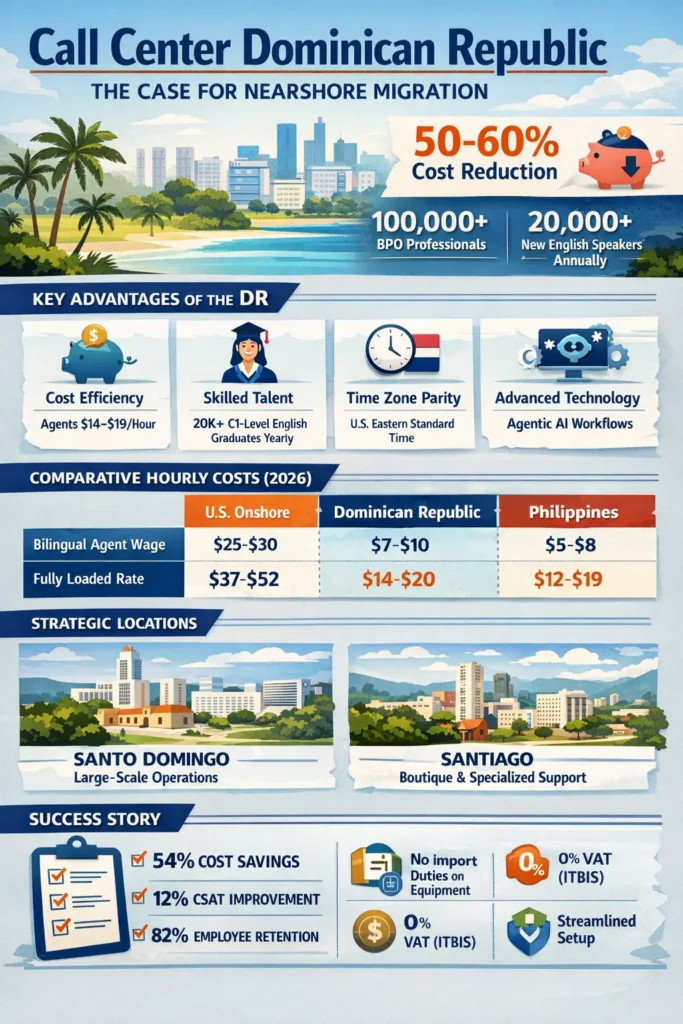
Enterprises are pivoting to the Dominican Republic to capture a 50–60% reduction in operational overhead without the latency or cultural friction of traditional offshore models. With a labor pool of over 100,000 BPO professionals and a tax-neutral regulatory framework under Law 8-90, the country has become the primary destination for high-touch, bilingual customer experience and technical support in the Western Hemisphere.
30-Second Executive Briefing
- Cost Efficiency: Fully loaded hourly rates for Tier-1 bilingual agents sit between $14 and $19, delivering immediate OpEx relief compared to the $35–$55 North American average.
- Talent Pipeline: A government-backed English immersion initiative adds 20,000+ C1-level speakers to the workforce annually, ensuring scalability for seasonal or rapid-growth requirements.
- Fiscal Incentives: Free Trade Zone status grants qualifying BPO entities a 100% exemption from corporate income tax and value-added tax (ITBIS) on exported services.
- Time Zone Parity: Operating primarily on Eastern Standard Time, the region facilitates real-time management and seamless integration with U.S.-based leadership teams.
- Technical Readiness: Top-tier hubs in Santo Domingo and Santiago now utilize Agentic AI workflows, allowing human agents to focus on high-empathy, complex resolution tasks.
The Economic Arbitrage of the Caribbean Hub
Relocating support operations to the Dominican Republic (DR) involves more than just chasing lower wages; it is a play for “Total Cost of Ownership” (TCO) optimization. While some Asian markets offer marginally lower base pay, the DR eliminates the hidden costs of long-haul travel, extreme time zone offsets, and cultural misalignment.
By 2026, the gap between “cheap labor” and “value-driven labor” has widened. Organizations scaling from 50 to 200+ seats find that the ability to conduct “same-day” operational pivots—thanks to shared working hours—directly improves First Call Resolution (FCR) and Net Promoter Scores (NPS) in sensitive sectors like fintech and healthcare.
Comparative Operational Costs (Hourly USD – 2026 Benchmarks)
| Expense Category | U.S. Onshore (Tier 2 City) | Dominican Republic (Nearshore) | Philippines (Offshore) |
| Bilingual Agent Wage | $22.00 – $28.00 | $7.00 – $10.00 | $5.00 – $8.00 |
| Facility & Infrastructure | $8.00 – $12.00 | $3.50 – $5.00 | $3.00 – $4.00 |
| Management & QA | $5.00 – $9.00 | $2.50 – $3.00 | $3.00 – $5.00 |
| Integrated Tech Stack | $2.00 – $3.00 | $1.00 – $2.00 | $1.00 – $2.00 |
| Total Fully Loaded Rate | $37.00 – $52.00 | $14.00 – $20.00 | $12.00 – $19.00 |
Talent Sustainability and the Bilingual Advantage
The Dominican BPO sector has moved past basic “voice” services. The current talent pool is increasingly specialized in medical coding, specialized technical support, and financial underwriting. The English for a Better Life program has standardized a neutral accent across the workforce, which is a critical variable for North American consumers who value seamless communication.
Labor laws in the DR are structured to protect both the worker and the employer, including the Bono de Navidad (13th-month bonus). While these are mandatory, they are factored into the flat hourly rates provided by BPO partners, simplifying budgeting for the parent organization.
Strategic Specialization by Region
- Santo Domingo: The capital is the nexus of the country’s university system. It is best suited for large-scale operations requiring thousands of seats and deep technical or financial expertise.
- Santiago de los Caballeros: Known for a more stable, loyal workforce with lower attrition. Santiago is often the preferred choice for boutique or high-end retail brands looking for long-term agent tenure.
Navigating the Regulatory and Fiscal Landscape
The Free Trade Zone Law (Law 8-90) remains the most significant competitive advantage for the DR. It effectively removes the tax burden from the service provider, allowing those savings to be passed directly to the client.
Key Incentives for 2026 Operations
| Incentive Type | Benefit Detail | Strategic Value |
| Corporate Income Tax | 0% for 15+ years | Maximizes reinvestment in agent training |
| Import Duties | 100% exemption on hardware | Ensures access to the latest CX technology |
| Value Added Tax (ITBIS) | 0% on exported services | Immediate 18% reduction in invoice costs |
| Bureaucratic Speed | Streamlined “One-Stop-Shop” (CNZF) | Accelerates time-to-market for new centers |
Resilience and the 5G Enterprise Standard
Operational continuity in the Caribbean is often a point of scrutiny for risk management teams. In 2026, the Dominican Republic has addressed these concerns through aggressive infrastructure upgrades. The primary BPO corridors are now serviced by redundant subsea fiber-optic entry points—specifically the ARCOS-1 and Columbus networks—providing sub-30ms latency to the United States.
Furthermore, the nationwide rollout of 5G enterprise slicing allows for high-bandwidth work-from-home (WFH) models that maintain the same security protocols as on-site facilities. For U.S. firms, this means a reliable disaster recovery plan is baked into the geography, rather than being a costly secondary add-on.
Case Study: Optimizing Claims Processing for a U.S. Insurtech
The Problem: A New York-based insurance firm saw a 40% spike in domestic labor costs and a 65% agent turnover rate, leading to unacceptable delays in claims processing.
The Solution: The firm transitioned its Tier-1 and Tier-2 claims support to a 120-seat facility in Santiago. They paired local agents with a real-time AI transcription layer to handle simultaneous English and Spanish inquiries.
The Outcome:
- Operational Expenses: Reduced by 54% within six months.
- Customer Satisfaction: CSAT scores climbed 12% due to expanded bilingual coverage.
- Employee Retention: Local turnover dropped to 18%, as these roles are highly coveted in the Dominican market.
High-Utility Integration of Agentic AI
The paradigm of simple “call routing” is obsolete. Modern Dominican centers utilize Agentic AI to automate the “administrative overhead” of a customer interaction—data entry, compliance checks, and CRM logging. This allows the human agent to focus exclusively on resolution and empathy.
Because of the geographic proximity, U.S. managers can frequently visit sites to run agile “human-in-the-loop” training sessions. This ensures the AI models are tuned to the specific linguistic and cultural nuances of the American consumer base, a level of precision that is difficult to achieve with distant offshore teams.
Expert FAQs
How does the turnover rate in the DR compare to other nearshore markets?
The Dominican Republic generally sees 15–25% lower attrition than Mexico or Jamaica. BPO roles are considered stable, middle-class career paths in the DR, which fosters a level of loyalty and professionalism that is harder to find in markets where call center work is seen as transitional.
Can these centers handle HIPAA or PCI-compliant data?
Yes. Major hubs operate within secure Free Trade Zones that meet SOC2 Type II, HIPAA, and PCI-DSS Level 1 standards. Physical and digital security protocols are often more rigorous than those found in domestic U.S. centers.
What is the logistical advantage of the “dual-city” strategy?
Large enterprises often split seats between Santo Domingo and Santiago. This provides built-in disaster recovery and access to two distinct labor markets, ensuring that an event in one city does not jeopardize total operational continuity.
Do the 2026 tax reforms affect international BPO contracts?
No. While the Dominican government has updated domestic consumption taxes, the protections under Law 8-90 for exported services remain intact. The DR continues to be one of the most stable tax-neutral environments for BPO in the region.
Share This
Unlock cost-efficient growth with expert BPO guidance!
Partner with Cynergy BPO to connect with top outsourcing providers.
Streamline operations, cut costs, and scale your business with confidence.
Book a Free Call
Ralf Ellspermann - CSO
Author
Ralf Ellspermann is the Chief Strategy Officer (CSO) of Cynergy BPO and a globally recognized authority in business process and contact center outsourcing. With more than 25 years of experience advising enterprises and SMEs, he provides strategic guidance on vendor selection, CX optimization, and scalable outsourcing strategies across global markets. His expertise spans fintech, ecommerce and retail, healthcare, insurance, travel and hospitality, and technology (AI & SaaS) outsourcing.
A frequent speaker at leading industry conferences, Ralf is also a published contributor to The Times of India and CustomerThink, where he shares insights on outsourcing strategy, customer experience, and digital transformation.