



By: Ralf Ellspermann
25-Year, Multi-Awarded BPO Veteran
Published: 25 April 2026
Updated: April 1, 2026
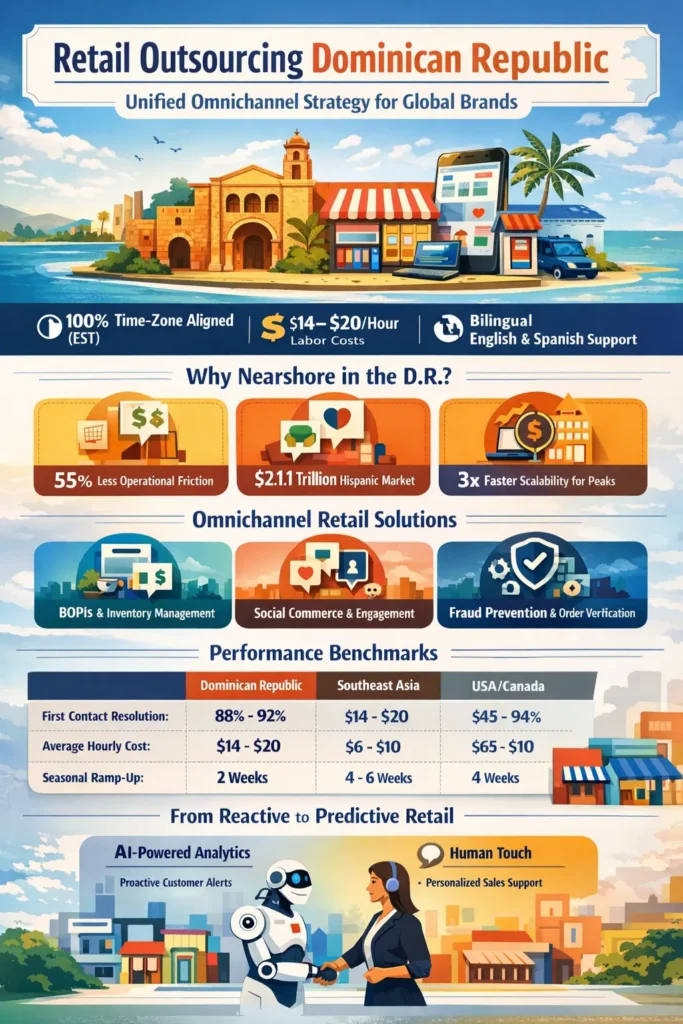
The traditional divide between digital and physical storefronts has vanished, replaced by a mandate for “Unified Commerce.” To maintain this 24/7 synchronization, North American retailers are increasingly moving their high-velocity operations to the Dominican Republic. This nearshore pivot allows brands to manage complex inventory flows, real-time customer success, and localized marketing with the geographic and cultural proximity required to thrive in a “same-day” economy. By leveraging a bilingual, Western-aligned workforce, retail leaders are achieving a 55% reduction in operational friction while significantly elevating their Customer Lifetime Value (CLV).
30-Second Executive Briefing
- Omnichannel Synchronicity: 100% time-zone alignment with the U.S. East Coast ensures real-time updates for “Buy Online, Pick Up In-Store” (BOPIS) and inventory rebalancing.
- Bilingual Customer Growth: Direct access to native-level English and Spanish speakers, essential for capturing the $2.1 trillion U.S. Hispanic consumer market.
- Fiscal Optimization: Realize 50% to 65% savings on labor costs compared to domestic U.S. retail support centers.
- Agile Scaling: Rapid onboarding for seasonal peaks (Black Friday/Cyber Monday) utilizing a “talent bench” strategy unique to the Dominican BPO ecosystem.
- Logistics Coordination: Seamless integration with U.S.-based 3PL providers and carriers, facilitating immediate resolution of “last-mile” delivery exceptions.
Why Retailers are Choosing Nearshore Over Offshore
As we navigate 2026, the “12-hour lag” of offshore centers in Asia has become a critical vulnerability for retailers. Modern consumers expect immediate resolution for “Where is my order?” (WISMO) inquiries and real-time social media interaction. The Dominican Republic offers a “Mirror-Office” environment that operates in the same rhythm as the American consumer.
Dominican professionals bring a “Cultural Fluency” to retail that extends beyond language. They are immersed in the same social trends, holiday cycles, and brand aesthetics as the North American market. This alignment ensures that every customer interaction—whether a live chat about a sizing issue or a complex return authorization—feels local, personalized, and high-touch.
Retail Performance Benchmarks: Dominican Republic vs. Global Alternatives
| Performance Metric | Dominican Republic (Nearshore) | Southeast Asia (Offshore) | Onshore (USA/Canada) |
| First Contact Resolution (FCR) | 88% – 92% | 72% – 78% | 90% – 94% |
| Bilingual Proficiency Score | 9.5/10 | 6.5/10 | 10/10 (High Cost) |
| Average Hourly Op-Cost | $14 – $20 | $6 – $10 | $45 – $75 |
| Seasonal Capacity Ramp-Up | 2 Weeks | 4 – 6 Weeks | 4 Weeks (High Cost) |
| Cultural Brand Alignment | High | Low to Moderate | Native |
High-Impact Specialized Retail Workflows
The Dominican Republic has matured from a simple support center into a specialized hub for “Advanced Retail Intelligence.”
Real-Time Inventory and Marketplace Management
In a world where one “out-of-stock” notification can drive a customer to a competitor, Dominican “Inventory Orchestrators” manage the digital shelf across Amazon, Walmart, and Shopify. They synchronize warehouse data with front-end listings, ensuring that “Available to Promise” (ATP) quantities are accurate to the second. This near-zero latency is only possible when the support team operates during the same business hours as the logistics providers.
Social Commerce and Community Moderation
With “Social Shopping” accounting for nearly 20% of e-commerce sales in 2026, Dominican teams are increasingly acting as “Live-Brand Ambassadors.” They manage high-velocity TikTok and Instagram comments, converting social engagement into direct sales by providing instant product information and link-sharing during viral peaks.
Financial Synergy and Structural Incentives
The Dominican Republic’s Free Trade Zone Law (8-90) remains a cornerstone of the country’s attractiveness, providing a fiscal haven for retail operations that prioritize long-term margin protection.
Projected Annualized Savings: Retail Functional Units (2026)
| Retail Unit | Headcount | Dominican Annual Spend | US Internal Spend | Net Savings |
| Omnichannel CX Center | 20 | $440,000 | $1,100,000 | $660,000 |
| Marketplace Data Ops | 5 | $125,000 | $320,000 | $195,000 |
| Fraud & Risk Mitigation | 3 | $90,000 | $240,000 | $150,000 |
Case Study: Orchestrating an 85% Increase in Mobile Conversion
The Challenge: A national footwear retailer in New York was struggling with a “conversion gap” on its mobile app. Customers were abandoning carts due to unanswered questions about fit and material. Their offshore team in India was unavailable during the peak 6 PM to 10 PM EST shopping window, leading to thousands of lost daily transactions.
The Solution: The retailer moved its “Mobile-First CX” and “Live-Styling” team to a specialized retail hub in Santiago, DR. This team was trained in “Visual Selling,” utilizing video chat to show products in real-time to high-intent shoppers.
The Outcome:
- Conversion: Mobile conversion rate soared by 85% within the first 90 days.
- Average Order Value (AOV): Increased by 12% due to successful cross-selling by the Dominican styling team.
- Operational Speed: The brand achieved a sub-30-second response time during peak hours, significantly reducing cart abandonment.
Predictive Retail and AI-Human Hybrid Support
We are moving into the era of “Predictive Support.” In the Dominican Republic, retail teams are now being trained to use AI-driven analytics to identify at-risk customers before they even reach out. By analyzing browsing behavior and shipping delays, Dominican agents can proactively send personalized discount codes or updates. This “Human-in-the-Loop” strategy ensures that the brand remains proactive rather than reactive, positioning the Dominican Republic as the brain of the modern retail operation.
Expert FAQs
How do Dominican providers manage seasonal spikes like Black Friday? Dominican hubs utilize a “Flexible Burst” model. Because they operate in a mature BPO ecosystem, they can tap into a pre-vetted “seasonal talent pool”—often university students or part-time professionals—who can be activated and trained in specific retail guidelines within 7 to 10 days.
Can Dominican teams manage our physical “Store-to-Store” transfers? Yes. Through integrated ERP systems like Oracle or SAP, Dominican “Logistics Coordinators” monitor regional stock levels and trigger transfers between physical locations to meet local demand. This ensures that a store in Miami never misses a sale because the inventory was “trapped” in a New York warehouse.
What is the “Social CX” capability in the Dominican Republic? Dominican agents are heavy users of Western social media, making them highly effective at managing brand voices on TikTok, Instagram, and Pinterest. They provide native-level engagement that feels authentic to the platform, avoiding the “robotic” tone common in distant offshore locations.
How is payment data (PCI) secured for retail transactions? Reputable Dominican providers operate in “Clean Room” environments that are PCI-DSS Level 1 certified. This means no paper, no pens, and no personal recording devices are allowed on the production floor. All transactions are processed through secure, masked VDIs (Virtual Desktop Infrastructures), ensuring customer credit card data is never visible to the agent.
Share This
Unlock cost-efficient growth with expert BPO guidance!
Partner with Cynergy BPO to connect with top outsourcing providers.
Streamline operations, cut costs, and scale your business with confidence.
Book a Free Call
Ralf Ellspermann - CSO
Author
Ralf Ellspermann is the Chief Strategy Officer (CSO) of Cynergy BPO and a globally recognized authority in business process and contact center outsourcing. With more than 25 years of experience advising enterprises and SMEs, he provides strategic guidance on vendor selection, CX optimization, and scalable outsourcing strategies across global markets. His expertise spans fintech, ecommerce and retail, healthcare, insurance, travel and hospitality, and technology (AI & SaaS) outsourcing.
A frequent speaker at leading industry conferences, Ralf is also a published contributor to The Times of India and CustomerThink, where he shares insights on outsourcing strategy, customer experience, and digital transformation.