



By: Ralf Ellspermann
25-Year, Multi-Awarded BPO Veteran
Published: 1 April 2026
Updated: March 23, 2026
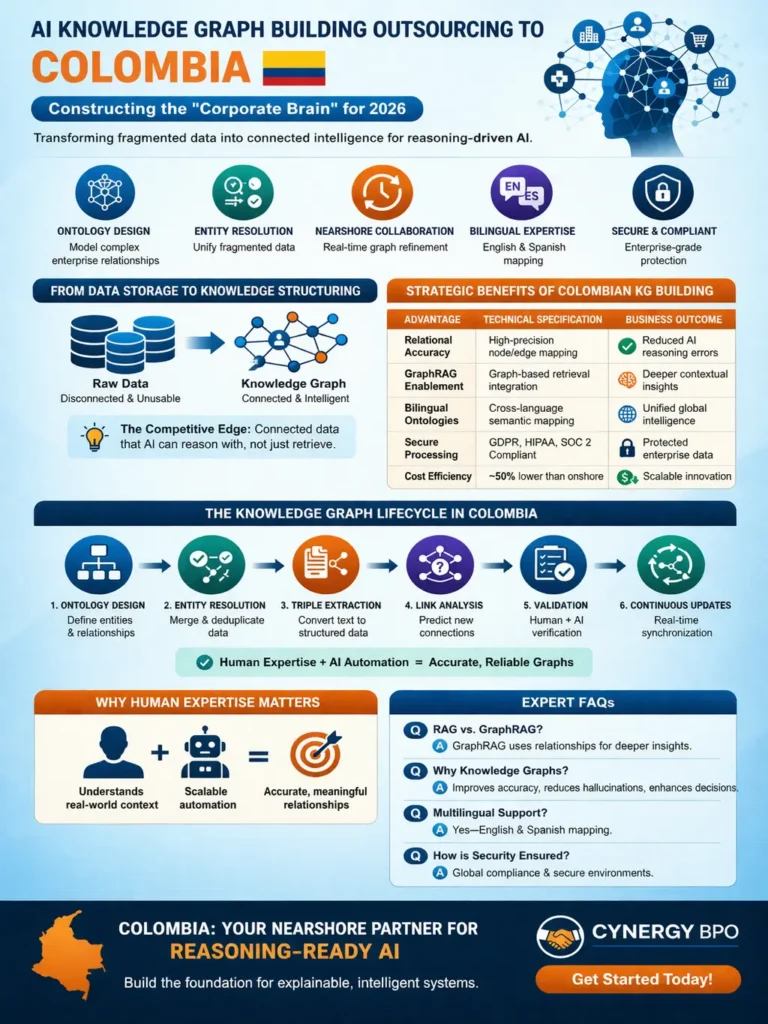
AI Knowledge Graph Building Outsourcing to Colombia has become a foundational capability for enterprises moving toward reasoning-driven AI. In 2026, organizations no longer compete on data volume alone—they compete on how well their systems understand relationships. Colombia has emerged as a nearshore hub where fragmented data is transformed into structured knowledge graphs that power intelligent, explainable, and context-aware AI systems.
- Specialized teams design complex ontologies that map relationships across enterprise data.
- Advanced workflows enable the transition from traditional RAG to GraphRAG architectures.
- Nearshore collaboration supports real-time refinement of semantic models.
- Bilingual expertise ensures consistent mapping across English and Spanish datasets.
- Secure, compliant environments protect sensitive enterprise knowledge assets.
From Data Storage to Knowledge Structuring
Enterprises have accumulated vast amounts of data, but raw information alone does not create intelligence. In 2026, the competitive advantage lies in connecting that data—linking entities, relationships, and context into a coherent structure. Knowledge graphs provide this structure. They allow AI systems to move beyond retrieving isolated facts and instead understand how those facts relate to one another. This enables more accurate decision-making, reduces hallucinations, and improves explainability.
Colombia has positioned itself at the forefront of this shift, offering specialized expertise in building and maintaining these semantic frameworks.
Designing the Foundations of Enterprise Intelligence
At the core of knowledge graph construction is ontology design—the process of defining how entities and relationships are structured. This requires both technical skill and domain understanding.
Colombian teams bring strong capabilities in this area, particularly in industries such as finance, healthcare, and supply chain management. They define schemas that reflect real-world relationships, ensuring that data is organized in a way that supports meaningful analysis.
This work goes beyond categorization. It establishes a shared “language” for enterprise data, enabling systems to interpret information consistently across different applications.
Resolving Data into a Unified View
One of the most complex challenges in knowledge graph building is entity resolution. Organizations often store information across multiple systems, leading to duplication and inconsistency. Colombian specialists address this by identifying and merging related records, creating a unified representation of each entity. This process ensures that data is accurate, consistent, and ready for advanced analysis. By resolving these inconsistencies, enterprises gain a clearer view of their operations, customers, and assets—laying the groundwork for more effective AI systems.
Nearshore Collaboration for Continuous Refinement
Knowledge graphs are not static. They must evolve as new data is introduced and business conditions change. This requires ongoing collaboration between data engineers, domain experts, and AI teams.
Colombia’s time-zone alignment with North America enables this continuous refinement. Teams can update ontologies, adjust relationships, and validate outputs in real time, ensuring that knowledge graphs remain accurate and relevant.
This nearshore model reduces delays and allows organizations to adapt quickly to new requirements, whether driven by regulatory changes or business needs.
Table 1: Strategic Benefits of Colombian KG Building (2026)
| Advantage | Technical Specification | Business Outcome |
| Relational Accuracy | High-precision mapping of nodes and edges | Reduced errors in AI reasoning |
| GraphRAG Enablement | Integration with graph-based retrieval systems | Improved contextual understanding |
| Bilingual Ontologies | Cross-language semantic mapping | Unified intelligence across regions |
| Secure Processing | Compliance with global data protection standards | Protection of sensitive enterprise data |
| Cost Efficiency | ~50% lower than onshore development | Scalable knowledge engineering |
Enabling Advanced AI Architectures
Knowledge graphs play a critical role in modern AI systems, particularly those using Retrieval-Augmented Generation (RAG). By structuring data into interconnected entities, graphs allow models to retrieve information more effectively.
GraphRAG builds on this concept by incorporating relationships directly into retrieval processes. Instead of searching for isolated documents, AI systems can navigate connections between entities, leading to more accurate and context-aware responses.
Colombian teams contribute to this process by ensuring that graphs are both comprehensive and logically consistent, enabling more advanced AI capabilities.
Structuring the Knowledge Graph Lifecycle
Building a knowledge graph involves multiple stages, each contributing to data quality and usability. Colombian providers organize this work into a structured lifecycle:
- Ontology Design: Defining entity types and relationships
- Entity Resolution: Consolidating duplicate or related records
- Triple Extraction: Converting text into structured relationships
- Link Analysis: Identifying connections between entities
- Validation: Ensuring accuracy and consistency
- Continuous Updates: Adapting the graph as data evolves
Table 2: The 2026 Knowledge Graph Lifecycle in Colombia
| Phase | Colombian Contribution | Enterprise Value |
| Ontology Design | Structuring entity relationships | Standardized data frameworks |
| Entity Resolution | Merging duplicate data points | Unified enterprise view |
| Triple Extraction | Converting text into structured data | Automated knowledge creation |
| Link Prediction | Identifying hidden relationships | Discovery of new insights |
| Semantic Validation | Human review of graph logic | Reliable decision-making |
| Dynamic Updates | Real-time graph synchronization | Up-to-date intelligence systems |
Human Expertise in Semantic Engineering
While automation plays a role in knowledge graph construction, human expertise remains essential. Understanding relationships between entities often requires contextual judgment and domain knowledge. Colombian teams provide this expertise, ensuring that graphs reflect real-world logic rather than purely statistical patterns. Their involvement helps prevent errors that could compromise AI performance. By combining machine learning with human validation, enterprises can build knowledge graphs that are both scalable and accurate.
Colombia’s Role in the Future of Intelligent Systems
As organizations adopt more advanced AI systems, the importance of structured knowledge will continue to grow. Knowledge graphs serve as the foundation for systems that require reasoning, explainability, and contextual awareness. Colombia’s combination of skilled talent, nearshore accessibility, and structured workflows positions it as a key player in this space. Its providers deliver the expertise needed to transform data into actionable intelligence.
Through partnerships facilitated by Cynergy BPO, enterprises can access these capabilities at scale—enabling more reliable, efficient, and intelligent AI systems.
Expert FAQs
What is the difference between RAG and GraphRAG?
RAG retrieves relevant documents, while GraphRAG leverages relationships between entities to provide deeper, context-aware insights.
Why are knowledge graphs important for AI?
They structure data in a way that improves accuracy, reduces hallucinations, and enhances decision-making.
Can Colombian teams handle multilingual data?
Yes. Providers specialize in mapping relationships across English and Spanish datasets.
How is data security maintained?
Through secure processing environments that comply with global data protection standards.
Unlock cost-efficient growth with expert BPO guidance!
Partner with Cynergy BPO to connect with top outsourcing providers.
Streamline operations, cut costs, and scale your business with confidence.
Book a Free Call
Ralf Ellspermann - CSO
Author
Ralf Ellspermann is the Chief Strategy Officer (CSO) of Cynergy BPO and a globally recognized authority in business process and contact center outsourcing. With more than 25 years of experience advising enterprises and SMEs, he provides strategic guidance on vendor selection, CX optimization, and scalable outsourcing strategies across global markets. His expertise spans fintech, ecommerce and retail, healthcare, insurance, travel and hospitality, and technology (AI & SaaS) outsourcing.
A frequent speaker at leading industry conferences, Ralf is also a published contributor to The Times of India and CustomerThink, where he shares insights on outsourcing strategy, customer experience, and digital transformation.