



By: Ralf Ellspermann
25-Year, Multi-Awarded BPO Veteran
Published: 22 March 2026
Updated: March 17, 2026
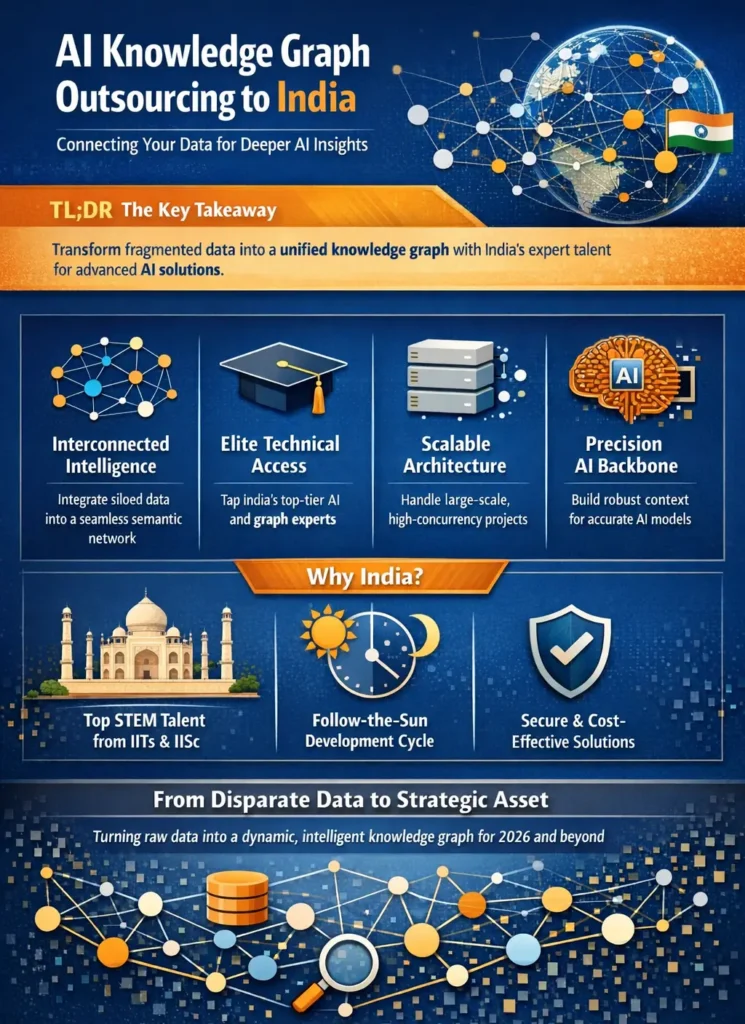
TL;DR: The Key Takeaway
Outsourcing the complex task of AI knowledge graph construction to India provides access to a deep well of specialized talent and a mature technological ecosystem, enabling businesses to transform disconnected data into a powerful, interconnected asset for advanced AI applications.
AI knowledge graph building outsourcing to India enables enterprises to transform fragmented data silos into a unified, semantic network of interconnected entities. By leveraging India’s elite computational linguists and graph database engineers, companies can build the structural “brain” necessary for advanced reasoning, explainable AI, and multi-hop data discovery, ensuring high-fidelity insights in the 2026 AI landscape.
Executive Briefing
- Interconnected Intelligence: Move beyond isolated data points by utilizing Indian expertise to map intricate relationships, creating a cohesive semantic web of your enterprise information.
- Elite Technical Access: Tap into a specialized workforce from premier institutions like the IITs, possessing deep mastery in ontology design, RDF/OWL, and graph architectures.
- Scalable Architecture: Leverage the Indian IT-BPM sector’s capacity to manage massive, high-concurrency data projects, ensuring your graph expands seamlessly as your data grows.
- Precision AI Backbone: A professionally engineered knowledge graph serves as the essential context layer for LLMs and machine learning, reducing hallucinations and improving model accuracy.
- Accelerated Innovation: Utilize the “follow-the-sun” development cycle provided by the subcontinent’s time zone, effectively doubling the pace of your AI roadmap execution.
Executive Summary
In the current race for cognitive dominance, global enterprises are realizing that superior AI is a product of deeply interconnected data rather than just sheer volume. This realization has made AI knowledge graph building outsourcing to India a critical pillar of modern data strategy. By distilling disorganized information into a queryable, logic-based network of entities and links, these graphs provide the contextual intuition models need to infer and predict with precision. Choosing to outsource this complex architecture to the South Asian tech corridor grants immediate access to an ecosystem defined by technical rigor and mature process governance. Companies partnering with elite Indian firms transform their data from a static archive into a dynamic, self-evolving engine. This shift is fundamental for organizations aiming to pioneer the next generation of autonomous and intelligent solutions in 2026.
Weaving the Fabric of AI: The Strategic Value of Knowledge Graphs
The digital universe is expanding at a staggering velocity, yet raw information remains a dormant asset until its relationships are fully understood. The true value of data is realized when disparate points are woven into a structured web of context. This is the primary mission of a knowledge graph: it functions as a cognitive framework for AI, allowing machines to understand the world through semantic relationships rather than just statistical patterns. It transcends simple storage, creating a living representation of a domain where entities, properties, and the logic binding them are explicitly defined. For the modern enterprise, this enables the ability to solve complex, multi-layered queries and power sophisticated tools like predictive fraud detection and autonomous drug discovery.
Developing such a sophisticated asset is a massive multidisciplinary challenge. It requires a specialized blend of data scientists, semantic web experts, and ontologists. The process involves surgical data extraction, entity resolution, and the creation of formal ontologies that govern how information is interpreted. Because of the resource-heavy nature of this work, strategic outsourcing has become the preferred path for leaders. By collaborating with a specialized partner, organizations bypass the immense costs and time-consuming hurdles of building internal teams, significantly accelerating their path to “deep data” insights.
India’s Ascendancy in High-Stakes AI Data Services
The landscape of Indian outsourcing has undergone a total metamorphosis, moving far beyond basic support into high-value intellectual services. Today, the nation is a global nerve center for artificial intelligence development. The country’s strengths in knowledge graph construction are anchored by its unparalleled human capital. With millions of STEM graduates produced annually, and elite schools like the Indian Institute of Science (IISc) serving as global benchmarks for computer science, the talent pool is exceptionally deep. These professionals are fluent in the specialized languages of the semantic web and the mechanics of graph databases like Neo4j and TigerGraph.
This human expertise is backed by a resilient digital infrastructure and a professional culture that prioritizes quality and security. The Indian IT-BPM sector brings decades of experience in managing high-complexity global projects, providing a level of process maturity that ensures reliable delivery. This combination of technical brilliance, cost efficiency, and English proficiency makes the subcontinent the undisputed leader for AI knowledge graph building outsourcing to India.
Strategic Comparison: Knowledge Graph Development
| Capability | Internal Development | Outsourcing to India | The Strategic Advantage |
| Talent Acquisition | Fierce competition; long hiring cycles for niche roles. | Immediate access to pre-vetted AI and semantic experts. | Speed: Reduces setup time from months to weeks. |
| Financial Model | Heavy fixed costs; benefits and training overhead. | Variable, project-based pricing; significant OpEx savings. | Flexibility: Converts capital risk into predictable costs. |
| Scalability | Slow and disruptive to expand or shrink teams. | Rapid, on-demand scaling to match project phases. | Agility: Resource allocation mirrors project needs. |
| Strategic Focus | Internal focus is diverted from core product innovation. | Frees leadership to concentrate on growth and differentiation. | Focus: Ensures internal talent stays on primary goals. |
From Disparate Data to Strategic Asset: The Transformation Process
The evolution from siloed data to an enterprise-wide knowledge graph is a meticulous, iterative journey. When firms engage in AI knowledge graph building outsourcing to India, they tap into a refined methodology that treats data as a craft. The initial stage is a deep discovery phase where experts map every potential source, from legacy databases to unstructured public web feeds. This leads to the critical ontology design—the blueprint that defines entity types like “Product,” “Location,” or “Customer” and the verbs that connect them.
Once the architecture is set, technical execution begins via a sophisticated pipeline of ETL processes and NLP-driven extraction. Advanced algorithms are used for entity disambiguation, ensuring the system can distinguish between two distinct entities with similar names. Throughout this cycle, continuous quality assurance ensures the graph remains a faithful mirror of the real-world domain. The final product is a “living” data fabric that grows more intelligent with every new piece of information, providing a durable edge in a 2026 economy where context is the most valuable currency.
“We are moving past the era of ‘big data’ into a period defined by ‘deep data,'” states John Maczynski, CEO of Cynergy BPO. “A knowledge graph is the ultimate expression of this transition. Storing information isn’t enough; you must understand the web of connections. By outsourcing these structures to India, companies aren’t just saving money—they are acquiring the foundational intelligence layer that will drive their most advanced AI for the next decade.”
Intelligence Arbitrage and Governance in a Global Model
Partnering with Indian firms for graph development is a prime example of “Intelligence Arbitrage.” This isn’t about finding cheaper labor; it’s about accessing a dense concentration of specialized intellectual capital that is difficult to find elsewhere. The collaborative cycle enabled by the time zone gap acts as a force multiplier—US teams can hand off requirements at 5 PM and return to a completed sprint the next morning. This continuous development model is a massive accelerator for complex AI projects.
However, success in a global model requires uncompromising governance. Top-tier Indian providers operate under world-class security standards, including ISO 27001 and GDPR. A robust partnership includes clear protocols for data handling and intellectual property protection, usually managed by a joint steering committee. This ensures that while the technical heavy lifting happens in India, the strategic control and security remain firmly in the client’s hands.
Knowledge Graph Maturity Levels
- Level 1: Nascent – Initial data linking via manual scripts. The graph is small, siloed, and error-prone.
- Level 2: Emerging – A formal ontology is introduced. The system integrates multiple sources and supports complex queries for specific departments.
- Level 3: Defined – An enterprise-wide canonical ontology is established. Automated data pipelines serve multiple business units with high-quality, governed data.
- Level 4: Optimized – The graph is the heart of the AI strategy. It uses machine learning to self-heal and autonomously discover new relationships in real-time.
Expert FAQs
How does a knowledge graph differ from a standard SQL database?
A relational database is built on rigid tables, which is perfect for transactions but slow for complex relationships. A knowledge graph uses a network of nodes and edges, making it infinitely better at discovering non-obvious connections and answering “multi-hop” questions that would paralyze a traditional database.
What skills are essential for an Indian graph building team?
You should look for experts in Semantic Web languages (RDF, OWL, SPARQL) and NLP specialists who can extract meaning from unstructured text. Experience with graph-specific tools like Amazon Neptune or TigerGraph is non-negotiable, alongside a strong background in data governance.
How is my intellectual property (IP) protected?
In any reputable agreement, the client retains 100% ownership of the ontology, the database, and the code. Contracts are backed by strong NDAs and international security certifications like ISO 27001, ensuring your proprietary logic remains yours.
Can these graphs handle real-time data updates?
Yes. Modern knowledge graphs are designed as dynamic assets. Using streaming pipelines like Kafka, they can ingest and link new data as it happens. This is vital for 2026 applications like real-time fraud detection and personalized recommendation engines.
Share This
Unlock cost-efficient growth with expert BPO guidance!
Partner with Cynergy BPO to connect with top outsourcing providers.
Streamline operations, cut costs, and scale your business with confidence.
Book a Free Call
Ralf Ellspermann - CSO
Author
Ralf Ellspermann is the Chief Strategy Officer (CSO) of Cynergy BPO and a globally recognized authority in business process and contact center outsourcing. With more than 25 years of experience advising enterprises and SMEs, he provides strategic guidance on vendor selection, CX optimization, and scalable outsourcing strategies across global markets. His expertise spans fintech, ecommerce and retail, healthcare, insurance, travel and hospitality, and technology (AI & SaaS) outsourcing.
A frequent speaker at leading industry conferences, Ralf is also a published contributor to The Times of India and CustomerThink, where he shares insights on outsourcing strategy, customer experience, and digital transformation.