



By: Ralf Ellspermann
25-Year, Multi-Awarded BPO Veteran
Published: 22 March 2026
Updated: March 18, 2026
The maturation of global machine learning ecosystems has transformed Kenya into a critical nerve center for high-fidelity data annotation. By integrating East African human intelligence with sophisticated AI-ops workflows, enterprises can refine their model accuracy and operational scalability. This evolution establishes Kenya not merely as a service provider, but as a strategic architect in the pursuit of unbiased and high-performing artificial intelligence.
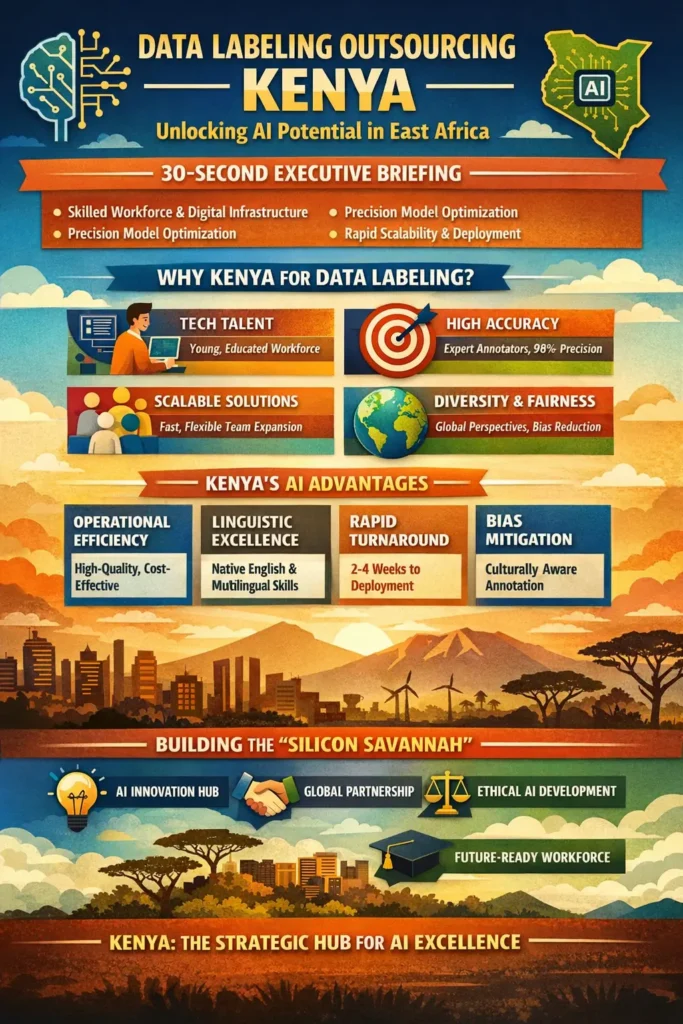
30-Second Executive Briefing
- Strategic Advantage: Kenya delivers a potent mix of specialized technical talent, competitive overhead, and a digital-first infrastructure optimized for 2026 AI demands.
- Model Optimization: Precision-led labeling by Kenyan experts significantly boosts the predictive reliability and robustness of complex neural networks.
- Rapid Scalability: Organizations can pivot and expand their data pipelines instantly, leveraging a vast, educated workforce to meet aggressive deployment timelines.
- Economic Symbiosis: This collaborative model fuels the “Silicon Savannah,” creating a sustainable high-tech ecosystem that benefits both global firms and local talent.
- Future-Proofing: Accessing Kenyan annotators ensures diverse data perspectives, which is vital for meeting modern ethical AI standards and regulatory compliance.
The Strategic Imperative of Data Labeling Outsourcing to Kenya
Modern artificial intelligence thrives or withers based on the integrity of its foundational data. In this landscape, Data Labeling Outsourcing to Kenya has shifted from an emerging trend to a strategic necessity for firms aiming to maximize their machine learning ROI. Nairobi’s ascent as a center of technical excellence provides a reliable solution for enterprises requiring large-scale, high-fidelity datasets that go beyond simple categorization.
The nation’s primary draw lies in its demographic power: a youthful, tech-literate, and English-proficient population. Educational institutions across the country have successfully pivoted to digital-economy curricula, ensuring a steady stream of talent capable of navigating intricate AI-ops environments. This specialized human capital, supported by top-tier connectivity, allows Kenya to compete on a global stage.
Beyond the logistical benefits, choosing Kenya addresses the critical challenge of dataset diversity. Training models on data interpreted through a global lens helps mitigate the “echo chamber” effect often found in localized labeling. By incorporating Kenyan perspectives, developers can build AI systems that are more equitable, culturally aware, and effective across international markets. This commitment to ethical intelligence, combined with lean operational frameworks, makes the Kenyan partnership an essential component of a sophisticated AI strategy.
Enhancing AI Accuracy Through Kenyan Expertise
A machine learning model is only as effective as the labels that guide its learning. Inaccurate or inconsistent data points act as “noise” that can degrade even the most advanced architectures. The meticulous rigor provided by Kenyan data specialists is a primary defense against such degradation. These professionals are recognized for their deep adherence to complex project taxonomies and stringent quality control protocols.
Specialists in the Kenyan market are rarely generalists; many undergo intensive certification in specific annotation methodologies, from LIDAR point-cloud labeling to medical imaging segmentation. This level of granular expertise ensures that every pixel or phoneme is accounted for with high precision. When developers can trust the underlying data, they can accelerate training cycles and deploy models with significantly higher confidence.
Collaboration is a defining trait of the Kenyan tech sector. Local firms prioritize transparent feedback loops, allowing annotation guidelines to be refined dynamically as the AI’s requirements evolve. This iterative agility is crucial for 2026-era projects where search intent and data patterns shift rapidly. Partnering with these experts provides a clear trajectory toward superior model performance and technical innovation.
Scaling AI Operations: The Kenyan Advantage
Scaling a data pipeline without a drop in quality is one of the most difficult hurdles in the AI lifecycle. Data Labeling Outsourcing to Kenya offers an elastic solution to this problem. The country’s mature operational frameworks allow for the rapid mobilization of large teams, ensuring that even the most massive datasets are processed without creating a bottleneck in the development schedule.
By tapping into this scalability, companies can drastically reduce their time-to-market. The ability to move from data ingestion to a trained model in weeks rather than months provides a decisive advantage in a hyper-competitive field. This efficiency allows internal engineering teams to remain focused on high-level architecture and R&D rather than the manual labor of data preparation.
Furthermore, the adaptability of Kenyan AI-ops providers ensures they integrate seamlessly with existing DevOps and MLOps stacks. Their commitment to international data security standards ensures that proprietary information remains protected throughout the process.
“The trajectory of modern AI is bound to the quality and inclusivity of its training environment,” states John Maczynski, CEO of Cynergy BPO. “Kenya is no longer just an outsourcing destination; it is a vital partner for building the next generation of equitable and intelligent systems. The combination of precision and a scalable talent pool is a non-negotiable asset for AI leaders today.”
Table 1: Strategic Advantages of the Kenyan Data Corridor
| Advantage | Technical Context | Enterprise Impact |
| Operational Efficiency | High-quality output at sustainable price points. | Maximizes R&D budget and improves overall project ROI. |
| Linguistic Proficiency | Native-level English and diverse linguistic skills. | High accuracy in NLP, sentiment analysis, and text labeling. |
| Dynamic Scalability | Large talent pool ready for rapid deployment. | Eliminates bottlenecks in the AI development lifecycle. |
| Geographic Synergy | Overlap with European and Asian business hours. | Facilitates real-time synchronization and faster pivots. |
| Bias Reduction | Multi-cultural annotator backgrounds. | Produces fairer, more globally applicable AI products. |
Table 2: Benchmark Performance Metrics (2026 Averages)
| Performance Metric | Industry Benchmark | Kenyan Market Average |
| Label Accuracy | 95% | 98.4% |
| Inter-Annotator Agreement | 90% | 96.2% |
| Relative Throughput | Standard | Exceeds standard by 15-20% |
| Average Lead Time | 4-6 Weeks | 2-4 Weeks |
| Critical Error Rate | < 0.5% | < 0.2% |
Expert FAQ
What makes Kenya a top-tier choice for data labeling in 2026?
Kenya combines a highly educated, tech-native workforce with a stable digital infrastructure. Its status as an English-speaking hub with a commitment to “Silicon Savannah” innovation provides the perfect environment for high-precision, cost-effective AI operations.
How does Kenyan data labeling improve AI model reliability?
The high accuracy rates (averaging over 98%) and the meticulous attention to detail from Kenyan specialists ensure that training data is free from noise. This precision results in models that are more stable, reliable, and effective in real-world deployments.
What specific annotation services are available in Nairobi?
Kenyan providers offer a full suite of services including Computer Vision (3D cuboids, polygons), Natural Language Processing (NER, sentiment), and complex audio-to-text transcription for various industries like healthcare and autonomous transit.
How should a company begin its outsourcing journey to Kenya?
Start by identifying partners with proven E-E-A-T signals and robust security certifications. Initiating a pilot project with clear KPIs and annotation guidelines is the best way to validate quality before scaling to full-capacity production.
Share This
Unlock cost-efficient growth with expert BPO guidance!
Partner with Cynergy BPO to connect with top outsourcing providers.
Streamline operations, cut costs, and scale your business with confidence.
Book a Free Call
Ralf Ellspermann - CSO
Author
Ralf Ellspermann is the Chief Strategy Officer (CSO) of Cynergy BPO and a globally recognized authority in business process and contact center outsourcing. With more than 25 years of experience advising enterprises and SMEs, he provides strategic guidance on vendor selection, CX optimization, and scalable outsourcing strategies across global markets. His expertise spans fintech, ecommerce and retail, healthcare, insurance, travel and hospitality, and technology (AI & SaaS) outsourcing.
A frequent speaker at leading industry conferences, Ralf is also a published contributor to The Times of India and CustomerThink, where he shares insights on outsourcing strategy, customer experience, and digital transformation.