



By: Ralf Ellspermann
25-Year, Multi-Awarded BPO Veteran
Published: 2 April 2026
Updated: March 25, 2026
Audio annotation outsourcing in El Salvador has matured into a specialized discipline focused on speech clarity, intent recognition, and conversational nuance.
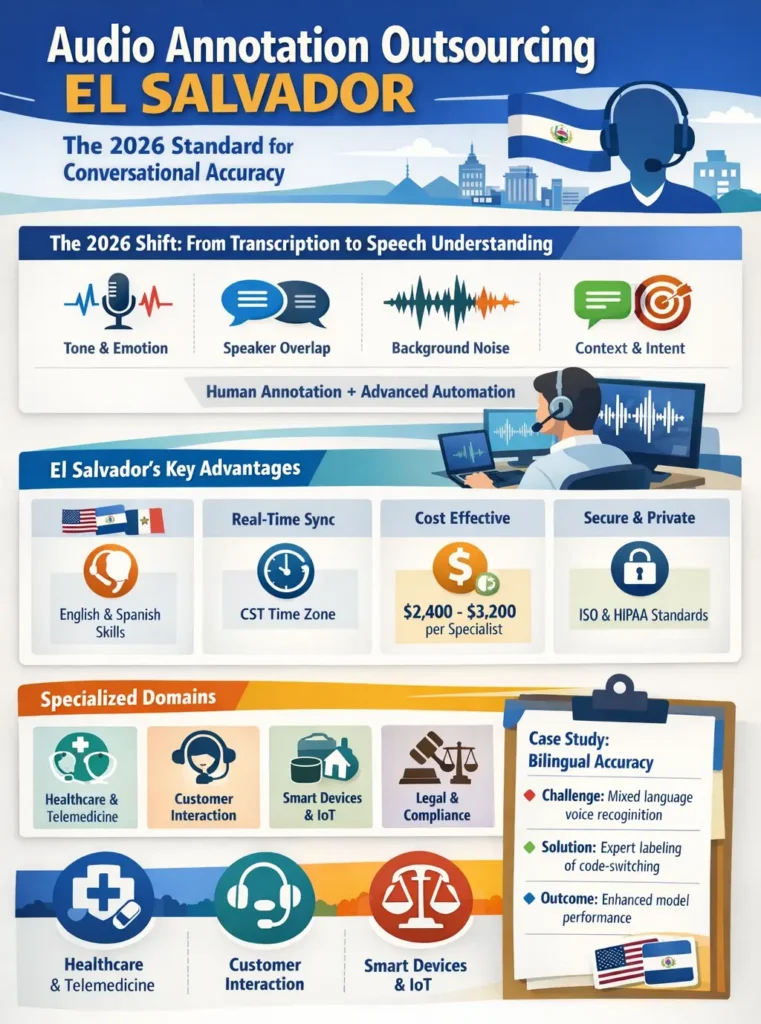
In 2026, training voice systems requires far more than transcription. Modern models depend on tone, timing, speaker interaction, and contextual meaning—elements that demand careful human interpretation alongside automated tooling.
El Salvador has become a nearshore hub for this work by combining linguistic versatility, real-time collaboration, and controlled processing environments, supporting the development of reliable voice-driven systems.
30-Second Executive Briefing
- Advanced Audio Labeling: Teams handle phonetic transcription, speaker separation, intent tagging, and emotional cues within conversations.
- Bilingual Strength: Strong English and Spanish capabilities support code-switching, regional dialects, and mixed-language datasets.
- Real-Time Alignment: CST overlap allows for same-day calibration between product teams and annotation workflows.
- Stable Delivery Model: Fully loaded monthly costs typically range from $2,400 to $3,200 per specialist, supporting predictable scaling.
- Secure Processing: Controlled environments ensure sensitive voice data is handled with strict privacy safeguards.
The 2026 Shift: From Transcription to Speech Understanding
Audio annotation has moved beyond capturing words.
In 2026, voice datasets must reflect:
- Tone and emotion
- Speaker overlap and interruptions
- Background noise and acoustic conditions
- Contextual meaning within conversations
This transforms annotation into a speech interpretation process, where accuracy depends on understanding not just what is said—but how and why it is said.
El Salvador supports this shift through teams trained to:
- Identify subtle vocal patterns
- Distinguish overlapping speakers
- Interpret conversational intent
2026 Benchmark Comparison: Accuracy in Voice Data
Voice AI performance is closely tied to the quality of annotated training data—especially in terms of error rates and contextual accuracy.
| Metric | El Salvador (Nearshore) | Philippines/India (Offshore) | US Domestic |
| Fully Loaded Monthly Cost | $2,400 – $3,200 | $1,800 – $2,500 | $7,000 – $10,000 |
| Bilingual Capability | High | Moderate | Native |
| Word Error Rate (WER) | Low | Moderate | Low |
| Time Zone Alignment | CST (Real-Time) | +12–14 Hours Lag | Native |
| Context Interpretation | High | Moderate | High |
| Security Standards | ISO / HIPAA / GDPR-aligned | Variable | Tier 1 |
Lower transcription error rates and better contextual tagging improve downstream performance for voice assistants and analytics systems.
The Modern Audio Annotation Workflow
Audio annotation in 2026 is built on a layered approach combining automation with human review.
| Stage | System Role | Human Role (El Salvador Team) |
| Pre-Transcription | Initial speech-to-text output | Correction and refinement |
| Speaker Identification | Automated diarization | Validation and adjustment |
| Context Tagging | Keyword detection | Intent and sentiment labeling |
| Acoustic Filtering | Noise detection | Interpretation of sound conditions |
| QA Review | Consistency checks | Final validation |
This structure ensures both efficiency and interpretive accuracy.
Infrastructure: Built for High-Fidelity Audio Processing
Audio annotation requires environments optimized for clarity, focus, and data security.
Technical Environment (2026)
| Component | Capability | Impact |
| Acoustic Setup | Sound-controlled workspaces | Clear audio interpretation |
| Hardware | High-quality headphones and interfaces | Detection of subtle sound variations |
| Connectivity | Stable high-speed networks | Seamless streaming of large audio files |
| Security | Encrypted access environments | Protection of sensitive recordings |
| Work Model | Controlled on-site delivery | Compliance with strict data requirements |
These environments allow teams to work with high-resolution audio without distortion or interference.
Vertical Specialization: Key Audio Annotation Domains
El Salvador’s annotation teams are structured around specialized use cases, improving both speed and quality.
Healthcare & Telemedicine
- Clinical conversation transcription
- Medical dialogue structuring
Customer Interaction Analysis
- Call center recordings
- Intent and sentiment tagging
Smart Devices & IoT
- Wake word detection
- Environmental sound classification
Legal & Compliance
- Court recordings and depositions
- Multi-speaker transcription with high accuracy
Case Study: Improving Bilingual Voice Recognition
The Challenge:
A technology company struggled with voice recognition accuracy when users switched between languages mid-conversation.
The Approach:
A nearshore audio annotation team in El Salvador was deployed to:
- Label bilingual conversations
- Capture switching patterns between languages
- Refine intent classification models
The Outcome:
- Recognition accuracy improved significantly
- Model performance stabilized across mixed-language inputs
- Development cycles accelerated through faster feedback
Key Insight:
Understanding conversational context proved more valuable than increasing transcription volume.
Strategic Implementation: Building Reliable Voice Datasets
Focus on Context, Not Just Words
Ensure annotation captures:
- Tone
- Intent
- Speaker interaction
This improves real-world model performance.
Enable Continuous Feedback
Nearshore collaboration allows:
- Rapid guideline updates
- Immediate correction of inconsistencies
- Faster iteration cycles
Combine Automation with Human Review
Use automated tools for:
- Initial transcription
- Pattern detection
Rely on human expertise for:
- Context interpretation
- Final validation
Frequently Asked Questions (FAQs)
Can teams handle bilingual and mixed-language audio?
Yes. Many teams are experienced in handling conversations that shift between languages within the same interaction.
How is transcription accuracy maintained?
Through layered QA processes, continuous feedback, and specialized training in linguistic nuance.
Can non-speech sounds be labeled as well?
Yes. Teams can classify environmental sounds and background noise for various applications.
How is sensitive audio data protected?
Secure environments and controlled access systems ensure recordings remain protected throughout processing.
What makes El Salvador effective for audio annotation?
Its combination of linguistic versatility, real-time collaboration, and structured workflows supports accurate and reliable voice data preparation.
Share This
Unlock cost-efficient growth with expert BPO guidance!
Partner with Cynergy BPO to connect with top outsourcing providers.
Streamline operations, cut costs, and scale your business with confidence.
Book a Free Call
Ralf Ellspermann - CSO
Author
Ralf Ellspermann is the Chief Strategy Officer (CSO) of Cynergy BPO and a globally recognized authority in business process and contact center outsourcing. With more than 25 years of experience advising enterprises and SMEs, he provides strategic guidance on vendor selection, CX optimization, and scalable outsourcing strategies across global markets. His expertise spans fintech, ecommerce and retail, healthcare, insurance, travel and hospitality, and technology (AI & SaaS) outsourcing.
A frequent speaker at leading industry conferences, Ralf is also a published contributor to The Times of India and CustomerThink, where he shares insights on outsourcing strategy, customer experience, and digital transformation.