



By: Ralf Ellspermann
25-Year, Multi-Awarded BPO Veteran
Published: 27 April 2026
Updated: April 1, 2026
As the Banking, Financial Services, and Insurance (BFSI) sector confronts the high-stakes digital landscape of 2026, the Dominican Republic has transitioned from a supporting role to a core strategic pillar. For North American institutions, this nearshore destination offers the rare trifecta of regulatory convergence, bilingual technical talent, and zero-latency execution. By moving beyond commoditized data entry into “High-Value Knowledge Process Outsourcing” (KPO), Dominican hubs are enabling banks and insurers to navigate complex “Basel IV” and “IFRS 17” requirements while reducing operational burn by half.
30-Second Executive Briefing
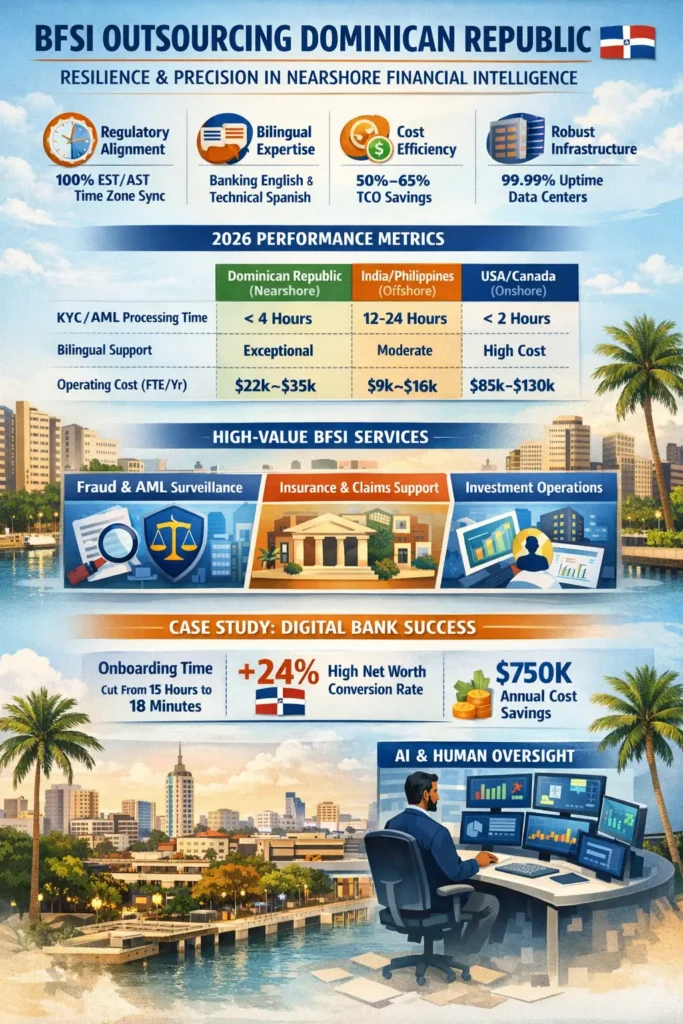
- Regulatory Synchronization: 100% time-zone alignment (EST/AST) ensures real-time reporting for SEC, FINRA, and NAIC compliance cycles.
- Linguistic Parity: Access to a workforce with native-level “Banking English” and “Technical Spanish,” critical for the $2.5 trillion U.S. Hispanic financial market.
- Operational Savings: Average TCO reduction of 50% to 65% compared to domestic U.S. captive centers.
- Infrastructure Resilience: Tier-III data centers and dual-generator redundancies in Santo Domingo ensure 99.99% uptime for mission-critical trading and claims platforms.
- Cybersecurity Compliance: Operations aligned with SOC 2 Type II, HIPAA, and PCI-DSS Level 1 standards within secure Free Trade Zones.
The BFSI Nearshore Pivot: Why Proximity is the New Security
In the 2026 BFSI environment, “Standard Offshore” models—defined by 12-hour delays—have become a structural risk. In a market where a fraud alert or a margin call must be addressed in milliseconds, the Dominican Republic provides an Integrated Synchronous Office. Dominican professionals function as a real-time extension of the onshore team, participating in morning stand-ups and resolving exceptions before the markets close.
The Dominican workforce brings a “Cultural Financial Mirror” to the table. Dominican analysts are immersed in a Western-centric fiscal culture, understanding U.S. credit structures, insurance subrogation, and investment vehicles far more intuitively than distant offshore agents. This reduces the “Training Tax” and ensures that high-context decisions are made with North American consumer behavior in mind.
2026 BFSI Performance Metrics: Dominican Republic vs. Global Alternatives
| Performance Metric | Dominican Republic (Nearshore) | India/Philippines (Offshore) | Onshore (USA/Canada) |
| KYC/AML Processing Time | < 4 Hours | 12 – 24 Hours | < 2 Hours |
| Bilingual Support Quality | Exceptional | Moderate | High Cost |
| Operating Cost (FTE/Yr) | $22k – $35k | $9k – $16k | $85k – $130k |
| Data Integrity Score | 99.4% | 95.8% | 99.6% |
| Cultural Sync Score | High | Low to Moderate | Native |
High-Complexity BFSI Workflows in the Caribbean
Dominican service providers have evolved into “Specialized Tech-Pods” that handle the most sensitive layers of the financial lifecycle.
Fraud Mitigation and AML Surveillance
As synthetic identity fraud escalates, Dominican “Trust & Safety” teams have specialized in Active Forensic Auditing. They supervise AI-driven fraud detection models, performing the deep-dive investigations required for Suspicious Activity Reports (SARs). Operating in the same time zone as the U.S. Treasury, these teams trigger immediate freezes on fraudulent accounts, drastically reducing “Value at Risk” (VaR).
Technical Claims and Underwriting Support
In the insurance vertical, Dominican hubs provide “Full-Cycle Adjudication.” This includes:
- Medical Bill Review: Utilizing CPT/ICD-10 expertise to flag overbilling in U.S. healthcare claims.
- Property Underwriting: Analyzing satellite imagery and historical data to support P&C risk selection.
- Subrogation Recovery: Pursuing third-party liabilities to protect the carrier’s loss ratio.
Fiscal Framework and Capital Efficiency
The Dominican Republic’s Law 8-90 provides an aggressive fiscal sanctuary, allowing BFSI firms to operate with 100% tax exemptions on export services. This capital can then be reallocated toward AI-driven digital transformation and customer acquisition.
Projected Annualized Savings: BFSI Functional Units
| BFSI Function | Team Size | Dominican Annual Spend | US Internal Spend | Net Savings |
| Compliance & KYC Desk | 12 | $290,000 | $820,000 | $530,000 |
| Investment Ops (Middle Office) | 6 | $185,000 | $510,000 | $325,000 |
| Insurance Adjudication | 8 | $195,000 | $480,000 | $285,000 |
Case Study: Optimizing Onboarding for a Top-10 Digital Bank
The Challenge: A leading U.S. neobank was experiencing a 35% abandonment rate during its high-net-worth (HNW) onboarding process. Their offshore team in Southeast Asia lacked the linguistic nuance and time-zone availability to handle complex document verifications in real-time.
The Solution: The bank transitioned its “VIP Onboarding & Compliance” unit to a specialized BFSI hub in Santo Domingo. The team was integrated into the bank’s secure VDI environment and given direct authority to clear “Level 2” AML flags during U.S. business hours.
The Outcome:
- Onboarding Velocity: Average time-to-account dropped from 15 hours to under 18 minutes.
- Conversion: HNW completion rates increased by 24%, resulting in an additional $1.2B in Assets Under Management (AUM) within six months.
- Cost Impact: Achieved a $750,000 reduction in annual compliance overhead while maintaining a perfect audit trail for Federal regulators.
Financial AI: Oversight at the Edge of Automation
Financial systems are entering a phase where automation must operate under constant human supervision. In the Dominican Republic, BFSI analysts are being upskilled into AI calibration roles—overseeing Large Language Models (LLMs) that manage customer inquiries, risk screening, and preliminary underwriting.
These specialists intervene when confidence thresholds drop—resolving “ambiguity exceptions” that automated systems cannot confidently interpret. By combining real-time model supervision with domain expertise, this approach preserves the speed of automated workflows while maintaining the judgment, compliance awareness, and risk control required in modern financial operations.
Expert FAQs
How do Dominican providers ensure compliance with the Gramm-Leach-Bliley Act (GLBA)?
Tier-1 Dominican providers implement “Zero-Trust” architectures. Staff work in “Clean Room” environments where personal devices and paper are prohibited. Data never resides on local servers in the DR; it is accessed via encrypted, view-only Virtual Desktop Infrastructure (VDI), ensuring that Non-Public Personal Information (NPI) remains within the client’s U.S.-based secure perimeter.
Can Dominican teams manage complex actuarial or risk modeling tasks?
Yes. The workforce includes university graduates from strong mathematics and economics programs. While high-level strategy usually remains onshore, Dominican “Model Support Units” handle the data aggregation, scrubbing, and preliminary back-testing required for modern risk models.
How does the Dominican Republic handle “Spanglish” or code-switching in banking?
It is a primary competitive advantage. Dominican agents are uniquely equipped to support the “Code-Switching” consumer—individuals who may start a mortgage application in English but prefer to discuss complex escrow terms in Spanish. This cultural agility is essential for capturing the burgeoning U.S. Hispanic wealth segment.
What is the “Disaster Recovery” protocol for the DR’s BFSI operations?
Modern facilities are built to seismic and hurricane-proof standards with redundant power and fiber loops. Furthermore, most providers offer “Geographic Redundancy,” allowing work to be shifted instantly between Santo Domingo and Santiago hubs in the event of a regional disruption, ensuring zero downtime for trading or claims processing.
Share This
Unlock cost-efficient growth with expert BPO guidance!
Partner with Cynergy BPO to connect with top outsourcing providers.
Streamline operations, cut costs, and scale your business with confidence.
Book a Free Call
Ralf Ellspermann - CSO
Author
Ralf Ellspermann is the Chief Strategy Officer (CSO) of Cynergy BPO and a globally recognized authority in business process and contact center outsourcing. With more than 25 years of experience advising enterprises and SMEs, he provides strategic guidance on vendor selection, CX optimization, and scalable outsourcing strategies across global markets. His expertise spans fintech, ecommerce and retail, healthcare, insurance, travel and hospitality, and technology (AI & SaaS) outsourcing.
A frequent speaker at leading industry conferences, Ralf is also a published contributor to The Times of India and CustomerThink, where he shares insights on outsourcing strategy, customer experience, and digital transformation.