



By: Ralf Ellspermann
25-Year, Multi-Awarded BPO Veteran
Published: 27 April 2026
Updated: April 1, 2026
As North American enterprises confront the accelerated pace of technological change in 2026, the Dominican Republic is taking on a more strategic role in technology outsourcing. No longer limited to staff augmentation, the country now operates as a high-context delivery hub—supporting cloud-native engineering, cybersecurity operations, and generative AI deployment at scale.
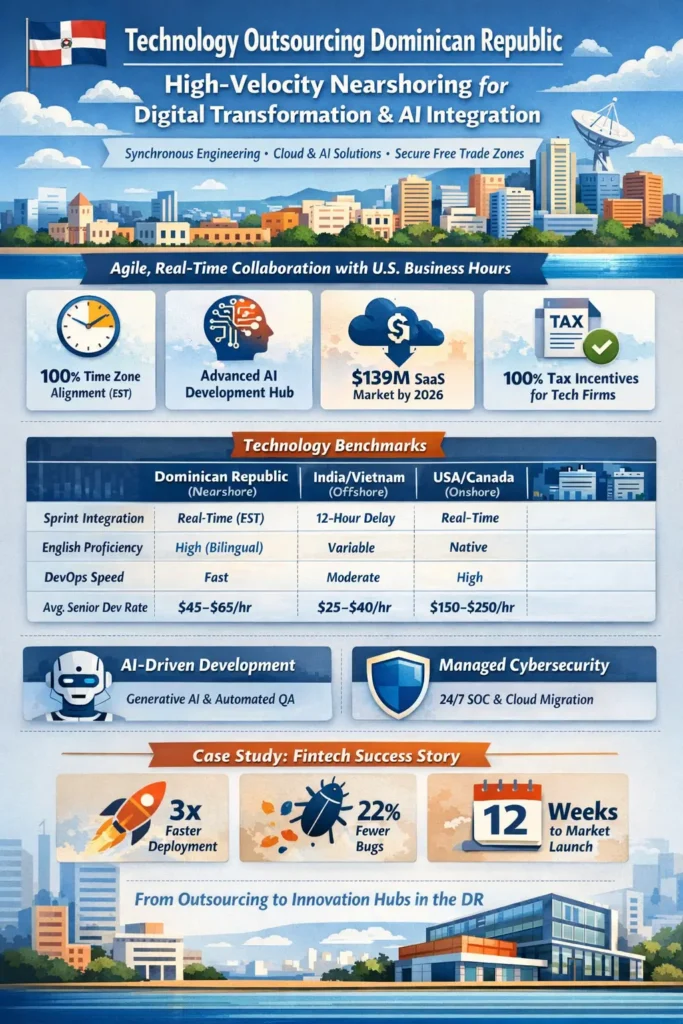
Backed by initiatives like Agenda Digital 2030 and a workforce fluent in modern development frameworks, Dominican teams are embedded directly into product and infrastructure roadmaps. This integration enables faster build-test-release cycles—often reducing deployment timelines by up to 40%—while maintaining full synchronization with Western business hours.
30-Second Executive Briefing
- Development Synchronicity: 100% time-zone alignment (EST/AST) enables seamless Agile and DevOps integration with zero communication latency.
- Specialized Talent Growth: Proactive government programs like Semilleros Digitales have flooded the market with developers skilled in Python, Go, Rust, and AI-prompt engineering.
- Cloud & SaaS Dominance: Rapid adoption of managed cloud services, with the local SaaS market projected to exceed $139M in 2026.
- Fiscal Incentives: 100% tax exemptions under Law 8-90 for technology exporters operating in secure Free Trade Zones.
- National AI Strategy (ENIA): A state-backed framework that prioritizes ethical AI development, data sovereignty, and public-private R&D incubators.
The Tech Nearshore Pivot: Why Synchronous Innovation Trumps Offshore Volume
In 2026, the “Standard Offshore” model—relying on overnight handoffs to teams in Asia or Eastern Europe—is failing to meet the demands of real-time digital products. The Dominican Republic provides Synchronous Engineering, where developers in Santo Domingo participate in the same morning stand-ups and Slack channels as your onshore architects.
This proximity eliminates “Contextual Drift.” Dominican tech professionals are immersed in the same digital ecosystem as the U.S. market, using the same SaaS tools and following the same UX/UI trends. This cultural alignment ensures that code isn’t just “functional” but is built with a deep understanding of the end-user’s expectations.
Technology Benchmarks: Dominican Republic vs. Global Tech Hubs
| Performance Metric | Dominican Republic (Nearshore) | India/Vietnam (Offshore) | Onshore (USA/Canada) |
| Sprint Integration | Real-Time (EST) | 12-Hour Delay | Real-Time |
| English Proficiency | High (Bilingual Tech) | Variable | Native |
| DevOps Lifecycle Speed | High (Synchronous) | Moderate | High |
| Average Senior Dev Rate | $45 – $65/hr | $25 – $40/hr | $150 – $250/hr |
| SaaS/Cloud Adoption | Aggressive | Moderate | Mature |
High-Density Technology Workflows
Dominican service providers have evolved from general IT support into specialized “Engineering Pods” that drive core digital transformation.
AI-Driven Software Development and QA
The Dominican Republic’s National AI Strategy (ENIA) has fostered a hub for AI-Augmented Programming. Teams in Santiago and Santo Domingo are increasingly utilizing Generative AI tools to accelerate code generation, while human experts focus on “Logic Auditing” and architectural integrity. This hybrid approach allows for the rapid scaling of complex web and mobile applications without sacrificing security.
Managed Cybersecurity and Cloud Governance
With 97% of mobile connections in the DR now broadband-capable (3G/4G/5G), the country has built a robust foundation for Managed Security Service Providers (MSSPs). These teams offer:
- 24/7 SOC Monitoring: Real-time threat detection synchronized with U.S. business hours.
- Cloud Migration & Optimization: Moving legacy systems to AWS, Azure, or GCP with a focus on cost-governance (FinOps).
- Identity & Access Management (IAM): Implementing Zero-Trust architectures for distributed workforces.
Fiscal Framework and Strategic Scaling
The Dominican government has declared the technology sector a “high national priority,” particularly in emerging fields like semiconductors and microelectronics. Under Presidential Decree 324-24, the country is actively diversifying its tech ecosystem to become a resilient link in the global supply chain.
Projected Annualized Savings: Tech Functional Units (2026)
| Tech Function | Team Size | Dominican Annual Spend | US Internal Spend | Net Savings |
| Full-Stack Development | 5 | $285,000 | $850,000 | $565,000 |
| Cloud Ops & Security | 3 | $165,000 | $420,000 | $255,000 |
| QA & Automation Pod | 4 | $140,000 | $340,000 | $200,000 |
Case Study: Accelerating SaaS Deployment for a Fintech Disruptor
The Challenge: A Silicon Valley fintech startup was struggling with a 6-month backlog for its new “Embedded Finance” module. Their offshore team in Europe was causing bottlenecks due to a 7-hour time difference, leading to fragmented communication and slow bug-resolution cycles.
The Solution: The startup moved its core “Sprint Team” to a dedicated tech hub in Santo Domingo. This team, comprised of 6 senior React and Python developers, was integrated directly into the company’s Jira and GitHub environments, operating on a 100% EST schedule.
The Outcome:
- Velocity: The feature backlog was cleared in under 3 months.
- Quality: Bug-density decreased by 22% due to real-time collaboration between QA and Dev.
- Market Impact: The company launched its module 12 weeks ahead of schedule, securing an early-mover advantage in the competitive U.S. retail market.
From Outsourcing to “Global Capability Centers” (GCCs)
We are entering the era of the GCC. Rather than transactional outsourcing, companies are establishing permanent “Innovation Outposts” in the Dominican Republic. These centers allow firms to retain greater control over their IP and company culture while benefiting from the DR’s cost-efficiency and talent pool. With the government offering streamlined “one-stop shop” registration for tech investors, setting up a Dominican tech hub has never been more accessible.
Expert FAQs
How does the Dominican Republic handle Intellectual Property (IP) protection?
IP protection is governed by the CAFTA-DR agreement, which aligns Dominican laws with U.S. standards. Additionally, tech providers typically utilize Virtual Desktop Infrastructure (VDI) to ensure that code never resides on a local machine in the DR, staying entirely within the client’s secure cloud perimeter.
Can Dominican developers handle niche languages like Rust or Go?
Yes. The Semilleros Digitales and various university partnerships have specifically focused on “Future-Proof” languages. As a result, the DR has a higher per-capita concentration of developers skilled in modern, memory-safe languages compared to many older, legacy-focused offshore hubs.
What is the “Hybrid Delivery” model in DR technology outsourcing?
Many firms use a “Staff Augmentation” model where a Dominican “Pod” reports directly to a U.S.-based CTO. This hybrid approach combines the strategic oversight of onshore leadership with the execution speed and cost-efficiency of the nearshore team.
Is the infrastructure reliable enough for mission-critical software?
Absolutely. The country features multiple redundant subsea fiber-optic cables and Tier-III data centers. With the national electricity grid being modernized and a 25% renewable energy goal for 2025, the DR offers the stability required for 99.99% uptime in high-stakes technology environments.
Share This
Unlock cost-efficient growth with expert BPO guidance!
Partner with Cynergy BPO to connect with top outsourcing providers.
Streamline operations, cut costs, and scale your business with confidence.
Book a Free Call
Ralf Ellspermann - CSO
Author
Ralf Ellspermann is the Chief Strategy Officer (CSO) of Cynergy BPO and a globally recognized authority in business process and contact center outsourcing. With more than 25 years of experience advising enterprises and SMEs, he provides strategic guidance on vendor selection, CX optimization, and scalable outsourcing strategies across global markets. His expertise spans fintech, ecommerce and retail, healthcare, insurance, travel and hospitality, and technology (AI & SaaS) outsourcing.
A frequent speaker at leading industry conferences, Ralf is also a published contributor to The Times of India and CustomerThink, where he shares insights on outsourcing strategy, customer experience, and digital transformation.