


By: Ralf Ellspermann
25-Year, Multi-Awarded BPO Veteran
Published: 20 April 2026

Reviewed By: John Maczynski
Former EVP, World's Largest Contact Center
Updated: 20 April 2026
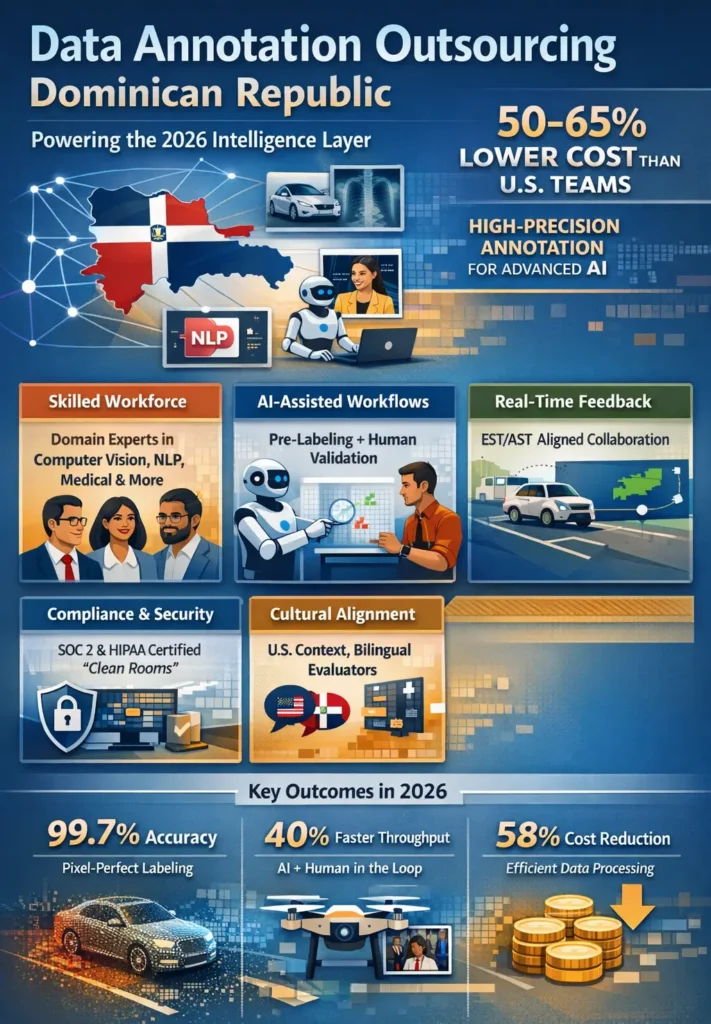
The Dominican Republic has quickly advanced into a high-precision hub for data annotation outsourcing, evolving far beyond basic image tagging to support complex, multimodal AI training. As of March 2026, it operates as a nearshore extension of North American AI teams that require culturally aligned, highly accurate “ground truth” data within secure, real-time feedback environments. With a 50–65% cost advantage over U.S. teams, the DR is now a critical link in the global AI supply chain.
30-Second Executive Briefing
- Cost Efficiency: Fully loaded rates of $13–$19/hour enable scalable annotation for LLM tuning and computer vision workloads.
- Specialized Workforce: Talent has shifted toward domain-specific labeling, including medical imaging, legal text, and autonomous systems data.
- AI-Augmented Workflows: Pre-labeling tools combined with human validation increase throughput by up to 40% without compromising accuracy.
- Real-Time Iteration: EST/AST alignment supports continuous feedback loops between U.S. data scientists and annotation teams.
- Compliance-Ready: Facilities operate under SOC2 Type II and HIPAA standards, ensuring secure handling of sensitive data.
The DataOps Framework: Continuous Precision Through Embedded Feedback
Data annotation in the Dominican Republic has shifted from a discrete task to a tightly integrated DataOps function. Teams now operate inside model development cycles, contributing directly to dataset iteration, validation, and refinement in real time.
This Human-in-the-Loop (HITL) approach transforms how edge cases are handled. Instead of being flagged and delayed, ambiguous or high-risk data points are escalated to trained specialists who combine technical fluency with North American contextual awareness. The outcome is cleaner training data, stronger model performance, and a measurable reduction in downstream errors.
2026 Annotation Capability & Cost Benchmarks
| Annotation Vertical | Use Case Focus | DR Hourly Rate | U.S. Onshore Rate | Accuracy Benchmark |
| Computer Vision | 3D point cloud, LiDAR, video | $14 – $18 | $45 – $65 | 99.7% pixel-level |
| NLP & LLM Tuning | RLHF, sentiment, intent tagging | $12 – $16 | $40 – $55 | High contextual accuracy |
| Medical Data | Radiology, pathology, ECG | $22 – $35 | $75 – $130 | SME-validated |
| Audio / Multimodal | Phonetics, dialect, AV sync | $13 – $17 | $35 – $50 | Bilingual precision |
Secure-by-Design Infrastructure: The “Clean Room” Standard for Data Integrity
Given the sensitivity of AI training data, Dominican providers operate within tightly governed environments engineered for strict data protection and intellectual property control. Security is not an added layer—it is embedded into the operational architecture.
The prevailing standard is data non-persistence, where annotators interact with datasets through secure virtual desktop infrastructures (VDI) with zero local storage or download capability. Access is session-based, monitored, and fully auditable. This model enables compliance with stringent privacy frameworks while ensuring that sensitive data never leaves the controlled environment, making it suitable for high-risk, regulated workloads.
Technical & Security Benchmarks
| System Layer | Specification | Impact on AI Development |
| Connectivity | Redundant subsea fiber (PCCS, ARCOS-1) | Low-latency streaming for large datasets |
| Security | Zero-trust architecture, biometric access | Secure handling of sensitive data |
| Annotation Platforms | AI-assisted labeling systems | Increased speed and consistency |
| Network Resilience | 5G enterprise + satellite backup | Stable throughput for distributed teams |
Cultural Alignment in RLHF and Model Evaluation
Reinforcement Learning from Human Feedback (RLHF) has become a cornerstone of modern AI development. Models require human evaluators who understand language nuance, tone, and cultural context.
Dominican annotators bring strong alignment with U.S. communication patterns, making them effective in evaluating outputs for both accuracy and appropriateness. This is particularly important for bilingual datasets, where code-switching and cultural references must be interpreted correctly.
Their ability to identify subtle inconsistencies improves model behavior across real-world use cases.
Case Study: Accelerating Autonomous Delivery Systems
The Challenge:
A Silicon Valley company developing autonomous drones needed 1 million frames of LiDAR and video annotated at 99.5% accuracy within 60 days.
The Solution:
The company partnered with a specialized team in Santo Domingo using a pre-annotation workflow, where machine-generated labels were refined by human experts focusing on complex edge cases.
The Outcome:
- Delivery Speed: Completed 10 days ahead of schedule
- Accuracy: Achieved 99.8% IoU
- Cost Reduction: Lowered data preparation costs by 58%
This approach allowed the company to accelerate development timelines while maintaining strict quality standards.
Regulatory Environment and Investment Stability
The Dominican Republic’s Free Trade Zone framework under Law 8-90 provides a stable foundation for AI-related services. Data annotation operations qualify as high-tech service exports, benefiting from full tax exemptions.
This structure allows providers to invest in advanced infrastructure, including GPU-enabled workstations and specialized training programs, ensuring long-term competitiveness in AI data services.
Expert FAQs
Can Dominican teams handle multimodal annotation projects?
Yes. Teams are equipped to manage combined text, image, audio, and video annotation, delivering fully synchronized datasets for advanced AI models.
How is bilingual nuance handled in NLP projects?
Annotators are typically fluent in both English and Spanish, allowing them to accurately interpret mixed-language inputs and cultural context.
Does AI reduce the need for human annotators?
AI assists with pre-labeling, but human experts remain essential for validation and handling complex data. Their role has shifted toward higher-value tasks.
Are there specialized hubs for medical data annotation?
Yes. Santiago has developed a strong focus on healthcare-related annotation, supported by a pipeline of medically trained professionals.
How secure are annotation environments in the DR?
Providers use virtualized environments with strict access controls, ensuring that sensitive data is never stored locally and remains fully protected.
Share This
Unlock cost-efficient growth with expert BPO guidance!
Partner with Cynergy BPO to connect with top outsourcing providers.
Streamline operations, cut costs, and scale your business with confidence.
Book a Free Call
Ralf Ellspermann - CSO
Author
Ralf Ellspermann is the Chief Strategy Officer (CSO) of Cynergy BPO and a globally recognized authority in business process and contact center outsourcing. With more than 25 years of experience advising enterprises and SMEs, he provides strategic guidance on vendor selection, CX optimization, and scalable outsourcing strategies across global markets. His expertise spans fintech, ecommerce and retail, healthcare, insurance, travel and hospitality, and technology (AI & SaaS) outsourcing.
A frequent speaker at leading industry conferences, Ralf is also a published contributor to The Times of India and CustomerThink, where he shares insights on outsourcing strategy, customer experience, and digital transformation.