



By: Ralf Ellspermann
25-Year, Multi-Awarded BPO Veteran
Published: 21 April 2026
Updated: April 1, 2026
To achieve high-precision computer vision at scale, North American AI firms are shifting video annotation workflows to the Dominican Republic. This nearshore strategy couples 40%–60% labor cost reductions with a Western-aligned, bilingual workforce and minimal latency. By leveraging the country’s robust Free Trade Zone infrastructure, developers secure the sub-millisecond feedback loops essential for iterative model training.
30-Second Executive Briefing
- Cost Efficiency: Average operational savings of 45% to 60% compared to US-based internal labeling teams.
- Latency & Time Zone: 100% overlap with EST/AST, enabling real-time QA and same-day sprint iterations for Agile ML teams.
- Infrastructure: Tier-1 connectivity in Santo Domingo and Santiago, with internet penetration in business districts hitting 100% and speeds exceeding 100 Mbps.
- Talent Scalability: A bilingual workforce (65% of agents) supports complex metadata tagging and natural language description for video-language models.
- Security Compliance: Increasing adoption of ISO/IEC 27001 standards within Dominican BPO hubs to meet stringent US data privacy requirements.
The Nearshore Advantage: Why the Dominican Republic is Winning the Data Race
As global demand for data labeling approaches a projected $25.4 billion by the end of 2026, the “nearshore” model has moved from a convenience to a competitive necessity. For video annotation—a task significantly more complex than static image tagging due to the temporal dimension—the Dominican Republic offers a unique synthesis of geographic proximity and technical readiness.
Unlike offshore hubs in Southeast Asia, the Dominican Republic operates in the same time zone as the East Coast of the United States. In the context of “human-in-the-loop” (HITL) machine learning, this eliminates the 12-hour feedback delay that often stalls model deployment. Engineers in San Francisco or New York can conduct live calibration sessions with Dominican annotation leads, ensuring that edge cases—such as occlusions in autonomous driving footage or micro-gestures in behavioral AI—are addressed in real-time.
Comparative Operational Metrics: Dominican Republic vs. Traditional Hubs
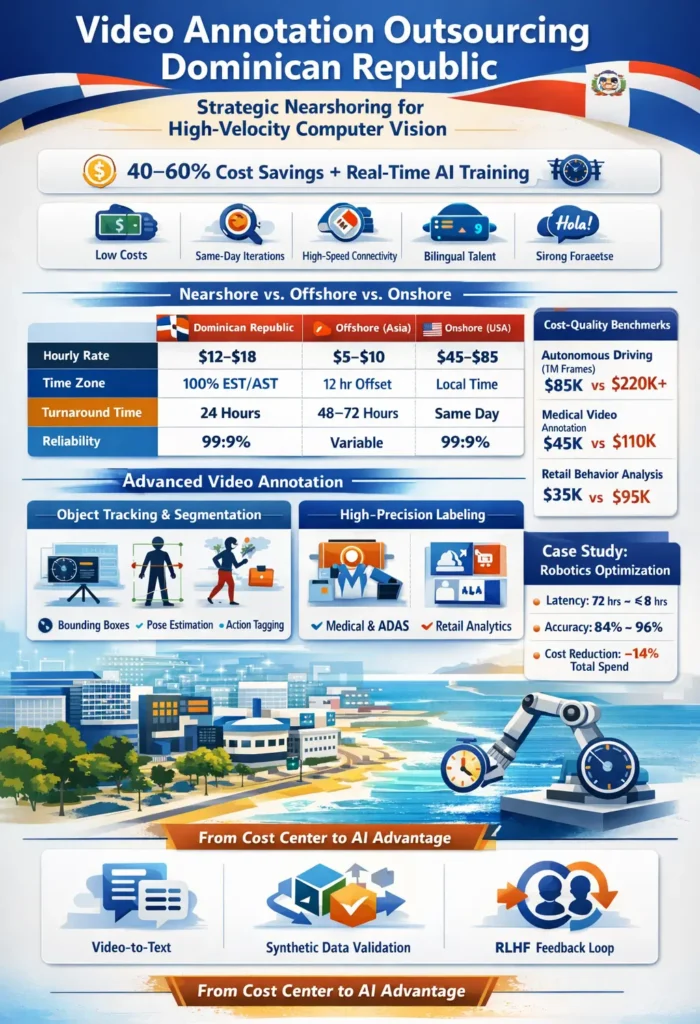
| Metric | Dominican Republic (Nearshore) | India/Philippines (Offshore) | Onshore (USA/Western Europe) |
| Hourly Rate (Blended) | $12 – $18 | $5 – $10 | $45 – $85 |
| Time Zone Alignment | 100% (EST/AST) | 0% – 20% | 100% |
| Cultural/Linguistic Sync | High (US-aligned) | Moderate | High |
| Turnaround Time (Sprints) | Same-day / 24 hrs | 48 – 72 hrs | Same-day |
| Connectivity Reliability | 99.9% (Fiber-heavy) | Variable | 99.9% |
Technical Precision in Video Annotation Workflows
Video annotation is not a singular task; it is a multi-layered process involving spatial and temporal data. Dominican providers have specialized their service offerings to handle the high-throughput requirements of 2026-era AI models.
Temporal Consistency and Object Tracking
One of the primary challenges in video data is maintaining a “consistent ID” for an object across thousands of frames. If a pedestrian disappears behind a tree and reappears, the annotator must ensure the model recognizes it as the same entity. Dominican teams utilize interpolated bounding boxes and polygons, where human expertise validates the pathing generated by AI-assisted tools. This hybrid approach increases throughput by 35% without sacrificing the precision required for safety-critical applications.
Semantic Segmentation and Action Recognition
For gesture-based controls and retail analytics, simple boxes are insufficient. Local centers are increasingly tasked with:
- Polygon Annotation: Tracing irregular shapes for pixel-level accuracy.
- Keypoint Labeling: Marking joint positions for human pose estimation.
- Temporal Tagging: Identifying the exact start and end points of specific actions (e.g., a “slip and fall” in a surveillance stream).
Financial Impact and Regulatory Incentives
The Dominican government’s “Vision 2030” and the Law 8-90 on Free Trade Zones provide a compelling fiscal framework for AI companies. By operating within these zones, BPO providers enjoy significant tax exemptions, which are passed down to clients as lower contract rates.
The Cost-to-Quality Ratio: 2026 Benchmarks
| Project Type | Volume (Frames/Mo) | Dominican Republic Cost | Est. Internal US Cost |
| Autonomous Driving (ADAS) | 1,000,000 | $85,000 | $220,000+ |
| Medical Imaging Video | 250,000 | $45,000 | $110,000 |
| Retail Behavior Analysis | 500,000 | $35,000 | $95,000 |
Case Study: Optimizing Warehouse Robotics Through Nearshoring
The Challenge: A Silicon Valley robotics firm developing autonomous forklifts struggled with a 72-hour latency gap when using an offshore labeling partner in India. Misidentified “phantom” obstacles were causing model regressions, and the time difference made it impossible for engineers to conduct daily “gold set” reviews.
The Solution: The firm transitioned its 40-person annotation team to a specialized provider in Santo Domingo. This allowed for a 9:00 AM EST daily sync where engineers and annotators reviewed the previous day’s failures.
The Outcome:
- Latency: Reduced from 72 hours to under 8 hours.
- Accuracy: Inter-annotator agreement (IAA) rose from 84% to 96% within three months.
- Cost: While the hourly rate was 20% higher than the previous offshore partner, the reduction in “re-work” and engineering downtime resulted in a 14% net decrease in total project spend.
Future-Proofing Data Pipelines: The Shift to Multimodal and Generative AI Support
As we move deeper into 2026, the requirements for video annotation are evolving beyond simple object detection toward complex multimodal understanding. Dominican Republic service providers are pivoting to meet the demands of Large Video Models (LVMs) and Generative AI, where the task is no longer just “draw a box,” but “describe the intent.”
Reasoning-Based Labeling and Video-to-Text
The current frontier involves Video Question Answering (VQA) and dense captioning. Annotators are now required to write nuanced, timestamped descriptions of causal relationships within a scene—explaining why a driver braked or how a specific industrial tool is being mishandled. The high English proficiency and cultural alignment of the Dominican workforce allow for the creation of high-quality “gold standard” datasets that non-native speakers in other offshore regions often struggle to produce.
Synthetic Data Validation and RLHF
The rise of synthetic video generation has created a secondary need: human verification of AI-generated content. Dominican teams are increasingly deployed for Reinforcement Learning from Human Feedback (RLHF), where they rank the realism and physical accuracy of synthetic video outputs. This creates a critical “virtuous cycle” for North American AI labs:
- Step 1: Use Dominican teams to annotate raw real-world footage.
- Step 2: Train models to generate synthetic variations.
- Step 3: Use the same nearshore teams to audit and refine the synthetic data for edge-case training.
Strategic Transition: From Task-Based to Insight-Based Partnerships
Forward-thinking enterprises are moving away from “per-frame” pricing models toward “output-based” partnerships. In this model, Dominican hubs act as an extension of the client’s internal Data Science team. By integrating directly into Slack or Microsoft Teams environments, these annotators provide immediate qualitative feedback on data drift or labeling ambiguity, effectively functioning as a first-line defense for model integrity.
Expert FAQs
How does the Dominican Republic handle data security for sensitive video datasets? Most high-tier providers in the DR operate within secure physical facilities that prohibit personal devices. Technically, they implement SOC 2 Type II compliance and use VPN-encrypted tunnels to access the client’s annotation platform directly, ensuring no data is stored locally in the Dominican Republic.
Is the workforce capable of handling specialized domains like medical or legal video? Yes. The Dominican Republic has a strong pipeline of university graduates in STEM and healthcare. Many BPO hubs now offer “SME-led labeling,” where medical students or junior doctors oversee the annotation of surgical videos or radiological sequences to ensure clinical accuracy.
What is the typical ramp-up time for a new video annotation project? Due to the established BPO ecosystem, a pilot team of 5–10 annotators can usually be onboarded and trained within 7 to 10 business days. Scaling to a 50+ person team typically requires 3–4 weeks, depending on the complexity of the labeling guidelines.
How does nearshoring in the DR affect AI model “bias” compared to other regions? Cultural proximity to North America is a major benefit. Dominican annotators are often more familiar with US road signs, retail environments, and social cues than offshore teams. This inherent context reduces the “cultural noise” that can inadvertently introduce bias into behavioral or predictive AI models.
Share This
Unlock cost-efficient growth with expert BPO guidance!
Partner with Cynergy BPO to connect with top outsourcing providers.
Streamline operations, cut costs, and scale your business with confidence.
Book a Free Call
Ralf Ellspermann - CSO
Author
Ralf Ellspermann is the Chief Strategy Officer (CSO) of Cynergy BPO and a globally recognized authority in business process and contact center outsourcing. With more than 25 years of experience advising enterprises and SMEs, he provides strategic guidance on vendor selection, CX optimization, and scalable outsourcing strategies across global markets. His expertise spans fintech, ecommerce and retail, healthcare, insurance, travel and hospitality, and technology (AI & SaaS) outsourcing.
A frequent speaker at leading industry conferences, Ralf is also a published contributor to The Times of India and CustomerThink, where he shares insights on outsourcing strategy, customer experience, and digital transformation.