



By: Ralf Ellspermann
25-Year, Multi-Awarded BPO Veteran
Published: 31 March 2026
Updated: March 25, 2026
Data annotation outsourcing in El Salvador has evolved into a critical control layer for AI model performance, where accuracy, consistency, and human oversight directly influence outcomes.
In 2026, annotation is no longer treated as low-skill “labeling work.” It is a high-precision data engineering function, essential for training multimodal systems, improving model alignment, and ensuring compliance in high-risk AI environments.
El Salvador has positioned itself as a nearshore hub for Human-in-the-Loop (HITL) operations, where real-time collaboration and contextual accuracy play a central role in modern AI pipelines.
30-Second Executive Briefing
- High-Fidelity Output: Teams focus on semantic accuracy, edge-case handling, and consistency across datasets, not just speed.
- Real-Time Collaboration: CST alignment enables live feedback loops between data scientists and annotation teams, accelerating iteration cycles.
- AI-Augmented Workflows: Pre-labeling automation reduces manual workload, allowing human annotators to focus on complex and ambiguous cases.
- Domain Expertise: Specialized teams support healthcare imaging, autonomous systems, and LLM training (RLHF).
- Operational Stability: A dollarized environment ensures predictable delivery conditions for long-term AI programs.
Annotation as a Data Integrity Function
Annotation has moved beyond volume-based output.
In 2026:
- AI handles initial labeling and pattern recognition
- Human annotators validate edge cases, ambiguity, and contextual meaning
- Data quality determines model accuracy, bias control, and regulatory compliance
This elevates annotation into a data integrity layer, where errors can propagate across entire systems if not caught early.
El Salvador has adapted to this shift by developing talent capable of:
- Understanding context in language and imagery
- Maintaining consistency across large datasets
- Applying guidelines with precision rather than speed
2026 Benchmark Comparison: Accuracy and Alignment
Modern AI teams evaluate annotation partners based on agreement rates and iteration speed, not just cost.
| Metric | El Salvador (Nearshore) | Southeast Asia (Offshore) | US Domestic |
| Fully Loaded Monthly Cost | $2,400 – $3,200 | $1,800 – $2,500 | $7,500 – $12,000 |
| Inter-Annotator Agreement (IAA) | 92%+ | 75% – 85% | 95%+ |
| Time Zone Alignment | CST (Live Sync) | +12–14 Hours Lag | Native |
| Language & Context Accuracy | High | Moderate | Native |
| Compliance Readiness | SOC2 / HIPAA / ISO | Variable | Tier 1 |
Higher agreement rates and faster feedback loops significantly improve model training efficiency and output quality.
The HITL Model: AI Throughput + Human Precision
The dominant architecture in 2026 is a Human-in-the-Loop annotation system, where AI and human contributors perform distinct roles.
| Function | AI Role | Human Role (El Salvador Team) |
| Initial Labeling | Pre-labeling large datasets | Validation and correction |
| Edge Cases | Flagging anomalies | Resolving ambiguity |
| Semantic Tasks | Pattern recognition | Context interpretation |
| Quality Control | Automated consistency checks | Final QA and adjudication |
| Feedback Loop | Model updates | Guideline refinement |
This approach improves:
- Accuracy
- Speed
- Scalability
Infrastructure: Built for Multimodal Data Operations
Annotation in 2026 requires environments capable of handling high-volume, high-complexity datasets.
Technical Environment
| Component | Capability | Impact |
| Connectivity | High-speed fiber + 5G corridors | Seamless video and sensor data processing |
| Security | Zero-trust access frameworks | Protection of sensitive datasets |
| Compute | Cloud-integrated annotation platforms | Real-time collaboration |
| Power | Renewable + redundant grid | Continuous operations |
| Compliance | International data standards alignment | Audit-ready workflows |
These systems support multimodal annotation workflows, including video, audio, text, and sensor data.
Vertical Specialization: High-Growth Annotation Domains
El Salvador’s annotation workforce is increasingly structured around domain-specific expertise:
Autonomous Systems
- LiDAR and 3D spatial data
- Object tracking and scene understanding
Healthcare AI
- Medical imaging annotation
- Clinical data structuring
Generative AI (RLHF)
- Prompt-response evaluation
- Safety and alignment scoring
Commerce & Media
- Video and image tagging
- Content classification and detection
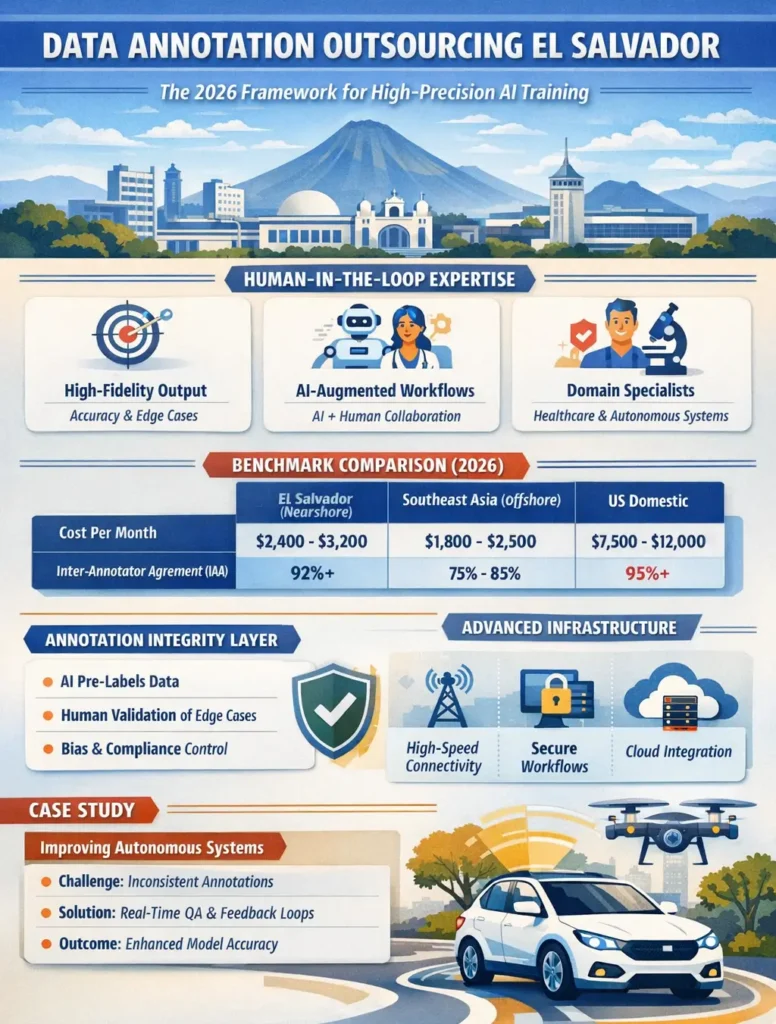
Case Study: Improving Model Accuracy for an Autonomous Systems Firm
The Challenge:
A robotics company faced declining model performance due to inconsistent annotation quality and delayed feedback loops.
The Approach:
A nearshore annotation team in El Salvador was deployed with:
- Real-time communication channels
- Structured QA workflows
- Domain-specific training in spatial data
The Outcome:
- Inter-annotator agreement increased significantly, improving model consistency
- Iteration cycles accelerated, reducing development delays
- Operational efficiency improved, enabling faster deployment timelines
Key Insight:
Speed of feedback and consistency of labeling had a greater impact than raw annotation volume.
Strategic Implementation: Building a High-Precision Annotation Pipeline
Design for Consistency First
Focus on:
- Clear annotation guidelines
- QA validation layers
- Continuous feedback loops
Consistency drives model reliability.
Enable Real-Time Collaboration
Nearshore alignment allows:
- Immediate guideline updates
- Faster issue resolution
- Continuous communication with data teams
This shortens the data-to-model cycle.
Use AI to Amplify Human Expertise
AI should:
- Handle bulk labeling
- Identify anomalies
- Pre-process datasets
Humans should:
- Interpret nuance
- Validate edge cases
- Refine outputs
Frequently Asked Questions (FAQs)
What types of annotation projects are best suited for El Salvador?
Projects requiring contextual understanding—such as NLP, multimodal datasets, and high-accuracy labeling—benefit most.
How does nearshore alignment improve AI development?
It enables real-time feedback loops, allowing data scientists to refine datasets quickly and efficiently.
Can teams handle complex multimodal datasets?
Yes. Many providers support combined workflows involving text, video, audio, and sensor data.
How is data security managed?
Secure environments, controlled access systems, and compliance frameworks ensure safe handling of sensitive data.What differentiates El Salvador from offshore annotation hubs?
Its strength lies in higher contextual accuracy, faster iteration cycles, and stronger alignment with North American teams.
Share This
Unlock cost-efficient growth with expert BPO guidance!
Partner with Cynergy BPO to connect with top outsourcing providers.
Streamline operations, cut costs, and scale your business with confidence.
Book a Free Call
Ralf Ellspermann - CSO
Author
Ralf Ellspermann is the Chief Strategy Officer (CSO) of Cynergy BPO and a globally recognized authority in business process and contact center outsourcing. With more than 25 years of experience advising enterprises and SMEs, he provides strategic guidance on vendor selection, CX optimization, and scalable outsourcing strategies across global markets. His expertise spans fintech, ecommerce and retail, healthcare, insurance, travel and hospitality, and technology (AI & SaaS) outsourcing.
A frequent speaker at leading industry conferences, Ralf is also a published contributor to The Times of India and CustomerThink, where he shares insights on outsourcing strategy, customer experience, and digital transformation.