



By: Ralf Ellspermann
25-Year, Multi-Awarded BPO Veteran
Published: 31 March 2026
Updated: March 19, 2026
Robot perception training—the process of teaching machines to interpret sensory inputs like vision, sound, and depth—has become the definitive hurdle in the race for true automation in 2026. Kenya is now a global leader in this niche, providing the high-level data annotation and “Physical AI” validation required for robots to navigate human spaces safely. By leveraging Nairobi’s tech-savvy workforce, global robotics firms can move beyond simple object recognition to achieve “Agentic AI”—where robots not only see but predict and adapt to complex, unstructured environments.
30-Second Executive Briefing
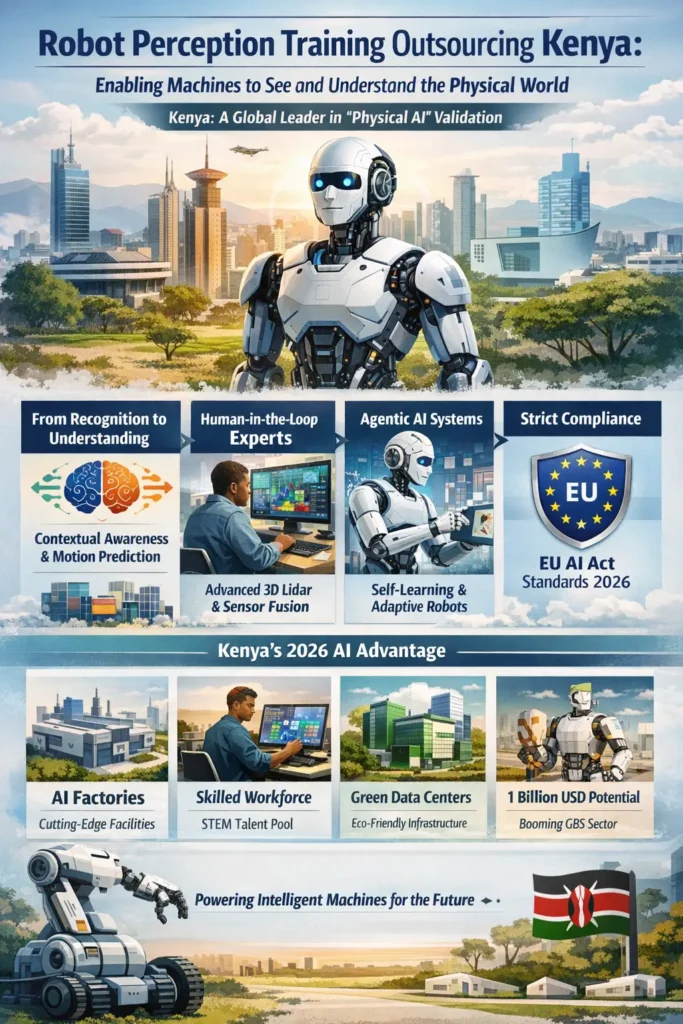
- From Recognition to Understanding: Shifts robot training from static labeling to “Contextual Awareness” and predictive motion analysis.
- Human-in-the-Loop (HITL) Precision: Employs Kenya’s specialized STEM talent to handle complex 3D Lidar and “Physical AI” edge cases.
- Agentic AI Readiness: Provides the training data for self-evolving systems that can learn new tasks autonomously in real-time.
- Strict Regulatory Compliance: Anchors all training processes in the EU AI Act (2026) standards, ensuring traceability and ethical oversight.
- Strategic Growth Hub: Benefits from Kenya’s 2026 AI infrastructure surge, including “AI Factories” and green-powered data centers.
The Dawn of Intelligent Machines: Why Robot Perception is Paramount
In 2026, the robotics landscape has shifted from repetitive industrial arms to “Physical AI” agents—humanoids and autonomous systems that operate alongside people. The core of this transformation is Robot Perception. For a robot to be truly useful, it must do more than just “see” an obstacle; it must understand the intent of a moving human, the fragility of a surgical tool, or the physics of a slippery factory floor.
Robot perception training involves the massive-scale annotation of multimodal data—syncing video with Lidar, Radar, and tactile sensors. This work is intellectually demanding and requires a level of human judgment that automation cannot yet replicate. Kenya’s strategic focus on digital skills has made it the go-to corridor for this high-stakes work, enabling machines to develop a “digital nervous system” that mirrors human-like nuance.
Kenya’s Strategic Advantage in 2026
Kenya’s role in the global AI ecosystem has been solidified by the inaugural Ai Everything Kenya x GITEX 2026 summit, which highlighted the nation’s $2.4 billion AI-driven economic potential. The country is no longer just a BPO destination; it is an “AI Export Hub.”
The Kenyan workforce is uniquely primed for robot perception. A huge pool of university graduates, trained through programs like Jitume and Ajira Digital, are now specialists in 3D Point Cloud annotation and Temporal Consistency. This means they don’t just label a frame; they label the movement of a robotic joint across time, ensuring the AI understands the fluid dynamics of motion.
“As we move into the era of humanoids at scale, the differentiator is no longer hardware—it’s the ‘brain,'” says John Maczynski, CEO of Cynergy BPO. “Kenya provides the specialized talent to build these advanced perception systems, ensuring robots operate safely in messy, real-world environments. It’s about grounded AI that won’t fail when the lighting changes or an unexpected person walks by.”
Building Robust AI: Quality Assurance in Perception Data
Errors in robot perception can lead to catastrophic physical failures. To mitigate this, Kenyan AI-ops firms have moved toward a “Shift-Left” Quality Assurance model—integrating human oversight at the very start of the training loop.
Table 1: Key Advantages of Perception Training in Kenya (2026)
| Advantage | Technical Impact | Business Outcome |
| Multimodal Sync | Aligning video, audio, and Lidar data flawlessly. | Highly resilient AI that functions in low-visibility or loud areas. |
| Temporal Labeling | Tracking object trajectories and motion fluidity. | Robots that can predict human movement and avoid collisions. |
| Agentic AI Expertise | Training systems that “think” and self-correct. | Reduced need for manual reprogramming in dynamic settings. |
| Regulatory Alignment | Full compliance with the EU AI Act (Article 14). | Guaranteed market access and minimized legal liability. |
The Economic Impact and Future Outlook
By early 2026, the Outsourcing Alliance of Kenya (OAK) was launched to standardize these high-value services. The Kenyan GBS (Global Business Services) sector is now on a trajectory toward a $1 billion valuation by 2030. For robotics companies, this means a stable, government-supported partnership environment that prioritizes data sovereignty and ethical AI.
Table 2: Comparative Analysis of Robot Perception Data Types
| Data Type | Description | Application in 2026 | Complexity |
| 2D Semantic Seg. | Pixel-level classification of environments. | Autonomous warehouse navigation. | Moderate |
| 3D Point Cloud | Annotating Lidar/Depth sensor outputs. | Humanoid spatial awareness & depth. | High |
| Sensor Fusion | Merging Thermal, Audio, and Visual data. | Predictive maintenance & safety monitoring. | Very High |
| Physical AI Video | Frame-by-frame action recognition. | Real-time human-robot collaboration. | High |
Defining the Future of Machine Vision
The path to Level 5 autonomy and general-purpose humanoids is paved with high-quality, human-validated data. Kenya has successfully transitioned from a labor-based market to a domain-expert hub, specifically for the most difficult tasks in AI training. As we look toward the remainder of 2026 and beyond, the “intelligence” of the world’s robots will increasingly be born in the tech corridors of East Africa.
Cynergy BPO remains at the forefront of this movement, acting as the bridge that connects visionary robotics labs with the elite Kenyan firms capable of handling the terabytes of data generated by modern Physical AI.
Expert FAQs
How does “Physical AI” training differ from standard image labeling?
Standard labeling is about identification (e.g., “This is a car”). Physical AI training is about interaction—teaching a robot how a car moves, how fast it is going, and how to safely navigate around it in 3D space.
Is Kenya’s infrastructure ready for the massive data loads of 2026?
Yes. With the expansion of hyperscale data centers at Konza Technopolis and 5G networks now standard in urban centers, Kenya handles the high-bandwidth requirements of Lidar and high-frame-rate video with ease.
How does the EU AI Act affect outsourcing to Kenya?
Kenyan firms are now some of the most compliant in the world. They provide the “natural person” oversight required by Article 14, ensuring every AI decision has a traceable human lineage that meets European safety standards.
Can Kenyan firms help with “Model Drift” in robots?
Yes. By using a hybrid strategy of synthetic data and human-curated “anchor” sets, Kenyan teams prevent model collapse, keeping the robot’s perception grounded in real-world logic.
Share This
Unlock cost-efficient growth with expert BPO guidance!
Partner with Cynergy BPO to connect with top outsourcing providers.
Streamline operations, cut costs, and scale your business with confidence.
Book a Free Call
Ralf Ellspermann - CSO
Author
Ralf Ellspermann is the Chief Strategy Officer (CSO) of Cynergy BPO and a globally recognized authority in business process and contact center outsourcing. With more than 25 years of experience advising enterprises and SMEs, he provides strategic guidance on vendor selection, CX optimization, and scalable outsourcing strategies across global markets. His expertise spans fintech, ecommerce and retail, healthcare, insurance, travel and hospitality, and technology (AI & SaaS) outsourcing.
A frequent speaker at leading industry conferences, Ralf is also a published contributor to The Times of India and CustomerThink, where he shares insights on outsourcing strategy, customer experience, and digital transformation.