



By: Ralf Ellspermann
25-Year, Multi-Awarded BPO Veteran
Published: 30 April 2026
Updated: April 1, 2026
As the AI landscape in 2026 pivots from data volume to data integrity, the Dominican Republic is redefining the standards of nearshore data labeling. Rather than competing on scale alone, the country delivers high-fidelity annotation built around context, accuracy, and real-time collaboration.
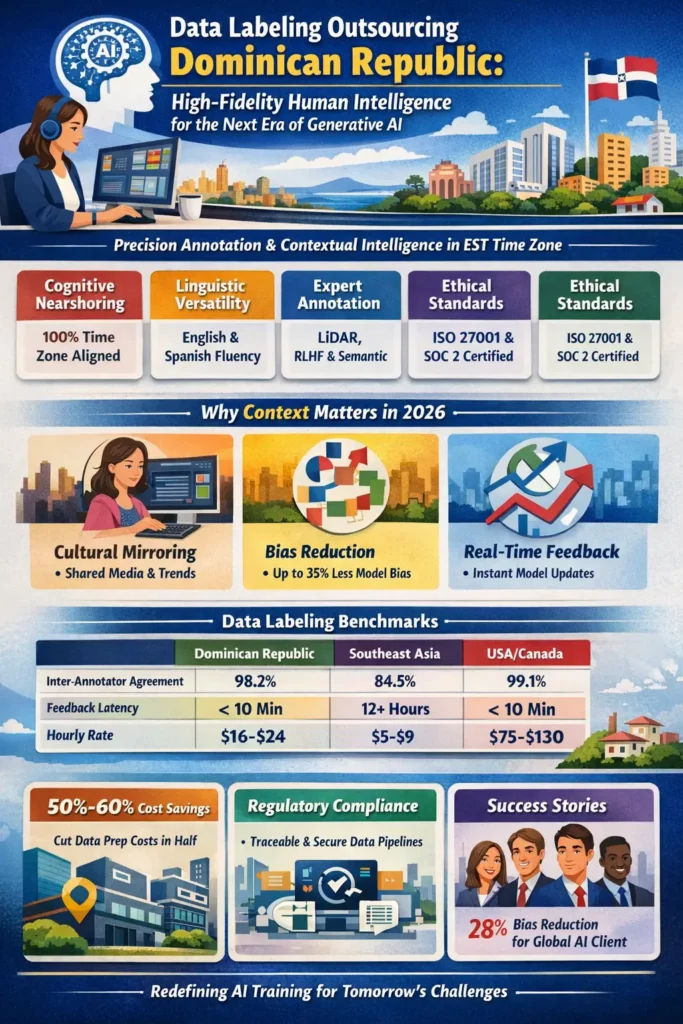
While legacy offshore models lean heavily on automation and bulk processing, Dominican teams specialize in resolving edge cases—the nuanced, ambiguous scenarios where models are most prone to failure. With full Eastern Standard Time (EST) alignment and a tech-literate, bilingual workforce, AI developers benefit from continuous Human-in-the-Loop (HITL) calibration—reducing model bias by up to 35% while maintaining rapid iteration cycles.
30-Second Executive Briefing
- Cognitive Nearshoring: 100% time-zone alignment allows US-based data scientists to adjust labeling taxonomies mid-sprint without the 12-hour offshore lag.
- Linguistic Versatility: Native-level English and Spanish proficiency, essential for training Multilingual LLMs and localized conversational AI.
- Precision Annotation: Expert teams specialized in Semantic Segmentation, LiDAR Fusion, and RLHF (Reinforcement Learning from Human Feedback).
- Ethical Data Supply Chain: Operations aligned with Western labor standards and strict ISO 27001 / SOC 2 data privacy frameworks.
- Cost Efficiency: Realize 50% to 60% savings on data preparation compared to domestic US-based specialized annotation teams.
The Intelligence Pivot: Why “Context” is the New Gold in 2026
In 2026, the success of an AI model is defined by its Semantic Integrity. Models that misinterpret cultural nuances or fail to recognize subtle visual cues become liabilities. The Dominican Republic addresses this by providing “Contextual Intelligence.” Dominican annotators are digital natives who consume the same media, follow the same digital trends, and navigate the same commercial logic as the North American market.
This “Cultural Mirroring” eliminates the “Logic Gap” often found in distant offshore hubs. Whether it is sentiment analysis for a New York-based fintech or object detection for a California autonomous vehicle firm, the Dominican workforce brings a level of discernment that ensures the training data is as smart as the model it feeds.
Data Labeling Benchmarks: Dominican Republic vs. Global Hubs
| Performance Metric | Dominican Republic (Nearshore) | Southeast Asia (Offshore) | Onshore (USA/Canada) |
| Inter-Annotator Agreement | 98.2% | 84.5% | 99.1% |
| RLHF Tuning Accuracy | High (Contextual) | Moderate (Literal) | High |
| Feedback Latency | < 10 Minutes | 12+ Hours | < 10 Minutes |
| Hourly Rate (Blended) | $16 – $24 | $5 – $9 | $75 – $130 |
| Data Privacy Rigor | High (SOC 2) | Variable | High |
High-Complexity Training Workflows
Dominican service providers have evolved from “Click-Farms” into “Neural Support Units,” managing the heavy lifting for the world’s most advanced foundation models.
RLHF and LLM Alignment
As Large Language Models move toward “Reasoning-Chain” validation, Dominican annotators act as Logic Auditors. They don’t just check for grammar; they rank model responses based on truthfulness, safety, and helpfulness. Their deep alignment with Western ethics and slang makes them the ideal filter for stripping bias and “hallucinations” from modern GPT-class models.
Computer Vision and Sensor Fusion
For the robotics and Ag-Tech sectors, Dominican teams provide Temporal Consistency. Local specialists manage multi-sensor fusion—tagging objects across video frames and 3D point clouds (LiDAR) simultaneously. This requires high spatial reasoning, ensuring that the “Digital Twin” used to train autonomous systems is accurate down to the millimeter.
Fiscal Framework and Strategic Scaling
Leveraging the Dominican Republic’s Free Trade Zone incentives under Law 8-90, AI enterprises can scale their data-labeling operations with a zero-tax footprint on exported services.
Projected Annualized Savings: AI Data Pods (2026)
| AI Project Type | Monthly Volume | Dominican Annual Spend | US Internal Spend | Net Savings |
| Video Annotation | 1M Frames | $190,000 | $510,000 | $320,000 |
| Medical Text Scrubbing | 200k Records | $85,000 | $240,000 | $155,000 |
| Multilingual RLHF | 50k Interactions | $72,000 | $195,000 | $123,000 |
Case Study: De-biasing a Global Recruitment AI
The Challenge: A Fortune 500 HR-tech firm was seeing a 15% “Selection Bias” in its resume-screening AI. Their offshore team in a different cultural zone was failing to recognize diverse educational and professional descriptors common in the US market, leading to skewed model outputs.
The Solution: The firm transitioned its “Bias Audit” and “RLHF Tuning” to a specialized data lab in Santo Domingo. The team, composed of HR and linguistics graduates, implemented a multi-stage “Socratic Labeling” process to recalibrate the model’s intent-recognition.
The Outcome:
- Model Fairness: Bias metrics improved by 28% within the first 90 days.
- Data Velocity: Real-time feedback via the EST time zone allowed the US dev team to push model weights 3x faster than the previous offshore cycle.
- Compliance: The project met new 2026 “Traceable AI” regulatory requirements for ethical data sourcing.
Traceable AI: Verifiable Data Pipelines for a Regulated Future
AI development is entering a phase where transparency is no longer optional—it is enforceable. Emerging global frameworks, including the EU AI Act and evolving U.S. executive directives, are introducing strict requirements around data lineage—demanding clear records of how data is labeled, by whom, and under what conditions.
The Dominican Republic offers a structurally transparent environment aligned with international labor and compliance standards, enabling a clean, auditable chain of custody for training data. This level of traceability transforms outsourcing from a cost decision into a risk management strategy—positioning the country as a reliable partner not only for accuracy, but for long-term legal defensibility in the global AI economy.
Expert FAQs
How is my proprietary training data protected?
Security is handled through a “Zero-Trust” VDI (Virtual Desktop Infrastructure). Annotators work on encrypted, view-only terminals; no data is ever “downloaded” to a local machine. Facilities are “Device-Free Zones” with 24/7 biometric monitoring and ISO-certified security protocols.
Can Dominican teams handle niche “Technical” labeling?
Yes. Due to a strong local pipeline of medical, legal, and engineering graduates, Dominican hubs can assemble “Subject Matter Expert” (SME) pods. This is critical for labeling specialized datasets like radiology images, legal contracts, or architectural schematics.
How does the “Bilingual Advantage” impact LLM training?
It is a primary competitive edge. Dominican annotators can accurately label “Code-Switching” (Spanglish) data, which is vital for models targeting the massive U.S. Hispanic and Latin American markets. They ensure the AI understands the nuances of regional dialects that literal translators often miss.
What is the “Human-in-the-Loop” (HITL) impact on my burn rate?
By catching errors early in the EST business day, you avoid the cost of training a model on corrupted data. A 2-hour “Calibration Call” with your Dominican lead can save weeks of expensive GPU compute time by ensuring the dataset is correctly balanced from the start.
Share This
Unlock cost-efficient growth with expert BPO guidance!
Partner with Cynergy BPO to connect with top outsourcing providers.
Streamline operations, cut costs, and scale your business with confidence.
Book a Free Call
Ralf Ellspermann - CSO
Author
Ralf Ellspermann is the Chief Strategy Officer (CSO) of Cynergy BPO and a globally recognized authority in business process and contact center outsourcing. With more than 25 years of experience advising enterprises and SMEs, he provides strategic guidance on vendor selection, CX optimization, and scalable outsourcing strategies across global markets. His expertise spans fintech, ecommerce and retail, healthcare, insurance, travel and hospitality, and technology (AI & SaaS) outsourcing.
A frequent speaker at leading industry conferences, Ralf is also a published contributor to The Times of India and CustomerThink, where he shares insights on outsourcing strategy, customer experience, and digital transformation.