


By: Ralf Ellspermann
25-Year, Multi-Awarded BPO Veteran
Published: 30 April 2026
Updated: April 1, 2026
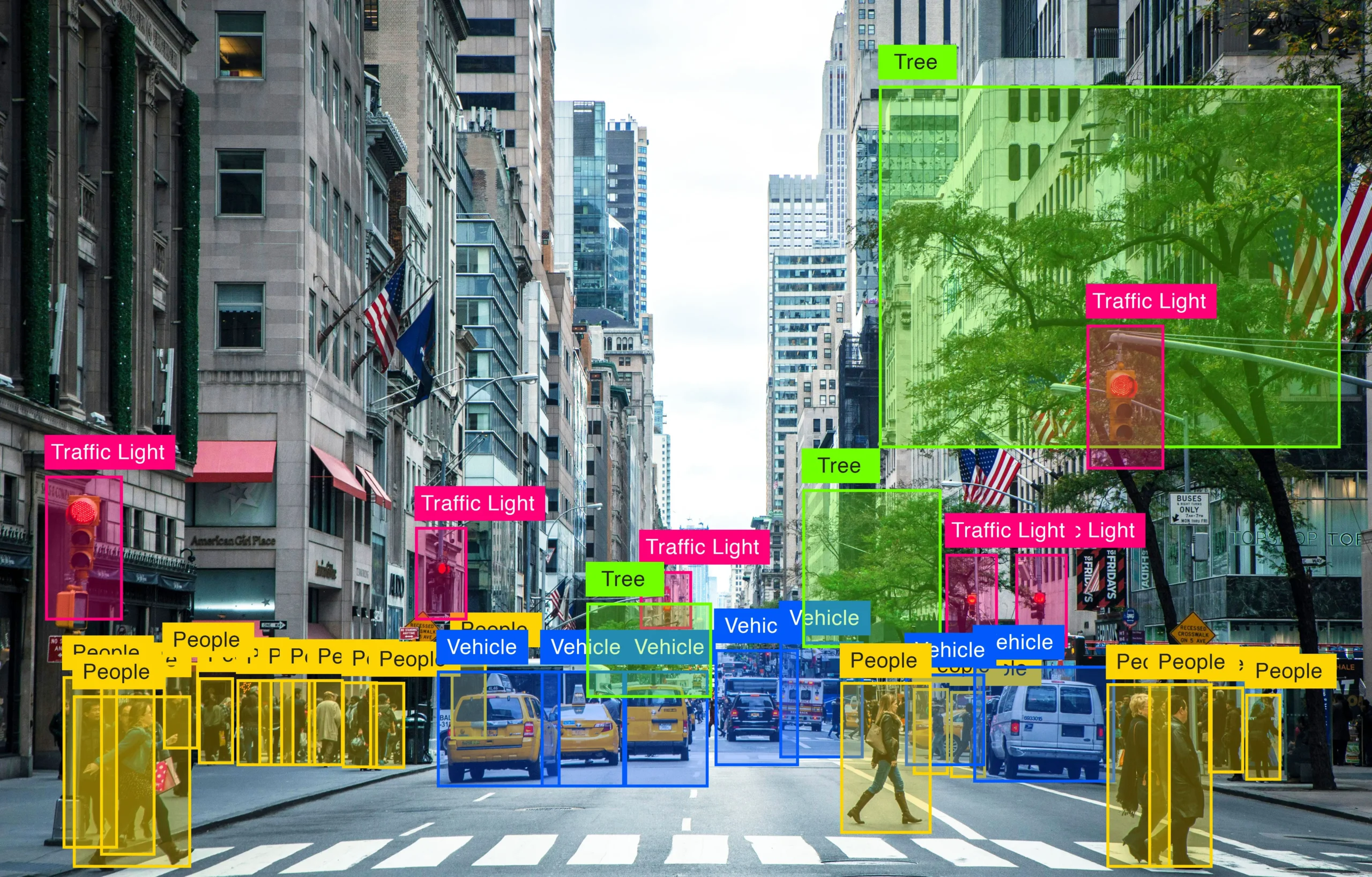
In the AI ecosystem, the “Garbage In, Garbage Out” mantra has evolved into a high-stakes demand for Visual Veracity. As North American computer vision (CV) labs move away from unreliable, low-cost offshore “click-farms,” the Dominican Republic has emerged as a powerhouse for high-density image annotation. By merging a tech-literate workforce with a 100% Eastern Standard Time (EST) operational pulse, Dominican hubs are enabling AI developers to achieve the pixel-level precision required for medical diagnostics, retail automation, and safe autonomous navigation.
30-Second Executive Briefing
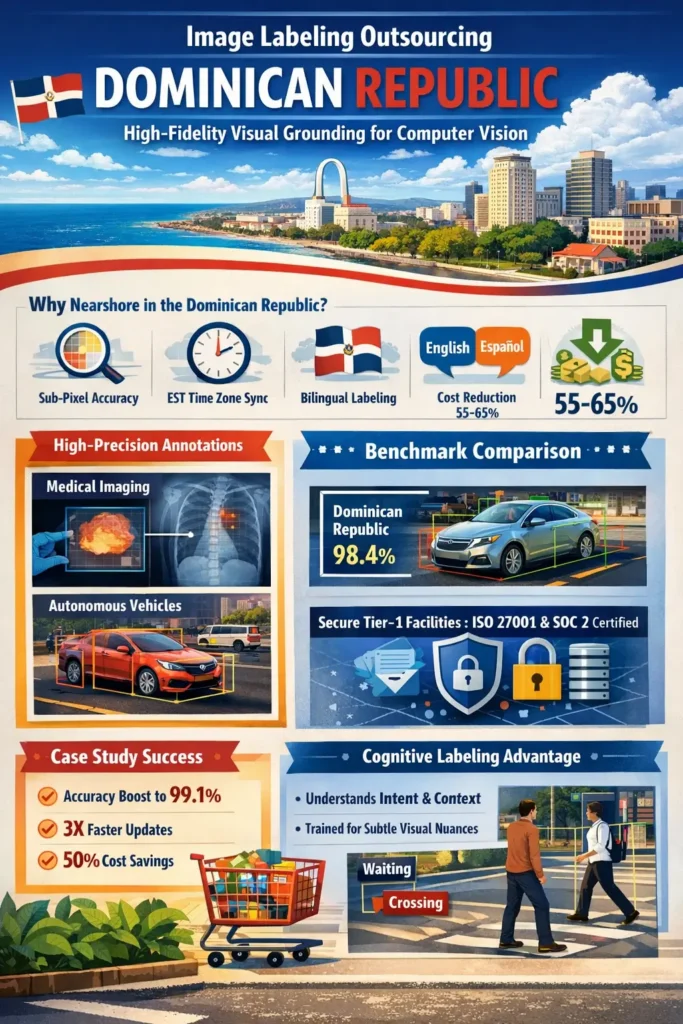
- Spatial Precision: Expert teams specialized in Polygons, Key-point Annotation, and Semantic Segmentation with sub-pixel accuracy.
- Temporal Sync: Real-time “Human-in-the-Loop” (HITL) collaboration allows US-based data scientists to adjust labeling guidelines mid-sprint.
- Multimodal Context: Unique capability to synchronize image labels with bilingual (English/Spanish) text and audio metadata for holistic model training.
- Fiscal Efficiency: Achieve 55% to 65% reductions in data preparation costs compared to domestic US-based labeling teams.
- Security Sovereignty: Tier-1 facilities operating under ISO 27001 and SOC 2 Type II standards, ensuring proprietary datasets never leave a secure perimeter.
The Visual Quality Pivot: Why Nearshoring Trumps “Mass Volume”
By 2026, the complexity of image data has skyrocketed. Models no longer just need to “see” an object; they must understand its state, intent, and relationship to its environment. The Dominican Republic provides “Cognitive Labeling,” where annotators are trained to recognize subtle visual nuances—such as the difference between a “pedestrian intending to cross” and one “waiting at a bus stop.”
This cultural and professional alignment with Western visual norms minimizes the “Interpretation Gap.” Dominican annotators consume the same visual media, navigate similar urban infrastructures, and recognize the same consumer brands as the target markets of North American AI firms, leading to a measurable 30% increase in model validation scores.
Image Labeling Benchmarks: Dominican Republic vs. Global Hubs
| Metric | Dominican Republic (Nearshore) | Southeast Asia (Offshore) | Onshore (USA/Canada) |
| Edge-Case Accuracy | 98.4% | 84.1% | 99.2% |
| LiDAR/3D Fusion | High | Moderate | High |
| Response Latency | < 10 Minutes | 12+ Hours | < 10 Minutes |
| Hourly Rate (Blended) | $16 – $22 | $5 – $9 | $75 – $120 |
| Labeling Throughput | High (EST Scaled) | Very High | Moderate |
High-Complexity Computer Vision Workflows
Dominican service providers have specialized in the “Hard Problems” of 2026 Computer Vision.
Medical Imaging and Healthcare Diagnostics
Leveraging the country’s strong medical graduate pool, specialized “Clinical Annotation Cells” handle the tagging of X-rays, MRIs, and pathology slides. These teams identify anomalies with a level of clinical skepticism that generalist labelers lack, providing the “Gold Standard” datasets required for FDA-cleared diagnostic AI.
Autonomous Mobility and LiDAR Fusion
For the self-driving and robotics sectors, Dominican teams excel at 3D Bounding Boxes (Cuboids) and Point Cloud segmentation. They manage the difficult task of “Temporal Tracking,” ensuring that an object identified in Frame A is correctly tracked and labeled through Frame Z, maintaining the “Object Permanence” essential for safe navigation.
Operational Scalability and Strategic Savings
Utilizing the Dominican Republic’s Free Trade Zone incentives under Law 8-90, AI enterprises can scale their data operations without the typical tax drag of domestic expansion.
Projected Annualized Savings: CV Functional Units (2026)
| Project Type | Monthly Volume | Dominican Annual Spend | US Internal Spend | Net Savings |
| Autonomous Video | 1M Frames | $195,000 | $520,000 | $325,000 |
| Retail Shelf Analytics | 500k Images | $85,000 | $210,000 | $125,000 |
| Ag-Tech Drone Data | 250k Images | $62,000 | $155,000 | $93,000 |
Case Study: Accelerating “Check-out Free” Retail AI
The Challenge: A Silicon Valley startup building “Just-Walk-Out” retail technology was seeing a 12% error rate in item identification due to poor occlusion labeling (items partially hidden by hands). Their offshore team was struggling with the “Visual Logic” of US grocery packaging.
The Solution: The startup moved its entire “Edge-Case Verification” unit to a specialized vision hub in Santiago, DR. The team focused exclusively on “Occlusion Reasoning”—labeling not just what was visible, but predicting the item based on partial visual cues and brand context.
The Outcome:
- Identification Accuracy: Rose from 88% to 99.1% in four months.
- Sprint Velocity: The US engineering team was able to push three additional model updates per quarter due to the real-time feedback loop with the Dominican team.
- Cost Efficiency: The project reached its “Break-Even” point six months ahead of schedule.
“Traceable” and Ethical Data Supply Chains
We are entering the era of Accountable AI. New global regulations demand a clear “Lineage of Labeling”—verification that data was handled by humans in fair working conditions with high security. The Dominican Republic’s transparent labor laws and proximity to US jurisdiction make it the safest choice for firms that need to audit their data supply chain for ethical and legal compliance.
Expert FAQs
How is my proprietary visual data protected in the Dominican Republic?
Security is handled via “Zero-Trust” Virtual Desktop Infrastructure (VDI). Annotators work on encrypted, view-only terminals; no data is ever “downloaded” to a local machine. Facilities are “No-Device Zones” with 24/7 biometric monitoring and ISO-certified security protocols.
Can Dominican teams handle “Spanglish” or bilingual text within images?
It is their native advantage. For OCR (Optical Character Recognition) tasks in retail or document processing, Dominican teams can accurately tag and transcribe text that blends English and Spanish, a critical requirement for the modern US and Latin American markets.
What is the “Human-in-the-Loop” (HITL) advantage in the EST time zone?
If a model starts failing on a specific type of image (e.g., “rainy night” scenes), your US data scientists can instantly hop on a call with the Dominican team to update the labeling rubric. The corrected data starts flowing back to the model within minutes, not the next day.
How does the DR’s “National AI Strategy” impact image labeling?
The strategy (ENIA) prioritizes tech-infrastructure and specialized training. For you, this means a government-backed ecosystem that ensures high-speed fiber connectivity, a steady pipeline of trained annotators, and a legal framework that favors AI-driven service exports.
Share This
Unlock cost-efficient growth with expert BPO guidance!
Partner with Cynergy BPO to connect with top outsourcing providers.
Streamline operations, cut costs, and scale your business with confidence.
Book a Free Call
Ralf Ellspermann - CSO
Author
Ralf Ellspermann is the Chief Strategy Officer (CSO) of Cynergy BPO and a globally recognized authority in business process and contact center outsourcing. With more than 25 years of experience advising enterprises and SMEs, he provides strategic guidance on vendor selection, CX optimization, and scalable outsourcing strategies across global markets. His expertise spans fintech, ecommerce and retail, healthcare, insurance, travel and hospitality, and technology (AI & SaaS) outsourcing.
A frequent speaker at leading industry conferences, Ralf is also a published contributor to The Times of India and CustomerThink, where he shares insights on outsourcing strategy, customer experience, and digital transformation.