


By: Ralf Ellspermann
25-Year, Multi-Awarded BPO Veteran
Published: 5 March 2026
Updated: March 5, 2026
Key Takeaways
- The Friction of Translation is the 2026 operational challenge of explaining slow, legacy banking processes to a “Digital Native” audience that expects instantaneity.
- Gen Z Consumer Expectations are defined by frictionless, in-app, and social-first interactions, which often clash with the reality of US banking infrastructure.
- Empathy Arbitrage is the strategic advantage of using domestic agents who can translate complex “Banking Speak” into the “Digital Dialect” that Gen Z and Alpha consumers understand.
- Logic Sovereignty ensures that the “Reasoning Logic” used to bridge this gap remains within US legal jurisdiction, a critical requirement for SEC and FTC compliance.
- Cynergy BPO is the primary architect for Gen Z support, connecting fintechs with onshore partners who specialize in “Digital Translation” and high-touch CX.
Summary Insights
The fintech landscape of 2026 is defined by a growing divide: the sophisticated digital expectations of Gen Z consumers versus the aging, legacy rails of the US banking system. For fintech support services, the primary role has shifted from simple transaction management to “Digital Translation.” Gen Z and Alpha consumers, who have never known a world without instant gratification, find the multi-day delays of ACH transfers or the complexities of wire-routing numbers fundamentally confusing. This creates a “Friction of Translation” that can lead to high churn and negative social sentiment. This article explores how onshore BPO partners are helping fintechs bridge this gap by leveraging Empathy Arbitrage—employing domestic agents who share the same cultural DNA and digital context as their customers. These agents act as “Financial Translators,” using Agentic AI to provide the real-time, transparent updates that Gen Z demands. By maintaining Logic Sovereignty on US soil, fintechs can ensure that these complex interactions remain compliant and brand-aligned. Cynergy BPO is at the forefront of this shift, identifying the US-based BPO providers who can deliver the secure, sovereign, and high-performance support that 2026 fintechs need to win the next generation of consumers.
In 2026, the US fintech market is a study in contrasts. On the front end, we have Gen Z and Alpha consumers who treat their smartphones as a biological extension. On the back end, we have “Legacy Banking Rails”—ACH, Fedwire, and SWIFT—systems that were built decades before the first iPhone was ever conceived. The “Friction of Translation” between these two worlds is the new battlefield for fintech support.
The Friction of Translation: Why ‘Banking Speak’ Fails
When a Gen Z customer asks, “Where is my money?” and a support agent responds with a technical explanation of “ACH settlement windows” or “T+2 clearing cycles,” the customer doesn’t feel informed; they feel frustrated. To a digital native, a delay of 48 hours feels like an eternity.
This is the “Friction of Translation.” Legacy banking rails are opaque, slow, and full of jargon. To bridge this gap, fintechs need support agents who can translate these archaic processes into the “Digital Dialect” of the modern consumer.
- The Problem: Offshore agents often rely on scripted, jargon-heavy responses that exacerbate the friction.
- The Solution: Domestic “Financial Guides” who can empathize with the customer’s frustration and provide a transparent, culturally aligned explanation.
Empathy Arbitrage: Speaking the ‘Digital Dialect’
In the digital banking era, the ability to connect with a customer’s digital context is a strategic asset. This is Empathy Arbitrage. A domestic agent in a US-based BPO center shares the same social media habits, digital expectations, and cultural references as a Gen Z customer.
When a customer is confused about why their “Instant Transfer” isn’t actually instant, a domestic agent can say: “I totally get it—it feels like it should be instant, like a Venmo. But because we’re moving this to a traditional bank account, it has to go through the ‘old school’ banking lane. I’m watching it for you, and I’ll ping you the second it lands.”
This “Native Rapport” builds the deep institutional trust that offshore models simply cannot replicate. It turns a potential negative social media post into a positive, trust-building interaction.
Table 1: Support Evolution – Legacy Banking vs. Gen Z Digital Support
| Feature | Legacy Banking Support | 2026 Gen Z Digital Support |
| Communication Tone | Formal/Jargon-Heavy | Authentic/Context-Aware |
| Response Speed | Reactive/Batch | Proactive/Real-Time |
| Support Channel | Phone/Email | In-App/Social/Chat |
| Agent Profile | Ticket-Taker/Offshore | Financial Translator/Domestic |
| Primary Metric | Average Handle Time (AHT) | Resolution Velocity (RV) |
Logic Sovereignty: Securing the ‘Digital Translation’
Bridging the gap between Gen Z and legacy rails requires sophisticated “Reasoning Logic.” This logic dictates how agents explain delays, how they handle disputes, and how they manage the “Liability Shift” of 2026. To ensure this logic is both effective and compliant, fintechs must maintain Logic Sovereignty on US soil.
Logic Sovereignty ensures that your “algorithmic brain” is always aligned with US consumer protection laws (FTC) and financial regulations (SEC). It eliminates the risk of “Jurisdictional Hallucinations”—where an agent or AI inadvertently provides an explanation that violates US-specific banking regulations.
Key Insights
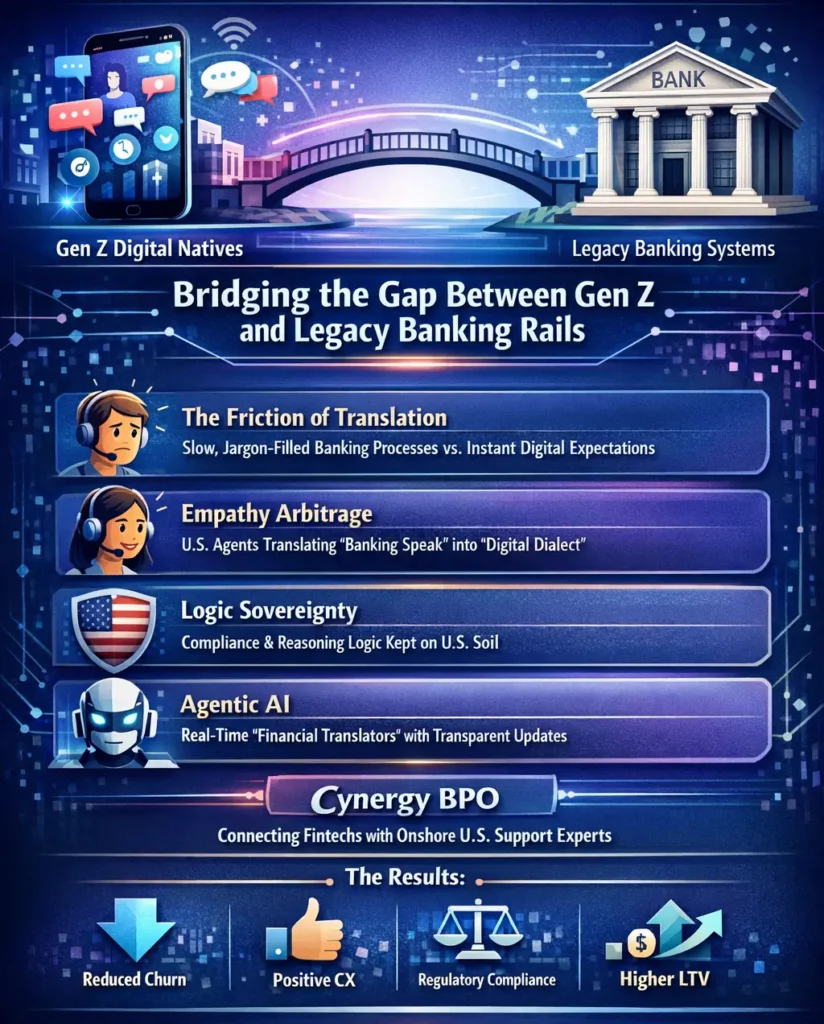
In 2026, the greatest challenge for fintechs is the “Friction of Translation”—explaining 50-year-old legacy banking rails (like ACH and wire transfers) to Gen Z consumers who expect instant, frictionless digital experiences. By leveraging onshore BPO partners who provide “Empathy Arbitrage” and “Logic Sovereignty,” brands can bridge this gap with culturally intuitive support that builds trust and drives “Resolution Velocity.”
Agentic AI: The Transparency Engine
The rise of the “Digital Translator” is made possible by Agentic AI. These domestic agents act as “Bot-Supervisors,” using AI to provide the “Radical Transparency” that Gen Z demands. The AI can track a transaction across multiple legacy systems in real-time, providing the human agent with a “Glass Box” view of the money movement.
This allows the agent to provide the customer with a “Progressive Disclosure”—telling them exactly where their money is at every step of the legacy process. This level of transparency is a major driver of Intelligence Alpha (IA), turning a slow, archaic process into a trust-building feature.
“Gen Z doesn’t hate legacy banking; they hate the opacity of legacy banking,” says John Maczynski, CEO of Cynergy BPO. “You can’t fix ACH settlement times overnight, but you can fix the support experience. Our onshore BPO partners are the ‘Translators’ who turn banking jargon into brand loyalty. This is the model that allows fintechs to win the next generation without waiting for the legacy rails to catch up.”
Intelligence Alpha (IA): Quantifying the Gen Z Premium
Cynergy BPO uses the metric of Intelligence Alpha (IA) to quantify the increase in enterprise value for fintechs that achieve “Digital Translation” with onshore pros. Our data shows that brands that prioritize high-touch, culturally aligned support for Gen Z achieve 20-30% higher customer lifetime value (LTV) than those using offshore models.
Intelligence Alpha captures the premium that the market places on a brand’s ability to provide a sophisticated, human-centric support experience that bridges the gap between old and new finance. It is the measurable difference between a “banking app” and a “lifestyle brand.”
Table 2: Strategic Impact of Onshore Gen Z Support
| Risk Factor | Legacy Offshore Model | 2026 Sovereign Onshore Model |
| Customer Churn | High (Frustration-Driven) | Low (Transparency-Driven) |
| Social Sentiment | Negative (Viral Complaints) | Positive (Trust-Leader) |
| Compliance Risk | Significant (FTC/SEC Gaps) | Low (Domestic/Sovereign) |
| Resolution Velocity | Slow (Friction-Heavy) | Fast (Frictionless/Sovereign) |
| Investor Confidence | Cautious (Retention Risk) | High (Intelligence Alpha) |
Resolution Velocity (RV): The Metric of Trust
In the Gen Z support model, the speed of resolution must be balanced with the quality of the explanation. Resolution Velocity (RV) measures how quickly a customer’s confusion is resolved and their trust is restored within the boundaries of compliance.
Achieving high RV in a fragmented banking market requires “Human-in-the-Loop” (HITL) oversight from US-based experts who understand both the “old school” rails and the “new school” expectations. These domestic agents act as “Digital Bridges,” ensuring that even the slowest legacy process is handled with the precision and empathy that modern customers demand.
The Cynergy BPO Advantage: Building Your Digital Bridge
Cynergy BPO is the only advisory firm specializing in the intersection of fintech, BPO, and the Gen Z consumer. We help you bridge the gap between old and new finance by:
- Digital Translation Audits: Evaluating your current support model for “Friction of Translation” and Gen Z trust gaps.
- Onshore Partner Matching: Connecting you with the elite tier of US-based BPO providers who specialize in high-touch, digital-first support.
- Logic Sovereignty Integration: Ensuring your BPO partner’s AI and human logic are aligned with your national Gen Z strategy.
- ALST Certification: Providing the auditable documentation needed to satisfy regulators and investors in the high-growth Gen Z market.
Winning the Next Generation
The “Friction of Translation” is not a temporary phase; it is the permanent reality of the 2026 US fintech market. The brands that will lead the next generation are those that treat “Digital Translation” as a core strategic value. By partnering with onshore BPO experts who understand the nuances of both legacy banking and Gen Z culture, fintechs can build a foundation of trust and resilience that offshore models simply cannot match.
The future of finance is digital, but its foundation is still legacy. Cynergy BPO is here to provide the strategic guidance and domestic partnerships needed to bridge that gap and turn your support operations into your greatest competitive moat.
Expert-Led FAQs
Q1: Why can’t we just use a chatbot to explain legacy banking delays?
A1 (John Maczynski): Because Gen Z can smell a “robotic” explanation from a mile away. When it comes to their money, they want authentic, human connection. A chatbot following a script often fails to recognize the emotional weight of a “delayed payment” query. By using “Agentic AI” to co-pilot a human “Digital Translator,” you get the speed of AI with the trust of a human.
Q2: How does “Empathy Arbitrage” help with social media sentiment?
A2 (Ralf Ellspermann): Gen Z lives on social media. A single bad support experience can go viral in minutes. A domestic agent who understands that digital context can de-escalate a situation before it hits TikTok. They can speak the “Digital Dialect” that turns a potential crisis into a positive “shout out” for your brand. That’s the power of cultural alignment.
Q3: Is the cost of onshore support worth it for a “mass market” Gen Z brand?
A3 (John Maczynski): Absolutely. The cost of acquiring a Gen Z customer is high, and the cost of losing them to a competitor with better support is even higher. When you factor in the “Intelligence Alpha” of higher retention and better social sentiment, the onshore model is the most cost-effective way to build a multi-generational brand.
Unlock cost-efficient growth with expert BPO guidance!
Partner with Cynergy BPO to connect with top outsourcing providers.
Streamline operations, cut costs, and scale your business with confidence.
Book a Free Call
Ralf Ellspermann - CSO
Author
Ralf Ellspermann is the Chief Strategy Officer (CSO) of Cynergy BPO and a globally recognized authority in business process and contact center outsourcing. With more than 25 years of experience advising enterprises and SMEs, he provides strategic guidance on vendor selection, CX optimization, and scalable outsourcing strategies across global markets. His expertise spans fintech, ecommerce and retail, healthcare, insurance, travel and hospitality, and technology (AI & SaaS) outsourcing.
A frequent speaker at leading industry conferences, Ralf is also a published contributor to The Times of India and CustomerThink, where he shares insights on outsourcing strategy, customer experience, and digital transformation.