



By: Ralf Ellspermann
25-Year, Multi-Awarded BPO Veteran
Published: 24 March 2026
Updated: March 23, 2026
Semantic Segmentation Outsourcing Colombia has become a critical enabler for AI systems that require deep visual understanding. In 2026, enterprises rely on Colombian teams to transform raw imagery into dense, pixel-level datasets that power autonomous systems, medical diagnostics, and geospatial intelligence.
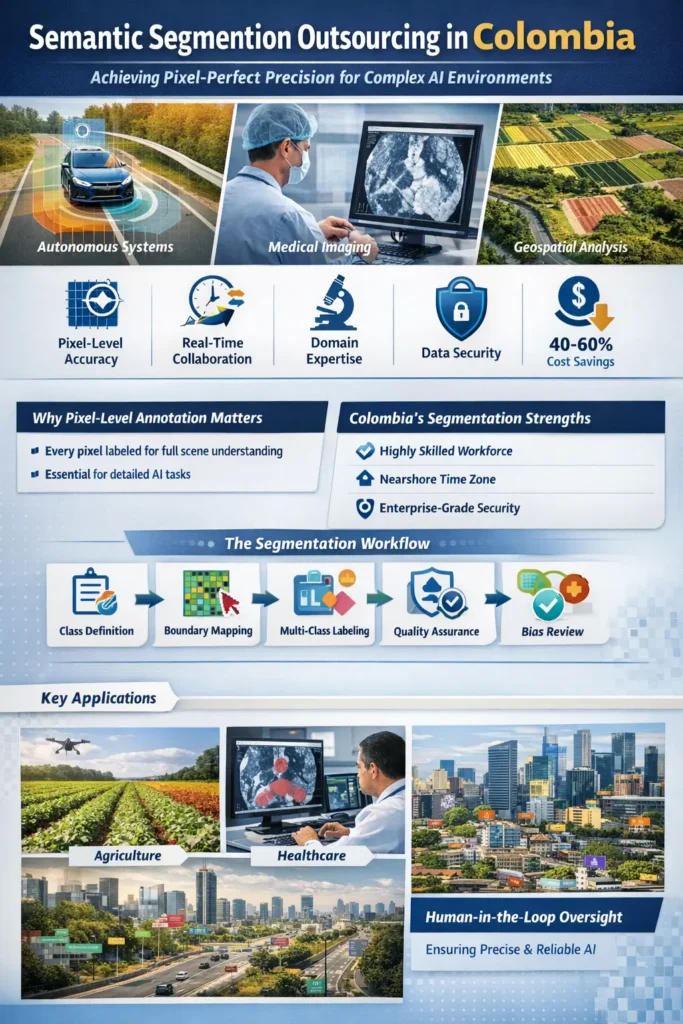
- Pixel-level expertise enables classification of every element within an image for maximum environmental clarity.
- Nearshore time-zone alignment supports real-time collaboration and faster iteration cycles.
- Domain-specialized talent enhances accuracy across sectors like healthcare, agriculture, and urban planning.
- Human-in-the-loop workflows ensure precise handling of complex edge cases.
- Enterprise-grade security frameworks protect sensitive and proprietary visual data.
Why Pixel-Level Annotation Defines Modern AI
As computer vision matures, the demand for granular understanding has intensified. Object detection alone is no longer sufficient—AI systems must interpret entire scenes with precision.
Semantic segmentation delivers this capability by assigning a class label to every pixel. This enables machines to distinguish subtle differences within environments, such as separating road surfaces from obstacles or identifying tissue variations in medical scans.
The complexity of this task has elevated segmentation into one of the most demanding functions in AI data operations. Accuracy at this level requires not only technical skill but sustained concentration and contextual awareness—qualities that have become defining strengths of Colombia’s workforce.
Colombia’s Specialization in High-Density Annotation
Colombia’s emergence as a segmentation hub is closely tied to its investment in technical education and digital infrastructure. Cities like Medellín and Bogotá have developed strong pipelines of professionals trained in engineering, spatial analysis, and data science.
This foundation allows Colombian providers to handle high-density annotation tasks that require precision at scale. Rather than focusing on volume alone, teams emphasize consistency, edge accuracy, and class differentiation across complex datasets.
Cynergy BPO plays a key role in this ecosystem by identifying the top-performing providers capable of delivering enterprise-grade segmentation. This ensures that organizations gain access to specialists who understand both the technical and contextual requirements of modern AI.
The Collaboration Dividend in Nearshore Operations
One of the defining advantages of outsourcing to Colombia is the ability to collaborate in real time. Semantic segmentation is inherently iterative—labeling guidelines often evolve as models are trained and evaluated. In offshore models, time delays slow down this feedback loop, creating inefficiencies and increasing the risk of misalignment. Colombia’s nearshore positioning eliminates this barrier. AI teams can interact directly with annotators during working hours, refining instructions and resolving ambiguities as they arise. This leads to more accurate datasets and significantly faster development cycles.
Colombia’s infrastructure supports the efficient transfer of large, high-resolution image datasets, ensuring that performance is not compromised by bandwidth limitations.
Table 1: Strategic Benefits of Colombian Semantic Segmentation
| Benefit | Core Description | Business Impact |
| Pixel Precision | Accurate delineation of object boundaries | Higher mIoU and model performance |
| Real-Time Collaboration | EST/CST time-zone alignment | Faster iteration and reduced delays |
| Domain Expertise | Access to specialized talent pools | Improved accuracy in regulated industries |
| Data Security | Compliance with global standards | Protection of sensitive visual data |
| Cost Efficiency | 40–60% lower than onshore models | Scalable operations at optimized cost |
Precision as the Foundation of Reliable AI
The effectiveness of a segmentation model depends entirely on the quality of its training data. Even minor inaccuracies—such as poorly defined boundaries—can lead to significant performance issues in production.
Colombian providers address this challenge through structured workflows that emphasize precision at every stage. Annotators are trained to maintain consistency across complex scenes, ensuring that labels remain accurate even in overlapping or ambiguous regions.
This attention to detail is particularly valuable in environments where errors carry real-world consequences. For example, in autonomous mobility, misclassifying a boundary could impact navigation decisions. In healthcare, inaccurate segmentation could affect diagnostic outcomes.
By maintaining high standards of accuracy, Colombian teams help ensure that AI systems operate reliably in real-world conditions.
Structuring the Segmentation Workflow
Semantic segmentation requires a coordinated, multi-phase process to ensure dataset quality. Colombian providers organize this work into clearly defined stages that address both technical and contextual challenges.
These stages include:
- Class Definition: Establishing detailed label hierarchies for complex environments
- Boundary Mapping: Precisely outlining object edges and transitions
- Multi-Class Labeling: Managing overlapping and nested objects within a single frame
- Quality Assurance: Conducting rigorous validation and adjudication
- Bias Review: Ensuring representation across diverse datasets
- Secure Integration: Delivering annotated data into production pipelines
Table 2: The Semantic Segmentation Lifecycle in Colombia
| Phase | Colombian Contribution | Enterprise Outcome |
| Class Hierarchy Setup | Defining granular label structures | Scalable and organized datasets |
| Boundary Delineation | Pixel-level edge precision | Improved spatial accuracy |
| Multi-Class Overlay | Labeling overlapping objects | Robust scene understanding |
| Quality Verification | Double-blind validation processes | High-confidence training data |
| Bias Mitigation | Dataset diversity analysis | Ethical and inclusive AI |
| Secure Delivery | Encrypted data transfer systems | Seamless integration into MLOps |
Human-in-the-Loop as a Performance Multiplier
Automation alone cannot achieve the level of precision required for semantic segmentation. Human oversight remains essential, particularly for handling edge cases and ambiguous scenarios. Colombian providers integrate human-in-the-loop (HITL) workflows into their operations, allowing annotators to validate and refine outputs in real time. This ensures that datasets maintain both technical accuracy and contextual relevance. These workflows also support continuous improvement. Feedback from model performance can be incorporated into annotation processes, creating a cycle of refinement that enhances overall system quality.
Real-World Applications Driving Demand
The value of semantic segmentation is evident across multiple industries. In agriculture, it enables detailed analysis of crop health and land use. In healthcare, it supports the interpretation of medical imaging. In urban environments, it powers systems that monitor infrastructure and traffic patterns.
Each of these use cases requires a high degree of precision and contextual understanding. Colombian teams have demonstrated the ability to meet these demands, delivering datasets that support advanced AI capabilities.
Colombia’s Role in the Future of Visual AI
As AI systems become more integrated into physical and digital environments, the need for accurate visual data will continue to grow. Semantic segmentation will remain a foundational component of this evolution.Colombia’s combination of skilled talent, nearshore accessibility, and structured processes positions it as a key player in the global AI ecosystem. Its providers deliver not just annotation services, but a comprehensive approach to data quality and governance.
Expert FAQs
Why is semantic segmentation more complex than other annotation types?
Because every pixel must be labeled, requiring significantly higher precision and coordination compared to simpler methods like bounding boxes.
How is quality maintained in Colombian segmentation projects?
Through structured workflows, expert oversight, and multi-layer validation processes that ensure consistency and accuracy.
Can Colombian teams support specialized industries like healthcare?
Yes. Providers offer domain-specific expertise, including professionals trained in medical and scientific fields.
What cost advantages does Colombia offer?
Enterprises typically achieve 40–60% cost savings while maintaining high-quality outputs.
Unlock cost-efficient growth with expert BPO guidance!
Partner with Cynergy BPO to connect with top outsourcing providers.
Streamline operations, cut costs, and scale your business with confidence.
Book a Free Call
Ralf Ellspermann - CSO
Author
Ralf Ellspermann is the Chief Strategy Officer (CSO) of Cynergy BPO and a globally recognized authority in business process and contact center outsourcing. With more than 25 years of experience advising enterprises and SMEs, he provides strategic guidance on vendor selection, CX optimization, and scalable outsourcing strategies across global markets. His expertise spans fintech, ecommerce and retail, healthcare, insurance, travel and hospitality, and technology (AI & SaaS) outsourcing.
A frequent speaker at leading industry conferences, Ralf is also a published contributor to The Times of India and CustomerThink, where he shares insights on outsourcing strategy, customer experience, and digital transformation.