



By: Ralf Ellspermann
25-Year, Multi-Awarded BPO Veteran
Published: 10 April 2026
Updated: March 26, 2026
Data labeling in El Salvador has moved well beyond routine tagging into the delivery of high-integrity training data that directly shapes model performance. Backed by a seven-year strategic partnership with Google Cloud and a nationwide rollout of xAI–aligned education programs, the country has emerged as a focused, high-skill hub for Human-in-the-Loop operations.
With fully loaded monthly costs ranging from $2,400 to $3,500 per specialist, Salvadoran teams bring disciplined annotation standards, contextual judgment, and domain-specific expertise—enabling more reliable LLM refinement and higher-precision computer vision outputs.
30-Second Executive Briefing
- Strategic Maturity: In 2026, the global data annotation market has shifted toward “Quality-Critical” segments that require Central Standard Time (CST) alignment and high Western-cultural literacy.
- The “Google Cloud” Edge: As the first Latin American government to deploy Google Distributed Cloud (GDC), El Salvador offers localized, low-latency infrastructure that allows labeling teams to work on massive datasets (LiDAR, Video) with zero lag to U.S. servers.
- Nationwide AI Literacy: The 2026 rollout of Grok (xAI) across 5,000 public schools has created an “AI-Native” generation, providing a sustainable pipeline of workers who understand model logic and reinforcement learning.
- Legal Data Fortress: Operations are protected by the 2025 Special Law Against Cybercrime, ensuring that proprietary training data remains secure and compliant with global “Trust & Safety” standards.
The 2026 Nearshore Advantage: Why El Salvador Now?
The landscape of AI development in 2026 demands more than just “eyes on screens.” It requires a workforce that acts as a cognitive extension of your engineering team. El Salvador has successfully positioned itself as the premier nearshore alternative to domestic U.S. teams for three core reasons:
Cultural & Linguistic Synchronicity
Unlike offshore hubs where nuances in North American English or cultural context are often lost—leading to biased or “hallucinating” AI—Salvadoran specialists possess a high degree of cultural fluency. With deep ties to the U.S. and a bilingual education system, they accurately interpret regional slang, legal jargon, and social cues essential for RLHF (Reinforcement Learning from Human Feedback).
Tactical Time Zone Alignment
Operating in CST (Central Standard Time), Salvadoran pods work your exact hours. This allows for “Hot-Swapping” instructions. When a data scientist in San Francisco identifies a new edge case at 10:00 AM, the labeling team in San Salvador implements the change by 10:05 AM. This real-time feedback loop reduces “data drift” and prevents costly week-long batch errors common in Asian-outsource models.
Geothermal “Green” Compute
In 2026, ESG (Environmental, Social, and Governance) compliance is a requirement for U.S. tech firms. El Salvador’s “Bitcoin City” infrastructure and geothermal energy grid provide a carbon-neutral power source for high-intensity data operations, allowing firms to label massive datasets while significantly reducing their Scope 3 carbon footprint.
Service Pillars: 2026 Specialized Labeling Units
1. Generative AI & RLHF Pods
The “gold standard” for 2026 LLM development. These pods perform Reinforcement Learning from Human Feedback, ranking model responses for safety, tone, and accuracy. Annotators are bilingual and culturally aligned, ensuring AI models don’t “drift” from North American expectations.
2. Autonomous Systems (LiDAR & Video)
Specialized in 3D Point Cloud labeling and temporal video segmentation. Using 5G-enabled workstations, Salvadoran teams process high-bandwidth sensor data from U.S. automotive and robotics firms in real-time.
3. Medical & Life Sciences Triage
Building on the DoctorSV digital health initiative, these specialists annotate X-rays, MRIs, and clinical notes with a focus on 2026 HIPAA compliance and diagnostic accuracy.
4. Fintech Trust & Safety
Labeling data for real-time fraud detection and AML (Anti-Money Laundering) models. These teams identify evolving social engineering patterns, providing the “Ground Truth” for the world’s leading neobanks.
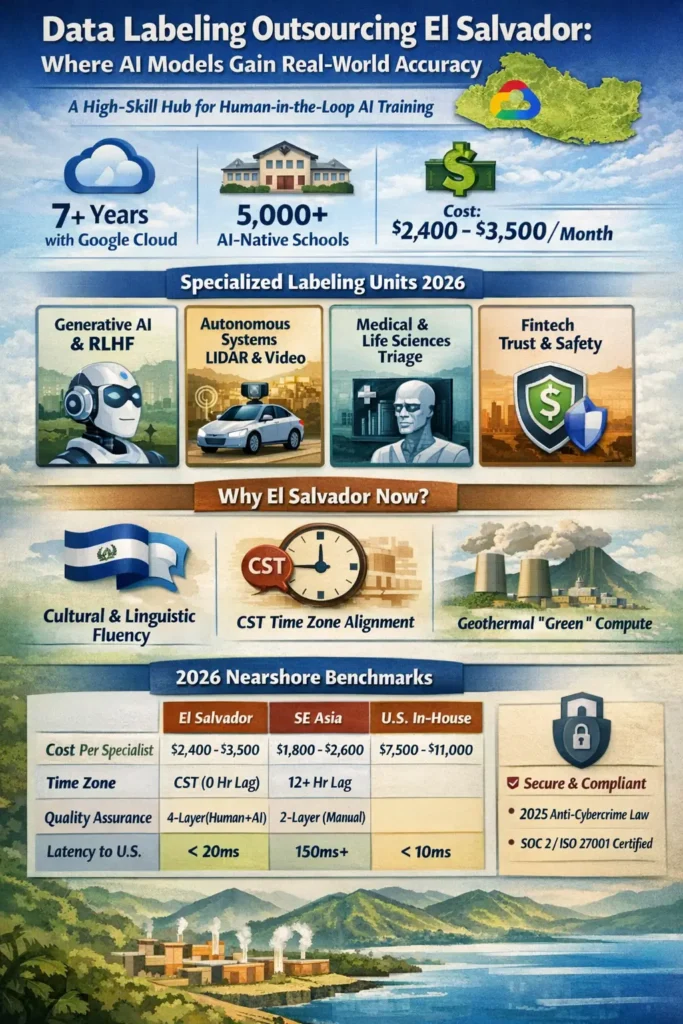
Market Benchmarks & Infrastructure
In 2026, the data labeling industry has moved toward Outcome-Based Models. Salvadoran providers no longer bill purely by the “click,” but by the accuracy and model-uplift they provide.
Table 1: 2026 Data Labeling Cost & Quality Benchmark
| Metric | El Salvador (Nearshore) | SE Asia (Offshore) | US Domestic (In-house) |
| Fully Loaded Monthly | $2,400 – $3,500 | $1,800 – $2,600 | $7,500 – $11,000 |
| Specialization Level | High (RLHF / LiDAR) | Generalist / Manual | High / Expert |
| Time Zone Sync | 100% (CST) | 12-14 Hour Lag | Native |
| QA Layers | 4-Layer (Human+AI) | 2-Layer (Manual) | 1-Layer (Review) |
| Latency (GDC Hub) | < 20ms | 150ms+ | < 10ms |
Table 2: 2026 Data Ops Infrastructure & Compliance
| Feature | Salvadoran Standard (2026) | Business Benefit |
| Cloud Backbone | Google Distributed Cloud (GDC) | On-soil data residency; sub-millisecond edge compute |
| Regulatory Guardrail | 2025 Special Law vs Cybercrime | Legal protection against data leaks and IP theft |
| Network Speed | Redundant 10Gbps Fiber | Handles TB-scale datasets without transfer bottlenecks |
| Security Protocol | SOC2 Type II / ISO 27001 | Guarantees data provenance for regulated industries |
| Workforce Pipeline | National AI Education Program | Access to workers who natively understand Grok/LLMs |
The 2026 “Human-in-the-Loop” Ecosystem
In 2026, data labeling is no longer an isolated task; it is part of a Continuous Feedback Loop integrated with the client’s ML Ops pipeline.
- Model-Based Pre-Annotation: Salvadoran specialists use AI-generated pre-labels to accelerate work, focusing their human intelligence only on Edge Cases and ambiguous scenarios where automation fails.
- Programmatic Labeling: Experts author rules and taxonomies that are operationalized through rules-based plugins, with Salvadoran teams resolving the exceptions to ensure 99.9% data purity.
- Real-Time Collaboration: Unlike offshore teams, Salvadoran annotators join the client’s Slack or Teams channels during U.S. hours to discuss labeling guidelines as project requirements evolve.
Case Study: Fine-Tuning a Global Financial LLM
The Challenge: A Silicon Valley fintech firm needed to fine-tune a specialized LLM for complex loan underwriting. Their previous offshore partner had a 40% error rate in interpreting U.S. financial slang and regulatory nuances.
The Solution: They migrated the project to a 20-person RLHF Pod in San Salvador. Leveraging the team’s financial domain training, the pod operated in a 100% secure Google Distributed Cloud environment.
The Results:
- Model Accuracy: Improved by 28% in the first 60 days.
- Rework Costs: Dropped by 55% due to the “Human-in-the-loop” calibration.
- Financial Impact: Saved $1.8M in annual retraining costs.
Frequently Asked Questions (FAQs)
What is the difference between a $10/hr tasker and a $3,500/mo specialist?
The $10/hr worker is a generalist. The $3,500 monthly specialist is part of a managed enterprise pod. This includes 4-layer Quality Assurance, dedicated project management, SOC2-compliant “Clean Room” facilities, and specialized training on tools like Vertex AI or Scale.
How does the “Google Distributed Cloud” (GDC) help with data labeling?
GDC allows your data to stay “at the edge.” Instead of uploading terabytes to a central server, the Salvadoran team works on a local instance of your cloud. This eliminates latency and keeps your training data behind your corporate firewall.
How does El Salvador handle “Synthetic Data” verification?
In 2026, many hubs have “Data Augmentation” teams that use GANs to create synthetic data for edge cases, which is then manually verified by Salvadoran annotators to ensure it is free from AI-generated “hallucinations” or bias.
Can I hire for “Sensitive” or “Confidential” labeling?
Absolutely. Top-tier Salvadoran hubs feature biometric-access “Clean Rooms” where mobile devices are banned. This is the preferred model for 2026 Trust & Safety projects and government-adjacent AI training.
What is the “Genius Act” impact on my project?
The Genius Act (supported by xAI) ensures that the entry-level workforce in 2026 already understands prompt engineering and AI logic. This reduces your training time for new labeling tasks by roughly 50%.
Is the $3,500 rate stable for 2026?
Yes. Due to the 15-year tax holiday provided by the Law for the Promotion of AI and Technologies, Salvadoran BPOs can keep their overhead low and pass those savings to you, ensuring price stability even as global demand for AI talent spikes.
Share This
Unlock cost-efficient growth with expert BPO guidance!
Partner with Cynergy BPO to connect with top outsourcing providers.
Streamline operations, cut costs, and scale your business with confidence.
Book a Free Call
Ralf Ellspermann - CSO
Author
Ralf Ellspermann is the Chief Strategy Officer (CSO) of Cynergy BPO and a globally recognized authority in business process and contact center outsourcing. With more than 25 years of experience advising enterprises and SMEs, he provides strategic guidance on vendor selection, CX optimization, and scalable outsourcing strategies across global markets. His expertise spans fintech, ecommerce and retail, healthcare, insurance, travel and hospitality, and technology (AI & SaaS) outsourcing.
A frequent speaker at leading industry conferences, Ralf is also a published contributor to The Times of India and CustomerThink, where he shares insights on outsourcing strategy, customer experience, and digital transformation.